
Headline Diagnosis
Pinpoints the exact words causing issues, not just vague advice
Headline Diagnosis
Pinpoints the exact words causing issues, not just vague advice
Showcase
Description
Explains clearly why your headline gets no clicks instead of just rewriting ten new ones. Using five failure causes (no target audience, no benefit, no conflict, too long, too vague), it pinpoints the exact problematic words and offers three revision methods: change one word, change the structure, or change the perspective.
Recommended by
Dancang
Why we love this skill
Instead of offering vague advice to "optimize further," it first determines if a title is worth revising, identifies specific issues like lack of audience or benefit, highlights the problematic words, and provides three distinct revision paths.
Best for
Content creators and editors looking to improve headline clarity, appeal, and click-through rates.
How to use this Skill
Provide your input
Provide a headline that needs to be checked.
Run the Skill
The system diagnoses the headline based on target audience, value, conflict, length, and specificity, and identifies the exact problematic words.
Review your result
Receive a headline diagnosis, three different revision approaches, and an explanation of the issues resolved by each change.
Related Skills
View all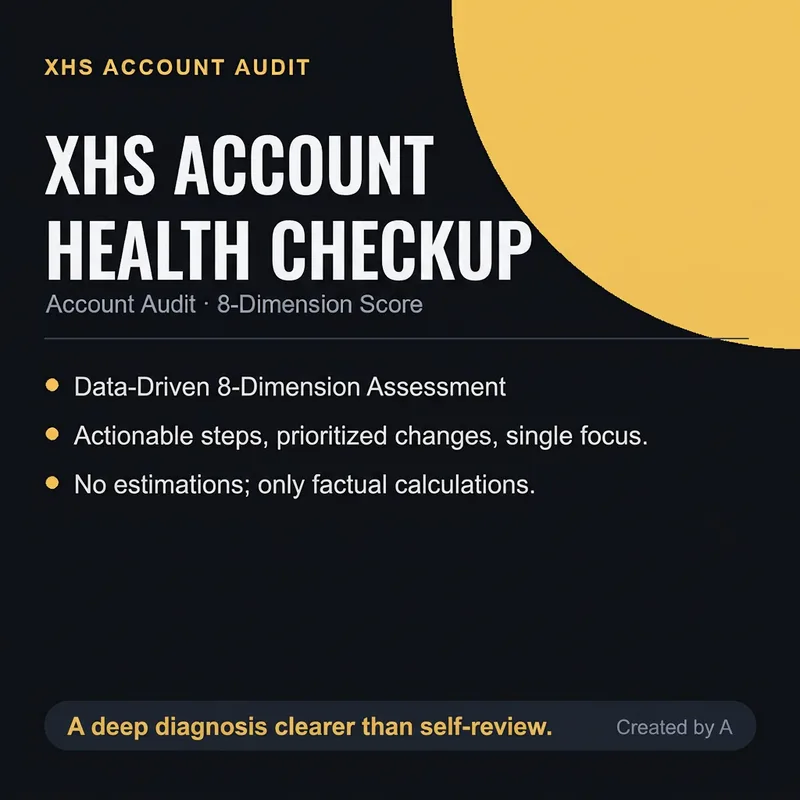 Research
RED Account Auditor
Triggers when users ask to review an account, diagnose a profile, fix a messy homepage, resolve low traffic, switch directions, or benchmark competitors. This skill audits accounts using an eight-dimensional scoring system covering positioning clarity, content verticality, cover consistency, title hook rate, update rhythm, engagement rate, breakout rate, and follower conversion. It identifies the 1 to 2 lowest-scoring bottlenecks, provides prioritized actionable changes, and focuses on one main change at a time. Unavailable data is marked as "unable to calculate" without estimation. Purely guidance-oriented.
 Write
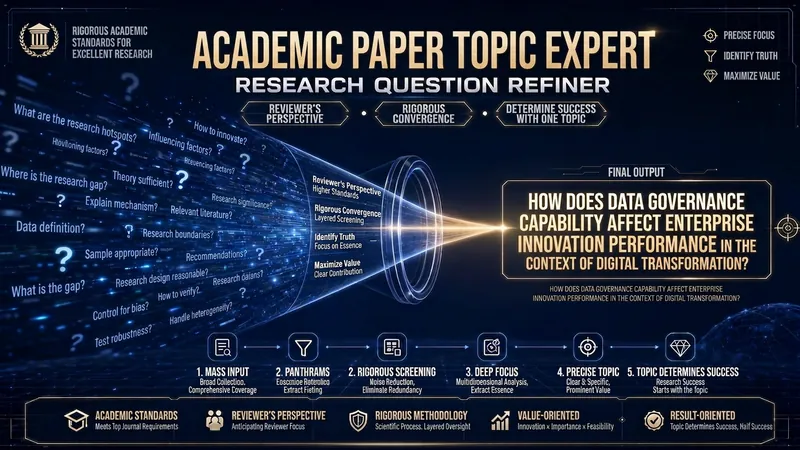
Academic Research Question
• Diagnose candidate topics: Identify overly broad topics, unclear subjects, uncontrolled boundaries, and false novelty before determining whether the topic is ready to be finalized. • Narrow the research scope: Remove nonessential subjects, variables, and objectives to reduce “trying to study everything” to one central question. • Derive the core question: Identify a single research direction based on subject clarity, question sharpness, scope control, and fit with available materials. • Generate a standardized title: Produce one Chinese title aligned with the research question, with an English title and a specific contribution statement when needed. After opening, say: “I have 3 candidate topics and want to submit to a CSSCI journal. Help me finalize the topic.” It will first check the research subject, core question, scope, and practical constraints, then provide a well-supported final research question. If information is insufficient, it will ask follow-up questions instead of forcing a polished title. Suitable for: Researchers with candidate topics who are struggling to choose one / scholars who need to focus quickly before submission / anyone who does not want to be rejected by a reviewer’s one-line criticism that the research question is unclear. ✅ This version has undergone two months of refinement, testing, and iteration.
 Write
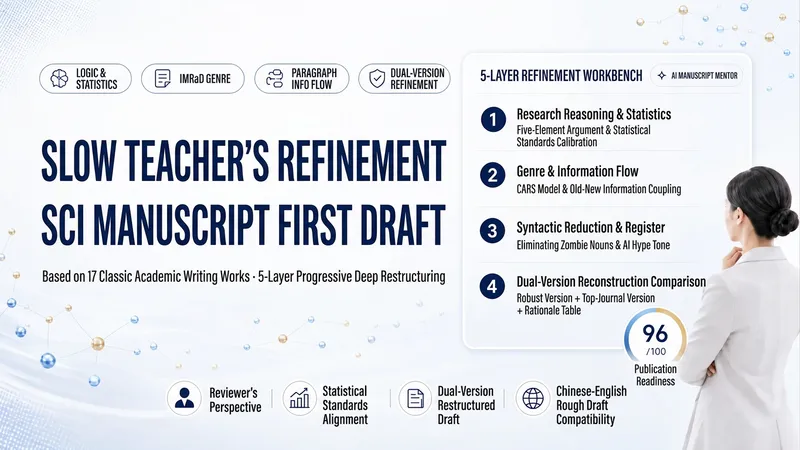
SCI Paper Revision
This goes beyond basic vocabulary polishing. It acts like an experienced mentor with peer-review expertise, helping you refine your early SCI draft toward top-journal standards. It places the [Original ❌] and the [Polished Version ✅] side by side, explaining in plain language why each change was made. [Paste Any Draft Directly] Whether it is a bilingual draft, a single section (Abstract, Introduction, Methods, Results & Discussion, Conclusion, figure captions), a full manuscript, a Cover Letter, or a Response to Reviewers, you can send it directly. [How to Use This Skill (Three-Step Reading Method)] Step 1 (Read the full paragraph preview for rhythm): After you submit your draft, each version (Robust Version A / Advanced Version B) begins with an underlined full-paragraph preview without Chinese explanations. Spend 15 seconds reading it from start to finish to sense the flow and rhythm. Step 2 (Review sentence-by-sentence comparisons and reasoning): Next, review the sentence-by-sentence breakdown. The [❌ Original (with strikethrough)] and [✅ Polished (bold and underlined)] are aligned right next to each other. Each sentence includes [💡 Writing Tip] explaining the awkwardness of the original, the rationale for the change, and underlying English writing principles. Step 3 (Select a version for a clean, copy-ready text): Reply with your choice of A or B (or request minor adjustments), and it will remove all underlines and notes to provide a clean, copy-ready English draft for your Word document. [3 Core Safeguards] 1. Preempts reviewer critiques by closing logical and statistical loopholes (such as treating P > 0.05 as proof of no effect, mismatched comparisons, or missing control experiment premises); 2. Avoids overly long, breathless sentences, keeping standard sentences within the 15–25 word golden range with a natural mix of sentence lengths; 3. 100% zero fabrication of data and literature, clearly marking missing values or error bar definitions for you to verify.
Information
- Version
- v2
- Last updated
- Runtime credits
- Usage-based
- Models
- Auto
- Use cases
- Writing & contentMarketing & growth
- What you get
- Report
