Avar
 Write
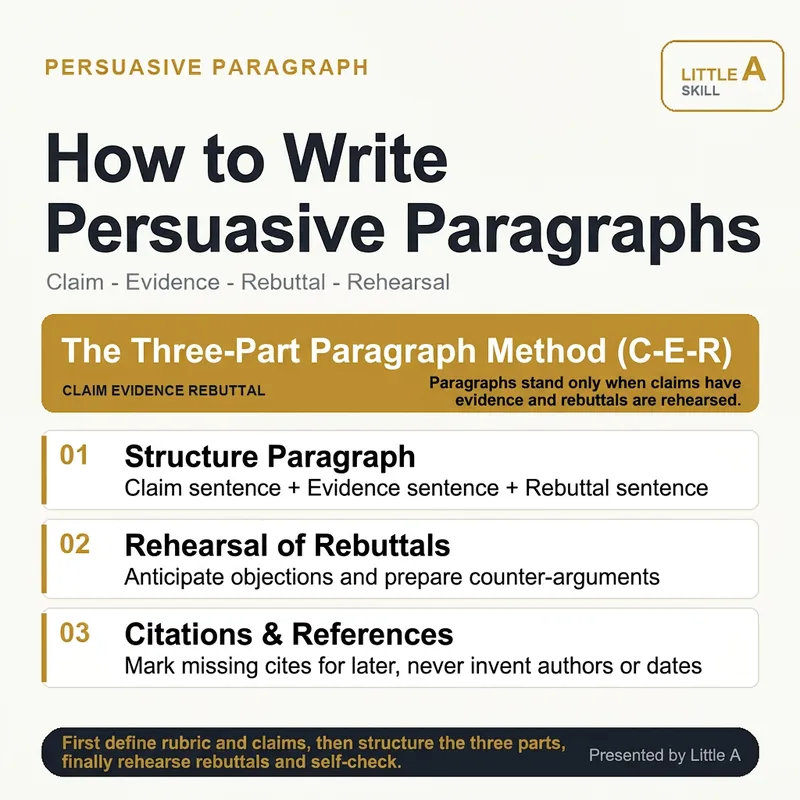
Persuasive Thesis Paragraph Builder
Finished thesis paragraphs: Structure your arguments into a three-part framework of claim, evidence, and rebuttal, linking evidence back to your materials and previewing rebuttals. Delivered after authorization, with no ghostwriting or fabricated citations. **Key Selling Point**: While competitors teach you theoretical terms and give you empty templates, this version organizes your arguments into a claim-evidence-rebuttal structure, ties evidence back to your own materials, and pre-empts peer critiques—delivering finalized content directly into your hands after authorization. **Best For**: Graduate students whose thesis paragraphs read like a running list, those told their argumentation is weak or lacks original viewpoints, and authors wanting to turn outlines into submission-ready paragraphs. **What to Input**: Your arguments and outline + your data or provided literature + target scenario rubric / requirements (optional, marks as pending verification if not found). **What is Delivered**: 8 content items + 4 finished items (12 in total). All three structural parts are filled with your own content, rebuttal previews do not fake real opinions, and missing citations are marked as [Pending Verification] without fabricating authors, years, or page numbers. If tools are unavailable, a copy-pasteable finished content package is provided instead and marked as "Unproduced". ## 【Exclusive Methodology】Claim-Evidence-Rebuttal Three-Part Framework A persuasive paragraph is not just a stack of sentences; it requires a solid claim, verifiable evidence, and a designated space for rebuttals. 1. **Claim**: A core sentence that can be judged as true or false, without using "everyone knows"; 2. **Evidence**: 1 to 3 supporting points pointing back to your material, with missing citations marked as [Pending]; 3. **Rebuttal Preview + Self-Check**: Preview peer critiques and reserve responses first, then self-check item by item to ensure no unfounded superlatives. Remember it in one sentence: **Determine the rubric and claim first, arrange the three parts next, then preview rebuttals and self-check; every paragraph traces back to your own arguments and evidence.** ## 【Competitor Upgrades】 Competitors' critical writing tools teach a theoretical term (like IBAC) and give an empty template, leaving you unsure if it's persuasive. This tool avoids copying their IP terms, adding three elements competitors lack on top of the writing core: 1. **Three-Part Framework Tied to Your Evidence**: Claim, evidence, and rebuttal sections all trace back to your own arguments and data, with missing citations marked as [Pending] and none fabricated; 2. **Rebuttal Preview**: Each core claim previews a peer critique with a reserved response slot, ensuring "persuasiveness" isn't just a feeling; 3. **Two-Step Gate**: The first step confirms the target scenario rubric and central claim before generating the paragraph structure, preventing wasted effort due to wrong directions. - **Grounded Three Parts**: Claims, evidence, and rebuttals are filled with your content, not empty templates; - **Rebuttal First**: State the most likely peer critique yourself and leave response slots in the paragraph; - **Two-Step Delivery**: Fix the rubric and claims first, then produce the paragraph, avoiding a dump of generic sample sentences. ## 【Well-Founded】Rules Based on Current Official Standards Anchored strictly in real public standards: current school/journal rubrics, user-provided literature and data, COPE guidelines, current citation formats, copyright and fair use, AI-generated content labeling requirements, and constraints on absolute language and earnings promises in marketing copy. **Clauses and fields that cannot be verified are marked as "Pending Verification" without relying on memory**; irrelevant standards are explicitly marked as inapplicable. ## 【v1 New · From Intermediates to Finished Files】 This version turns content **into usable files**: it first checks your current session's tool capabilities, tells you what will be generated and what the cost is, and only proceeds after your confirmation— - **Three-Part Framework**: Claim, evidence, and rebuttal filled with your content; - **Rebuttal Preview**: Previews the most likely peer critique with response slots in the paragraph; - **Citation List**: Missing items are marked as [Pending], never fabricating authors, years, or page numbers. **No generation tool in the session?** Delivers a "direct-copy finished content package" formatted entirely in Markdown for easy pasting into Word or tables. **Never pretends to generate or fabricates file paths.** ## 【Detailed Page Body】 ### What Boundaries Are Maintained Only organizes your provided real materials into a rubric definition table / three-part framework / pasteable paragraph draft / rebuttal preview table / citation list. Arguments, data, citation author/year/page numbers, rubric clauses, peer review or teacher feedback lacking are marked as [Pending / Pending Verification], and the skill will not fabricate them just to make the table look good; does not copy others' work, cites sources, and does not promise publication, acceptance, approval, or score increases. ### Core Logic 1. Rubric definition and claim collection; 2. Claim-evidence-rebuttal three-part construction, with each part tracing back to your materials; 3. Rebuttal preview with reserved response slots; 4. Paragraph self-check and citations, marking missing ones as [Pending]. + Competitor upgrade layer + Authority anchoring layer + Execution delivery layer (Detection -> Authorization -> Output -> Acceptance / Downgrade). ### What It Does Not Do (Red Lines) - **No Fabrication**: Missing arguments, data, citation author/year/page numbers, rubric clauses, or review feedback are marked as [Pending / Pending Verification]. - **No Plagiarism**: Does not copy others' drafts, skills, or copy; sources are cited. - **No Promises**: Does not guarantee publication, acceptance, passing, score increases, or sales. - **Honest Consumption**: Calling generation tools consumes resources as shown by the platform; no silent calls. - Output is labeled as AI-assisted; you must personally verify facts, numbers, attributions, and privacy before submission or publication.
 Research
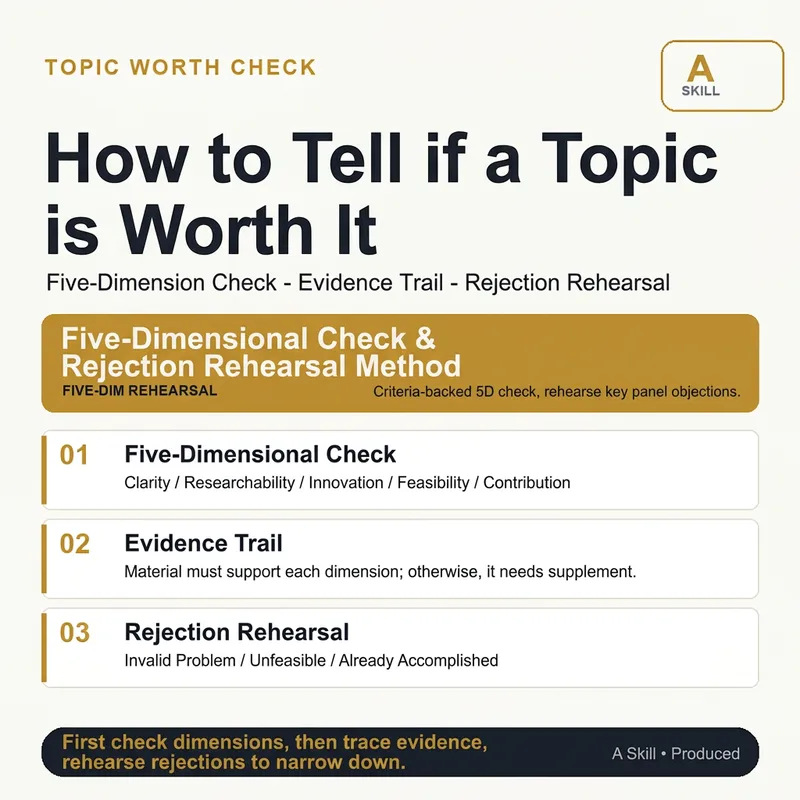
 Topic Evaluation
Determine whether your research topic is worth pursuing. This tool conducts a five-dimensional health check, traces every rating back to your evidence, and simulates tough peer review rejections. It generates a formatted table upon authorization without making decisions for you or guaranteeing success. **Core Value**: While competitors offer a simple checklist and a score, this tool evaluates your topic across five dimensions, links each judgment to your sources, and previews harsh reviewer objections before generating your report. **Best For**: Graduate students unsure of their thesis proposals, researchers whose supervisors noted lack of novelty, and grant or journal applicants. **What to Input**: Your one-sentence topic + available data/methods description + closest reference literature + practical constraints (time, funding, ethics). **What You Get**: 8 content items + 4 finished items (12 items total). All evaluations link directly to your materials without inventing data or faking peer reviews. ## Methodology: Five-Dimensional Check and Rejection Simulation 1. **Five Dimensions**: Evaluates clarity, researchability, originality, feasibility, and contribution. 2. **Evidence Tracing**: Links every judgment to your source material, marking unsupported points as pending. 3. **Rejection Simulation & Remedies**: Previews tough reviewer objections and offers compliant ways to narrow your scope. ## Advantages Over Competitors 1. **Evidence-Based Table**: Every dimension links to your sources instead of relying on arbitrary scores. 2. **Reviewer Rejection Simulation**: Anticipates common criticisms and turns them into actionable revisions. 3. **Two-Step Gate**: Confirms the initial evaluation before running the rejection simulation. ## Boundaries Strictly organizes your provided materials into evaluation and simulation tables. Missing data or literature is marked as pending, and no fake references or data are ever generated.
 Research
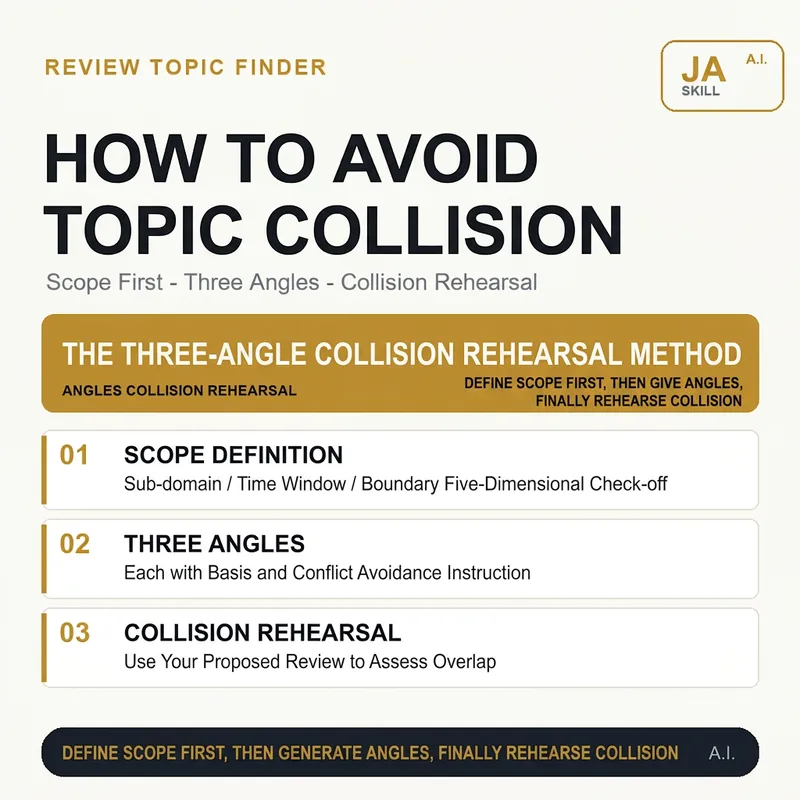
Literature Review Topic Scoping
Literature Review Topic Scoping: Define the scope first, then provide three angles, and pre-check for overlap using your provided literature. No fabricated literature or third-party retrieval, tables generated upon authorization. **Core Selling Point**: While competing tools simply recommend a single title and stop there, this version first defines the scope, offers three angles with distinct avoidance notes, and pre-checks for overlap using your provided literature—delivering cards and tables directly to you after authorization. **Best For**: Graduate students writing coursework papers or thesis reviews, early-career researchers whose topics frequently overlap with existing work, and writers unsure of which angle to choose. **What to Input**: Your subfield and recent literature (titles/years) + core questions you care about + target journal scope or course requirements (optional). **What is Delivered**: 8 content pieces + 4 final products (12 pieces in total). All three angles come with evidence and overlap avoidance notes. Overlap checking uses only the literature you provide, without automated retrieval or fabricated sources. When tools are unavailable, pasteable finished content packages marked as "unproduced" are used as a fallback. ## [Exclusive Methodology] Triangular Entry & Overlap Pre-check Method Literature review topic selection is not about letting someone else give you a title, but about clearly defining the scope, giving yourself a few selectable angles, and checking for potential overlap in advance. 1. **Define Scope**: Five-dimensional selection covering subfield, time window, core questions, exclusion boundaries, and target scenario. Narrow down if too broad; 2. **Triangular Entry**: Provide three viable angles, each marked with evidence, avoidance notes, and writability for you to decide; 3. **Overlap Pre-check**: Compare scope and angles line-by-line using similar reviews you provided to judge the degree of overlap. Switch angles or narrow scope if overlap is high. Remember it in one sentence: **Define scope first, generate three angles second, and pre-check for overlap last; mark insufficient literature as pending verification without fabricating lists.** ## [How It Outperforms Competitors] Competing review topic tools focus on "one-click topic recommendation," giving a single title and ending there without mentioning scope or whether the topic has already been thoroughly covered. This version builds upon the core writing logic with three additional features: 1. **Three Selectable Angle Cards (each with evidence and avoidance notes)**: Instead of a single answer, you get three candidates, each explaining its basis and how it differs from existing reviews for you to decide; 2. **Overlap Pre-check Table**: Line-by-line comparison of user-provided similar reviews against scope and angles to pre-check overlap and prevent discovering duplication after finalizing the topic; 3. **Two-Step Gate**: The first step confirms the domain scope and core questions before generating angle cards, preventing recommendations before the scope is clear. - **Three Angles for You to Choose**: Each angle includes evidence and avoidance notes rather than forcing a single title upon you; - **Pre-check Overlap**: Compare against similar reviews you provided first, switching angles if overlap is high; - **Two-Step Delivery**: Define scope before generating angles, so you don't pick topics within a vague boundary. ## [Well-Founded] Rules Based on Current Official Standards Anchored strictly on real public standards: user-provided literature, target journal current scope or course requirements, database current interfaces, current citation formats, copyright law reproduction and fair use guidelines, AI-generated content identification requirements, and restrictions on absolute terms and earnings promises in marketing copy. **Uncertain terms or fields are strictly marked as "pending verification" and never filled in from memory.** Irrelevant standards are explicitly marked as not applicable without rigid application.
 Write
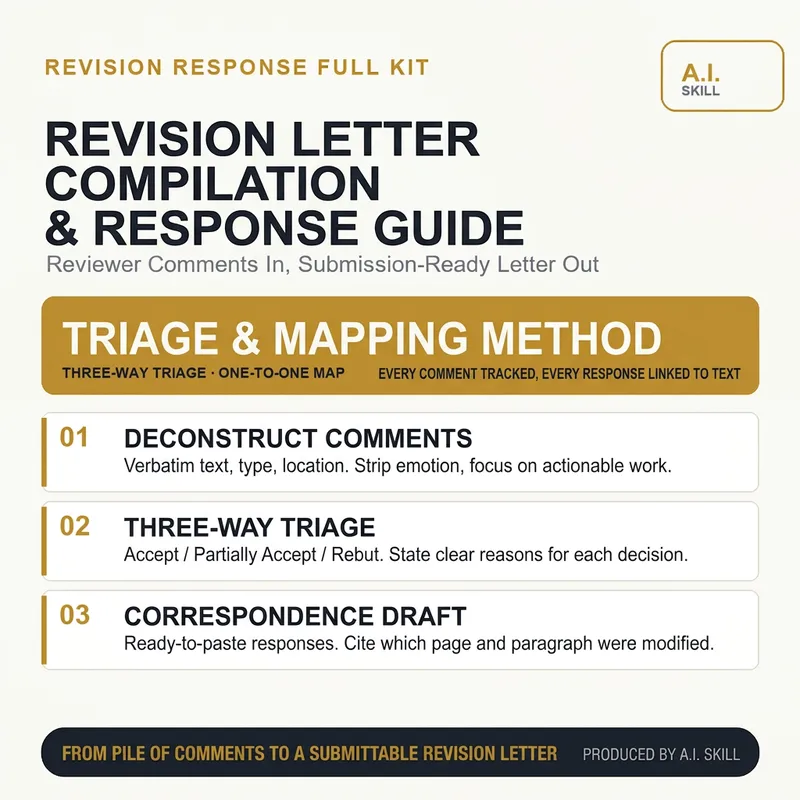
Peer Review Response & Revision
Struggling to organize dozens of reviewer comments into a cohesive response letter? The three-way triage and one-to-one matching method helps you break down, categorize, draft, and align every comment. With authorization, it generates ready-to-use response letters, item-by-item comparison tables, and revision checklists based strictly on your actual changes without fabricating data or reviewers. Key selling point: Goes beyond templates by delivering complete response letters, comparison tables, and checklists directly to you, backed by verifiable public guidelines and zero fabricated data. Best for: Graduate students and early-career researchers receiving major or minor revisions, resubmissions after rejection, or delayed responses; anyone struggling to organize multiple comments or respond without causing friction. Input: Original reviewer comments word for word, your planned changes (accept/partial/rebuttal), actual modification locations, and target journal requirements. Deliverables: 8 content items (comment breakdown, three-way triage, line-by-line responses, response-to-text comparison, revision checklist, response letter, follow-up letter plus log, compliance check) and 5 final items (authorization record, response letter file, response comparison table, revision checklist plus follow-up, sign-off sheet). When tools are unavailable, a ready-to-paste content package is provided instead. Methodology: Three-Way Triage & One-to-One Matching 1. Breakdown fields - Number each comment, keep verbatim text, type, location, and feasibility before writing. Isolate emotional remarks and focus solely on required actions. 2. Three-way triage - Accept, partially accept, or rebut, with clear justification for each. Rebuttals follow a framework of acknowledging valid points, presenting evidence, and explaining retention. 3. One-to-one matching - Generate paste-ready responses and create a comparison table with three valid status values, ensuring all promised changes appear in the text. Grounded in public guidelines: Based on journal author guidelines, COPE, ICMJE, APA 7, GB/T 7714-2015, and PRISMA 2020 where applicable. Every boundary is clearly marked, and authoritative sources are never fabricated.
 Research
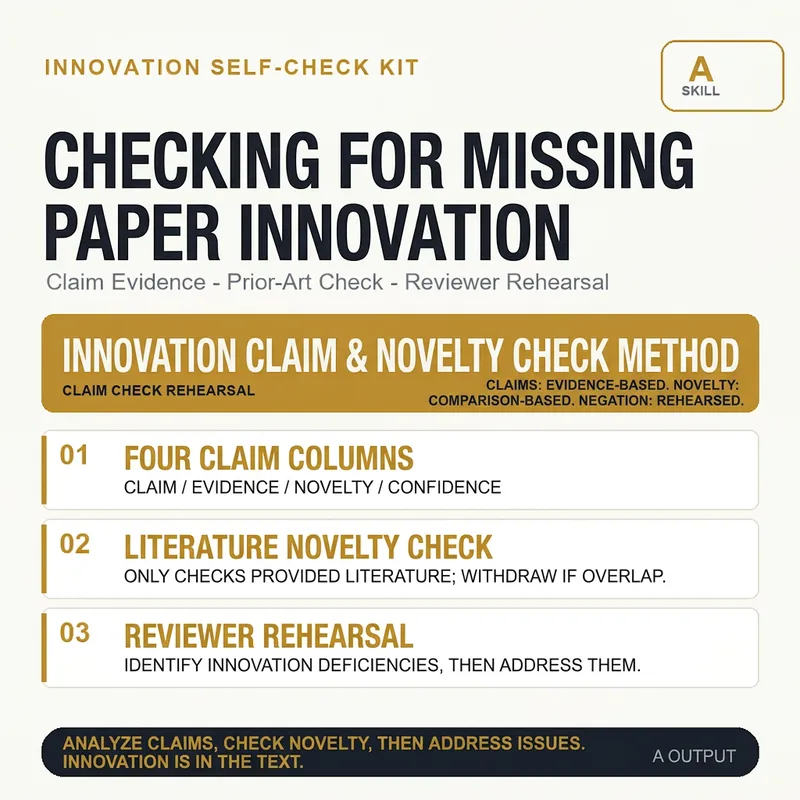
Paper Novelty and Review Rehearsal
Check your innovation points before submission: claims come with evidence and differentiators, overlap is checked against your literature, and peer review criticisms of lacking novelty are rehearsed. Tables are generated upon authorization; acceptance is not guaranteed. Key selling point: While competitors just give an innovation score, this version breaks down innovation into evidence-backed claims, runs overlap checks using your provided literature, and rehearses the reviewer's objection of lacking novelty—delivering ready-to-use tables directly to you after authorization. Who it's for: Graduate students and early-career researchers struggling to articulate innovation points before submission, those previously rejected due to perceived lack of novelty, and anyone needing a strong opening for abstracts or defenses. What to input: Paper body or abstract + closest reference literature (title/year/approach) + target journal submission guidelines (optional, marked as pending verification if unavailable). What is delivered: 8 content items + 4 finished items (12 in total). Claims feature individual evidence and differentiators, overlap is checked strictly against your provided literature, and remediation avoids fabricated data. If tools are unavailable, a paste-ready content package marked as unproduced is used instead. Exclusive Methodology: Paper Novelty and Review Rehearsal. Innovation isn't just writing that a paper is significantly novel; it's breaking down novelty into verifiable claims, checking literature overlap, and reinforcing weak spots. 1. Claims: Fill in each innovation with a claim, supporting text location, difference from closest work, and confidence level. 2. Overlap Check: Compare line-by-line using your provided literature, classifying as new, partially overlapping, or overlapping (remove if differences cannot be articulated). 3. Rehearsal and Remediation: Rehearse the reviewer's critique of lacking novelty, offering compliant remedies for weak points while strictly refusing data or literature fabrication. Remember it in one sentence: Break down claims first, check overlap second, and remediate third; every innovation points back to your own text and literature. How it upgrades on competitors: Most competitors only provide an innovation score or novelty conclusion without overlap processes or sources, leaving authors still wondering where the novelty lies. This version builds on its core mechanics with three unique additions: 1. Line-by-line evidence table for innovation claims indicating supporting text/data, differences, and confidence level, avoiding empty claims of significant novelty. 2. Peer review rehearsal for lack of novelty, self-critiquing against the target journal's standards to turn potential rejections into actionable remediation points. 3. Two-step gate: First outputs an innovation claim list for confirmation before running overlap checks and rehearsals, preventing wasted effort on incorrect directions. Traceable claims, preemptive self-critique, and two-step delivery. Grounded in rules: Anchored strictly in real public standards including current journal guidelines, user-provided literature and text, COPE, citation formats, copyright and fair use, AI generation disclosure requirements, and constraints against absolute terms or earnings promises. Items or fields that cannot be verified are marked as pending verification without relying on memory, and unrelated rules are marked inapplicable.
 Write
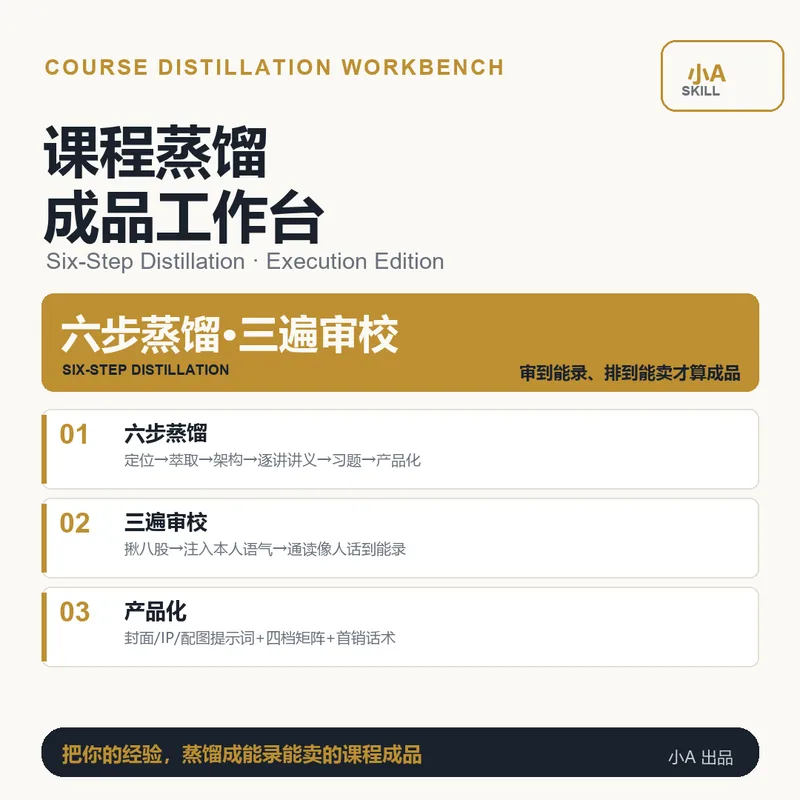
Course Distillation Studio
Distill your experience into a course you can record and sell. Using a six-step process with three review passes, this generates a complete outline, record-ready lecture scripts, visual assets, and launch sales copy directly from your personal expertise. **Core Value**: Beyond just a course skeleton—upon authorization, it delivers a positioning report, outline table, record-ready scripts with three review records, visual assets, a product matrix, and initial sales scripts, all derived from your own experience. **Best For**: Knowledge monetizers, trainers, and creators with professional expertise who want to build a course, as well as those who have an outline but find their teaching materials sound like AI and fail to sell. **Input Requirements**: Your genuine experience, articles, or materials, plus your desired topic. Leave placeholders marked as [To be filled] where real-world experience is missing. **Outputs Delivered**: 8 content pieces plus 5 finished products (13 items in total). Positioning report, outline, record-ready scripts, visual assets, product matrix, and initial sales scripts are produced individually as files. If tools are unavailable, a paste-ready content package is provided with an "Unproduced" label. ## 【Exclusive Methodology】Six-Step Distillation & Three Review Passes The six steps solve the outline, while the three review passes ensure the course is record-ready and sellable. Having a skeleton is not enough to make a finished product; this version embeds the final mile directly into the workflow. 1. **Six-Step Distillation**: Positioning (who it is for) -> Extraction (four questions for core insights) -> Architecture (3-5 modules x 2-4 lectures) -> Lecture handouts -> Takeaway exercises -> Productization. 2. **Three Passes to Remove AI Tone**: Eliminate cliché filler words -> Inject personal tone (at least 1 real experience per lecture; leave [Insert your case here] if missing) -> Read aloud naturally (phrase for reading, 600-900 words, include pause points). 3. **Productization**: Prompts for covers, instructor IP, and presentation illustrations provided all at once; a four-tier product matrix (lead-gen, trust, profit, premium) + 3 initial launch scripts (early-bird price, quota, deadline). Remember it in one sentence: **Building a skeleton is not enough; reviewing until it is record-ready and formatting until it sells makes a finished product.** ## 【Evidence-Based】Rules Follow Current Official Standards Anchored strictly in real, public standards: current skill package specifications of target platforms, copyright laws regarding copying and fair use, AI-generated content identification requirements, and restrictions on absolute terms and income promises in launch copywriting. Any unsure fields, clauses, or rules are strictly marked as "To be verified" without relying on memory. Rules unrelated to this scenario are explicitly marked as inapplicable. ## 【v1 New: From Intermediate Artifacts to Finished Files】 Older versions provided editable intermediate artifacts, but this version turns content into usable files. It first detects the tool capabilities of your current session, informs you what will be generated and what the consumption will be, and only proceeds after your confirmation. - **Record-Ready Lecture Scripts & Three Review Records**: Original draft -> changes made -> fully visible record-ready script process. Missing real experiences are left as placeholders without fabrication. - **Visual Asset Prompt Package**: Cover, instructor IP character, and lecture illustration prompts provided with stacking instructions only, without consuming image-generation credits. - **Product Matrix & Initial Sales Script Files**: Four-tier pricing matrix and 3 scripts including early-bird prices, quotas, and deadlines, ready to copy into your listing page. **No generation tools in the session?** A "Directly pasteable finished content package" is delivered in Markdown format so you can paste it straight into Word or spreadsheets. **Never pretends to generate and never fabricates file paths.** ## 【Details Page Body】 ### Boundaries It Maintains Its service scope is clear: **it only arranges your provided authentic materials into a course outline, record-ready lecture scripts, visual asset prompts, product matrix, and initial sales scripts**. Workflows, course content, cases, qualifications, data, and student reviews that you do not provide will be marked as [To be filled]; the Skill will not fabricate them just to make the table look good. It does not copy others' works, appropriately cites sources, and does not promise platform review or listing results. ### Core Workflow 1. Positioning + Four Extraction Questions -> Outline (Pyramid architecture); 2. Lecture handouts go through three review passes to remove the AI tone -> Record-ready scripts; 3. Takeaway exercise checklist + visual asset prompts + product matrix + initial sales scripts. + Authoritative anchoring layer + Execution delivery layer (detection -> authorization -> production output -> acceptance/downgrade).
 Write
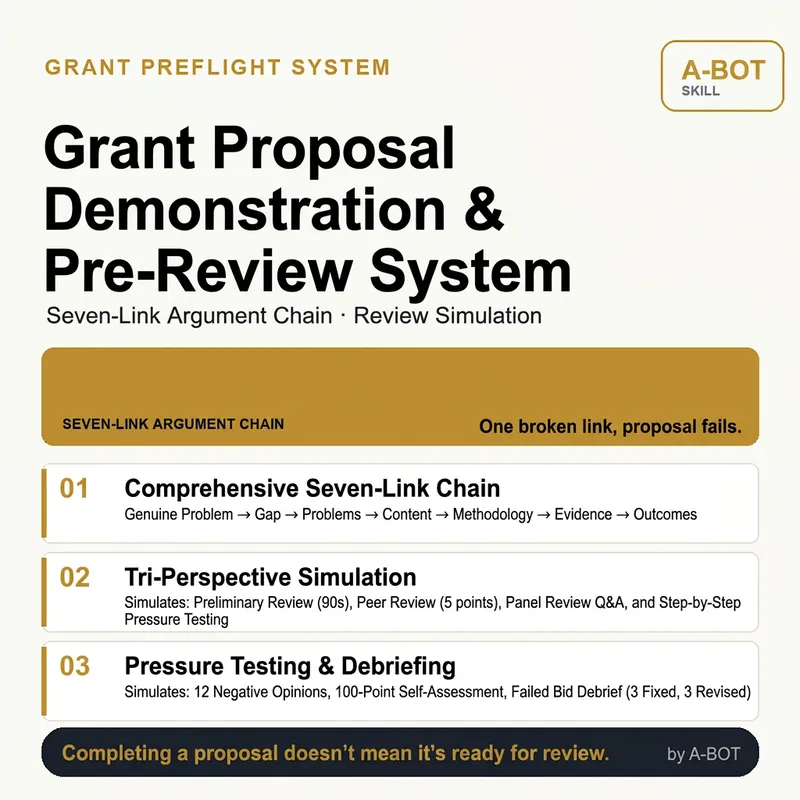
NSSF Proposal Review & Audit
Does your proposal hold up under scrutiny? This skill compresses your National Social Science Fund or Ministry of Education humanities proposal into a one-page 7-ring logic chain, previews it from three review perspectives, and stress-tests it against 12 negative review opinions. With execution upgrades, it organizes your materials into a 7-ring argument table, a negative opinion comparison table, and a self-assessment form after authorization. It never ghostwrites text, fabricates facts, or guarantees approval. Key selling point: It doesn't just point out flaws—after authorization, it directly generates the 7-ring argument table, negative opinion comparison table, dual-track framework, and self-assessment form for you. Announcements for the current year apply; no preliminary results are fabricated. Best for: Applicants for National Social Science Fund or Ministry of Education humanities projects, early-career researchers looking to review rejected submissions, or anyone whose content resembles a textbook table of contents, whose innovations sound like slogans, whose main thread is broken, or who worries about identity disclosure in blind reviews. What to input: Discipline + category + batch (subject to the current year's announcement) + research direction + your actual completed work + draft (optional). What is delivered: 8 content items (identity card / rejection review / restriction checklist / three-perspective card / 7-ring one-pager / dual-track framework / 12 negative opinions / 100-point self-assessment / authoritative anchor check) + 5 finished items (authorization record / 7-ring argument table / negative opinion comparison + dual-track framework / self-assessment form / rejection review & acceptance sheet). If tools are unavailable, a copy-pasteable finished content package is provided with notes. ## Exclusive Methodology: The 7-Ring Logic Chain Most rejections aren't due to formatting, but fragile arguments. Before writing a single word of text, this method compresses your logic onto a single page: 1. 7-ring thread: True problem → literature gap → research question → content → methods → evidence → outcomes. Any broken ring is highlighted in red with a fix, and rings 3→4→5→7 must connect. 2. Three-perspective preview: 90-second initial review, five-item desk review, and panel review skepticism—each step highlights "who is being defended against," helping you understand why the check matters. 3. Stress testing and review: Check off 12 negative opinions one by one, take a 100-point self-assessment (submissions under 70 points are not recommended), and conduct a rejection review for secondary submissions adhering to "three unchanged, three must-change" principles to block skin-deep rejections. Remember this: Break one ring, and the proposal fails. ## Evidence-Based: Parameter Rules Follow Current Announcements Anchored strictly to authentic public guidelines: current year's NSSF application announcement / Ministry of Education humanities notification / institutional research office template (highest priority), historical approval libraries, and CNKI/Wanfang novelty checks (self-checked), plus standard publishing ethics (background only). Age limits, word counts, restrictions, columns, and deadlines that cannot be confirmed are marked as "pending verification"; numbers are never filled in from memory. Unrelated guidelines (PRISMA, ICMJE, etc.) are explicitly marked as not applicable. ## v1 Update: From Tables to Finished Files Older versions provided modifiable intermediates, but this version turns content into usable files: it first tests your current session's tool capabilities, tells you what will be generated and resource consumption, and only proceeds upon your confirmation. - One-page 7-ring argument table: 7 rows of arguments with broken rings highlighted in red and connectivity conclusions, ready for Excel. - Negative opinion preview comparison table: 12 rows checked one by one, hit location + one-sentence fix. - Dual-track framework + self-assessment form + rejection review table: Frameworks based on Type A blind review 8 sections / Type B form 5 columns, complete with self-assessment scores and secondary submission revision lists. No generation tool in the session? Delivered as a "ready-to-paste finished content package"—all five tables written in Markdown, ready to copy into Word or Excel. Never pretends to generate or fabricates file paths. ## Detail Page Text ### Proposal AIGC is a hard red line. How does this skill safeguard it? Its scope is narrow: it only organizes the authentic materials you provide into tables and frameworks. If you lack data, interviews, samples, preliminary results, literature, or approved entries, they remain "pending supplement / pending verification." The skill will not fabricate them just to make a table look good; the 7,000-word text is written by you. ### Five Steps 1. Identity card + rejection review (secondary submissions prioritize three unchanged, three must-change rules); 2. Track gate + restrictions + three perspectives (mutually exclusive blocking, age verification, current year parameters); 3. 7-ring one-pager (broken rings highlighted in red, connectivity must pass); 4. Dual-track framework (no ghostwriting of text); 5. Negative opinions + removing AI tone + formal review + 100-point self-assessment. + Authoritative anchoring layer + execution delivery layer (detect → authorize → generate finished file → accept/downgrade).
 Write
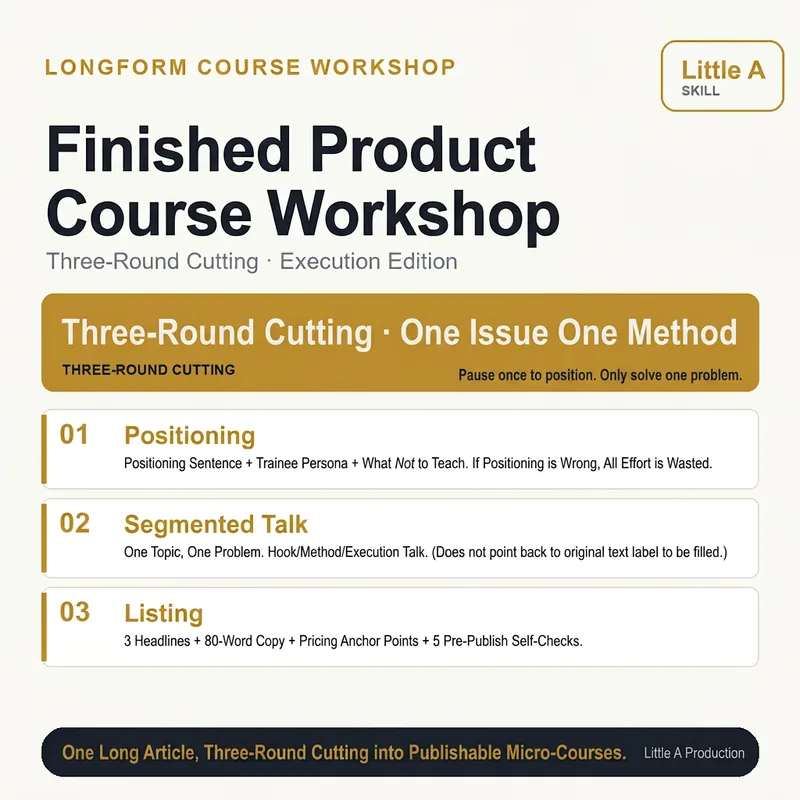
Micro-Course Rescuer
Turn a long text into a breakdown table, lecture handouts, and publishing copy for a 3-part mini-course through three rounds of segmentation. Uses only the source text without inventing anything. **Core Selling Point**: Beyond planning tips—directly generates your course profile, 3-part breakdown table, lecture handouts, and publishing kit. Each lecture solves one real problem, and every point links back to the source text. **Best For**: Content creators and knowledge bloggers looking to quickly test the waters; anyone with a long text, notes, or book excerpt who doesn't know how to structure it into a course. **Input**: A source text (1,800+ words of long text, notes, book excerpt, or draft) + goal (free lead-magnet course or low-priced entry-level course). **Output**: 8 content pieces + 4 finished pieces (12 total). Course profile, breakdown table, lecture handouts, and publishing kit are generated one by one. If tools are unavailable, a copy-pasteable package is provided with unproduced items marked. ## [Exclusive Methodology] Three-Round Segmentation · One Problem Per Lecture If your positioning is wrong, the next two rounds are wasted—so the first round must pause to confirm the course profile, which is the most efficient step in the entire workflow. 1. **Anchor**: Positioning formula "Help [who] achieve [result] in [scenario] using [method]" + 3 student persona questions + clarify what "not to teach" (cut anything the source text cannot support or exceeds capacity). 2. **Segment**: Each lecture solves one real problem (lecture titles written as questions); default hook lecture -> method lecture -> practical lecture; each point maps to a source paragraph, unmapped items marked as [To Be Added], no fluff. 3. **Publish**: 3 titles from result/pain-point/scenario angles + 80-word short copy (pain point -> what you get -> who it's for -> call to action) + pricing anchor + 5 pre-release self-checks. Remember it in one sentence: **Pause to anchor first, solve one problem per lecture.** ## [Grounded in Rules] Standards Based on Current Official Guidelines Anchored only in real public standards: target platform skill package guidelines, copyright duplication and fair use, AI-generated content labeling requirements, and restrictions on absolute terms and earnings promises in publishing copy. **Any fields, clauses, or rules that are unclear will be marked as "To Be Verified"—never filled from memory**; rules unrelated to this scenario are explicitly marked as not applicable. ## [v1 New · From Intermediates to Finished Files] Older versions provided editable intermediates; this version turns content **into ready-to-use files**: first detects your current session's tool capabilities, tells you what is about to be generated and the consumption cost, and only acts after your confirmation— - **Breakdown Table + Course Profile File**: Positioning sentence, what not to teach, 3 lecture problem titles, and corresponding source paragraphs in one table; - **Lecture Handout Drafts**: Five-section format per lecture (hook/explanation/demonstration/practice/summary) + take-away checklist, written as an editable draft; - **Publishing Kit + Checklist**: 3 titles, 80-word short copy, pricing anchor, and 5 pre-release self-checks. **No generation tools in the session?** Delivers a "ready-to-paste finished content package"—formatted entirely in Markdown, ready to use when copied into Word or tables. **Never pretends to generate, never invents file paths.** ## [Details Page Body] ### What Boundaries Are Maintained The service scope is clear: **only arranges your provided real material into a breakdown table / lecture handout drafts / publishing kit**. If you lack workflows, course content, cases, qualifications, data, or student reviews, they remain [To Be Added]; the skill will not invent them just to make the table look nice. It does not copy others' works, cites sources, and does not promise platform review or publishing results. ### Core Architecture 1. Anchor: Positioning sentence + student personas + what not to teach, pause to confirm; 2. Segment: One problem per lecture + five-section handout + take-away checklist; 3. Publish: 3 titles + 80-word short copy + pricing anchor + 5 self-checks. + Authoritative anchoring layer + execution delivery layer (detect -> authorize -> output finished product -> accept/fallback).
 Write
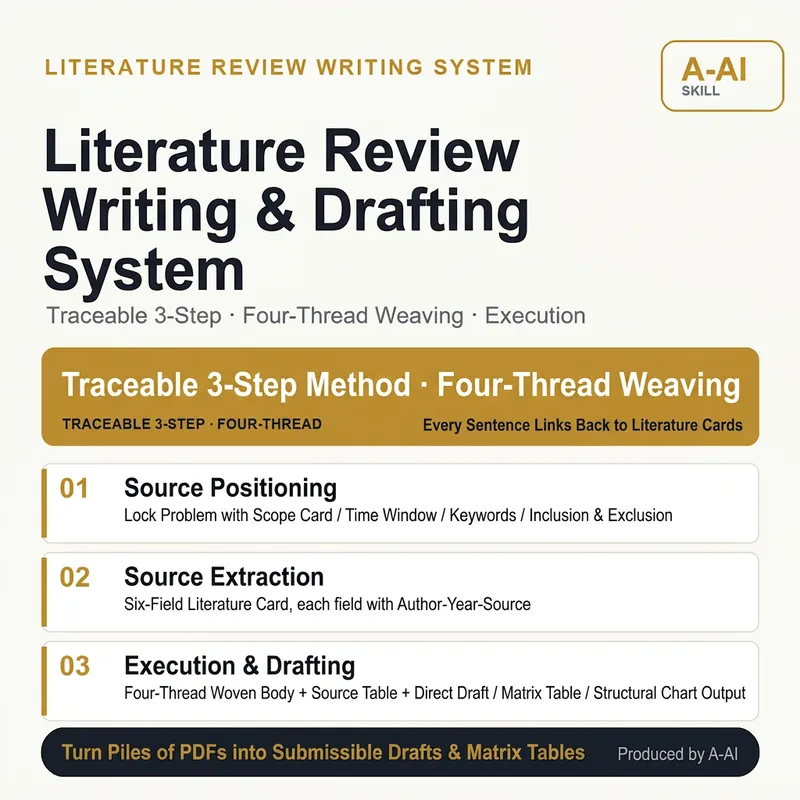
Literature Review Builder
Struggling with a monotonous literature review or missing citations? The three-step provenance method and four-line weaving help you locate, extract, and weave content so every sentence links back to a literature card. Execution upgrade: upon authorization, directly receive a review draft, literature matrix table, and four-line structure diagram, organizing only what you have read without inventing citations. **Core Value**: Beyond templates—after authorization, receive the review draft, literature matrix table, and four-line weaving diagram directly; every step anchors to verifiable public standards without making up a single citation. **Best For**: Graduate students and early-career researchers writing research proposals, thesis chapters, or grant foundations; anyone with piles of unorganized literature, monotonous reviews, or unreferenced claims. **What to Input**: Service goal + concise research question + read literature list (PDF, notes, or citations) + discipline + target format. **What You Get**: 8 content items (verification card, scope card, 6-field card library, citation authenticity check, four-line outline, body draft, traceback table + gap, self-check + authoritative anchor check) + 5 finished items (authorization record, review draft, literature matrix table, four-line structure diagram, acceptance table). Replaced with a ready-to-paste content package when tools are unavailable. ## Exclusive Methodology: Three-Step Provenance & Four-Line Weaving Reviews read like laundry lists because claims lack sources and literature is not broken down. This method addresses precisely that: 1. **Provenance Location**: Scope cards lock in your research question, time window, keywords, database, and inclusions/exclusions to set boundaries. 2. **Provenance Extraction**: Create 6-field cards for each source—claim, method, finding, limitation, key quote, association—with (author, year, source). Never write about what you haven't read or invent page numbers. 3. **Provenance Weaving**: Weave timeline, theme, method, and debate into the body, linking each paragraph to card numbers for balanced critique. Output a citation traceback table and 3 gaps. Remember: Every claim links back to a literature card. ## Evidence-Based Public Standards Anchored in public standards rather than guesswork: GB/T 7714-2015, APA 7, COPE, PRISMA 2020 (applicable only to systematic or scoping reviews). Clear boundaries are marked, deferring to target school or journal requirements. ## Version 1 Update: From Templates to Finished Files This version turns content into usable files. It detects tool capabilities, informs you of generation plans, and proceeds upon confirmation: - **Review Draft**: Four-line format with provenance and references, ready for Word; - **Literature Matrix Table**: Row-by-row 6-field cards ready for Excel; - **Four-Line Structure Diagram**: Maps your cards and relationships. **No generation tools?** Receive a ready-to-paste content package with full text, Markdown matrix, and prompts. ## Details ### Why Reviews Become Laundry Lists It happens when you write without breaking down cards. The three-step method breaks down sources first, then weaves them logically. ### Three Steps 1. **Location**: Scope card + inclusion/exclusion. 2. **Extraction**: 6-field cards with source info and citation checks. 3. **Weaving**: Four-line body text + critique + traceback table + 3 gaps. + **Authoritative Anchoring**: Verifiable public standards. + **Execution Delivery**: Tool detection → authorization → output → acceptance. ### What It Does Not Do - **Only processes read content**: No invented citations, authors, years, sources, page numbers, or data. - **No fake generation**: Clearly marks missing tools and provides paste-ready packages. - **No publication guarantees**: Focuses on clarity and rigor. - **No forced authority**: Applies standards only when appropriate. - **Honest resource usage**.
 Write
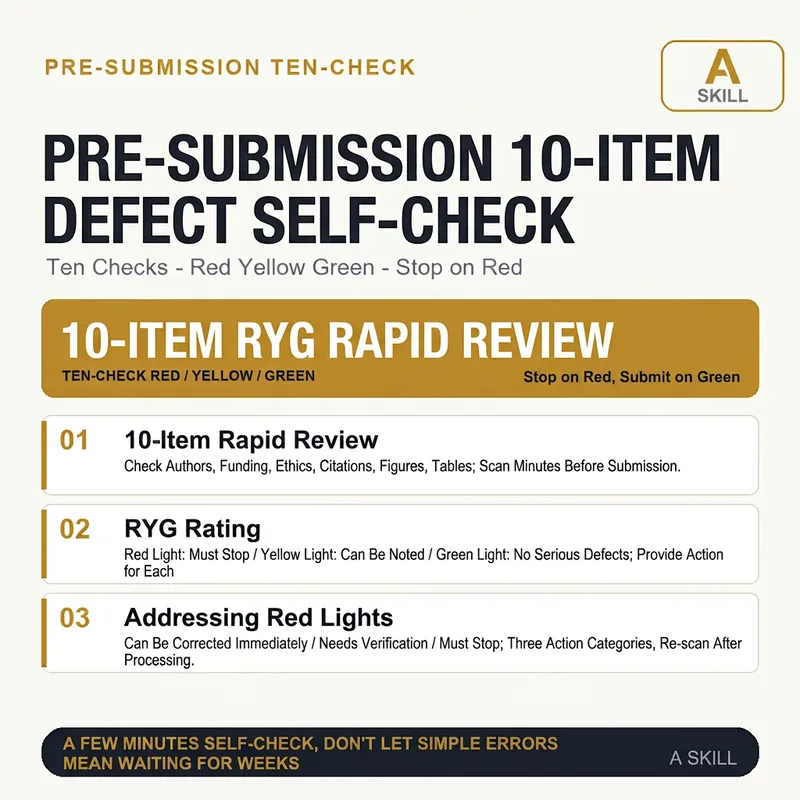
Pre-Submission Flaw Check
A few minutes before clicking submit, run this ten-point red-yellow-green checklist to scan for fatal rejection-level flaws: authorship, funding, duplicate submission, ethics, data, citations, figures, and length. Stop on a red light, proceed on a green light. Pure guidance only—no ghostwriting, no fabrication, and no acceptance guarantees. **One-Line Selling Point**: A quick pre-submission checklist to run through in minutes: stop on red, proceed on green, and catch amateur mistakes before wasting weeks waiting for a rejection. **Who It Is For**: Graduate students, early-career faculty, and researchers who have finished a draft and worry about missing authors, incorrect grant numbers, omitted ethics statements, or duplicate submissions. **What to Input**: The manuscript to submit + target journal author guidelines + author list + funding or ethics credentials (mark missing items as pending, do not fabricate). **What You Get**: A ten-point self-check list (red/yellow/green criteria + red-light actions) + deep authorship and ethics check + deep citation and data check + formatting and figure checklist + red-light handling quick reference + next-step guidance + 2 sample files. ## [Detail Page Content] ### Great Paper, Why Was It Desk-Rejected? Often it is not the research itself, but amateur pre-submission flaws: missing authors, wrong grant numbers, duplicate submissions, omitted ethics statements, unnumbered figures, or forgetting to remove author names from an anonymous draft. Editors spot these errors instantly, wasting weeks of your time and hurting your credibility. **This tool does only one thing: scans for fatal flaws a few minutes before submission.** ### How the Ten Points Are Checked Ordered from most to least severe: ① Author names and affiliations ② Funding acknowledgments ③ Duplicate submission and redundant publication ④ Ethics review and informed consent ⑤ Traceable data ⑥ Consistency between data and conclusions ⑦ Citation authenticity ⑧ Citation format and numbering ⑨ Figure and table standards ⑩ Length and submission format. Each point provides red (must stop) / yellow (known risk) / green (no fatal flaws) criteria and "what to do on a red light." ### Three Paired Deep Checks - **Authorship and Ethics**: Most severe consequences—missing an author is a retraction-level incident, and missing ethics leads to instant desk rejection. - **Citations and Data**: Most prone to stumbling—AI-generated fake references, mismatched data, and conclusions extending beyond the data. - **Red-Light Handling**: Divided into three categories: fix immediately / needs investigation / must stop. Re-scan after addressing. ### After Flaws Are Detected The checklist tells you what kind of advanced processing tool to use next (revisions, review rewriting, credential recognition, etc.), but **does not process it for you or promise results**. ### What It Does Not Do (Red Lines) - **No Ghostwriting**: Does not write body text, polish, or judge research value. - **No Fabrication**: Grant numbers, ethics approval letters, data, and citations—mark missing items as "pending verification." - **No Guarantees**: Does not guarantee acceptance, publication, or passing review. - **Official Guidelines Prevail**: Target journal and institutional requirements at the time of submission take precedence.
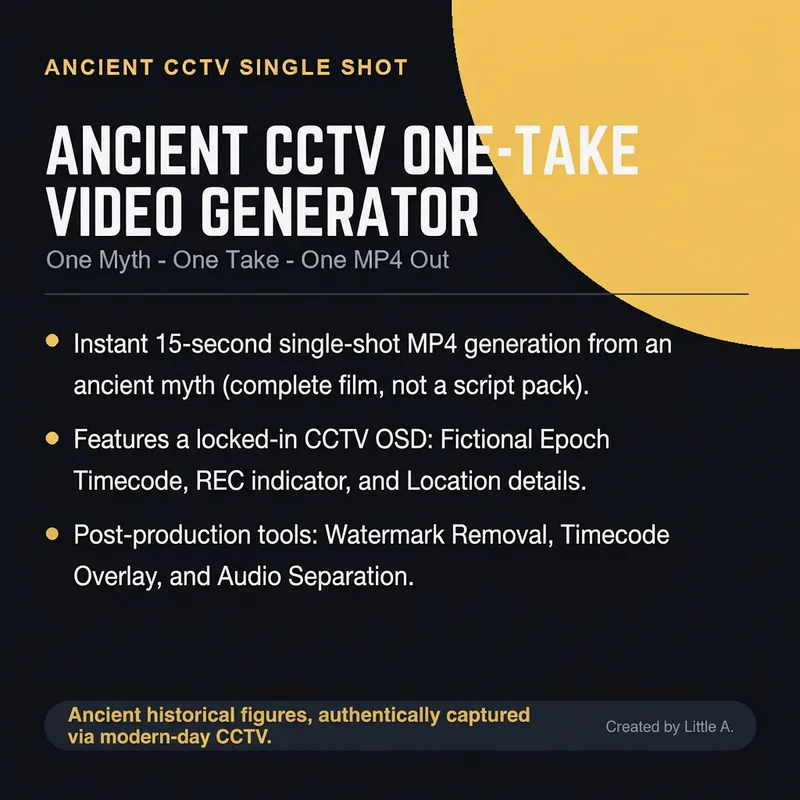
Ancient Surveillance Video Generator
Drop in a single-sentence allusion, and get a 15-second single-shot ancient surveillance meme video (mp4). This is not a script package; it produces the actual video. This skill makes the video directly for you: **input a sentence of an allusion, output a 15-second single-shot ancient surveillance meme mp4**, instead of making you fiddle with prompts yourself. It is different from the same series "Ancient Surveillance Meme Video Generator": that one outputs a script package (opening card/storyboard/character card/prompts), while this one outputs the **video file itself**. Use that one if you need shootable scripts, and use this one if you need ready-to-publish videos. ## What it does for you - **Branch determination**: Myth Duty Room / Marketplace Scene / Custom, auto-completing parameters without forms or follow-up questions - **Rhythm arrangement**: 3-9-3 single-shot structure (3s setup + 9s contrast action + 3s hard cut ending) - **Visual locking**: Fixed overhead one-shot, black & white low-saturation grain, slight barrel distortion, silent hard cut - **OSD trio locking**: Fictional era timestamp (seconds ticking up every second) + REC/playback + Surveillance N + location - **Pitfalls fully resolved**: This is the most valuable part—AI watermark removal, fixing model timestamp rendering errors by using incremental second overlay, forced audio track stripping, and OSD border erasure. All are formulas learned from actual practice, written into references for easy copying. ## What you will get - A single-shot mp4 of about 15 seconds (subject to model limits, marked honestly) - A clean keyframe png - Delivery notes: actual duration, aspect ratio, branch, OSD parameters, known limitations ## Who it is for - Those who want to build accounts with short videos of ancient/myth memes - Those who don't want to write scripts, storyboards, or tune prompts - Those tormented by AI video timestamps jumping around, watermarks, and audio tracks ## Who it is not for - Those who want multi-shot storylines over 1 minute (use the same series script package) - Those who want voiceover, dialogue, or BGM (this is silent and single-shot) - Those who want real contemporary date surveillance (compliance red line, fictional era only)
 Write
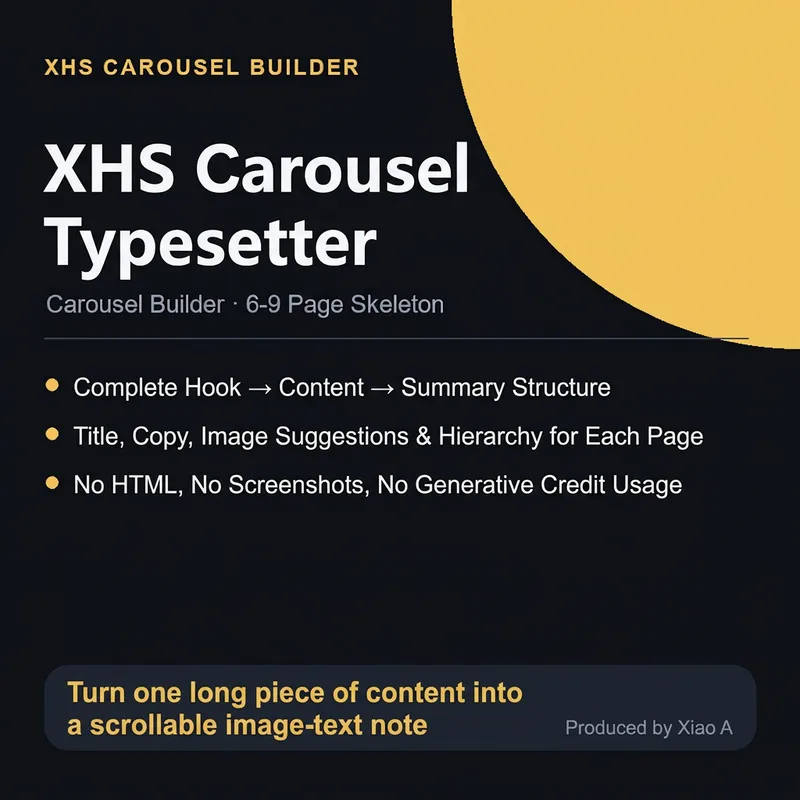
RED Carousel Planner (6-9 Pages)
Triggers when users ask to split carousel posts, format long images, or turn text into multi-page layouts. This Skill breaks an article, tutorial, SOP, or checklist into 6–9 pages of 3:4 plain text skeletons: hook page → content pages → summary page, complete with a title, copy, image suggestion, and hierarchy for each page. It doesn't rely on HTML, screenshots, or image generation credits, so you can easily take the output into your own layout tool. Includes examples of authentic cover copy tailored for everyday creators. Purely guidance-based.
 Research
RED Account Auditor
Triggers when users ask to review an account, diagnose a profile, fix a messy homepage, resolve low traffic, switch directions, or benchmark competitors. This skill audits accounts using an eight-dimensional scoring system covering positioning clarity, content verticality, cover consistency, title hook rate, update rhythm, engagement rate, breakout rate, and follower conversion. It identifies the 1 to 2 lowest-scoring bottlenecks, provides prioritized actionable changes, and focuses on one main change at a time. Unavailable data is marked as "unable to calculate" without estimation. Purely guidance-oriented.
 Write
Research Defense Strategy
Most presentation tools only focus on the surface layer—organizing materials into Slides, writing a script, and picking fonts. But academic defenses usually fail for two reasons: a shaky research storyline where innovations are unclear, and getting cornered by committee questions. Summary Goes beyond making your presentation look good to help you successfully defend your work with storyline diagnosis, a panelist question map, and timed scripts. Key Advantages 1. **Deep Diagnosis**: Evaluates whether your research storyline and contributions hold up, including patchiness checks, innovation grading, and vulnerability warnings. 2. **Panelist Q&A Map**: Categorizes questions into mandatory, high-frequency, and tough tiers, providing response frameworks and fallback phrases for tricky spots. 3. **Timed Scripts**: Segments your speech with time markers and optional cuts to prevent overtime without sacrificing core conclusions. 4. **Five Scenario Routes**: Tailored preparation for proposal, midterm, graduation, project completion, and title defense scenarios. 5. **Data Discipline**: No fabricated data or passing guarantees; missing items are marked as pending verification with a pre-defense checklist. Target Audience University faculty, early-career researchers, and graduate students preparing for academic defenses or evaluations who are worried about difficult committee questions.
 Write
RED Topic Calendar Generator
Triggered when users say "I don't know what to post", "help me find topics", "what should I write next", "topic bank", "topic calendar", or "what trends to follow". This Skill uses two zero-cost methods to generate topics: (1) deconstructing viral posts pasted by the user from the same field (title formulas, hooks, what the comment section is asking); (2) building an initial 10-20 or 30-day topic calendar from three content pillars. It does not rely on paid APIs. If real data cannot be retrieved, it is marked as "to be verified"—never fabricating popularity numbers. Includes real starter templates for the first three episodes. Purely guidance-based. Summary Don't know what to post? Deconstruct viral post structures + build a 10-30 day topic calendar from content pillars, complete with real starter templates for the first three episodes. Does not rely on paid APIs. Core Selling Points 1. Two zero-cost methods: deconstruct viral structures / build a calendar from content pillars 2. Honest about insufficient samples, never fabricates popularity metrics 3. Includes "Starting Point -> Trough -> First Order" real starter opening templates for the first three episodes Target Audience Bloggers who don't know what to post; account managers needing a topic bank; creators making visual columns who need a 30-day calendar. Tags / Keywords RED topics, topic calendar, viral deconstruction, content planning, topic bank, self-media
 Write
RED Positioning Diagnostic
Triggered when users ask about content direction, account positioning, persona building, or target audience on RED. Through guided questioning, this skill narrows down your experience, target audience, and monetization path into a clear positioning strategy: a one-sentence persona, account name/bio/visual toolkit, three content pillars, and initial topic directions. It is especially ideal for older creators, beginners, and solo starters, turning your real identity into differentiation without pretending to be an expert. Purely advisory and does not require a code environment. Quick Summary Transforms vague ideas into clear, actionable, and monetizable positioning: a one-sentence persona + account toolkit + three content pillars + initial topics. Key Selling Points (Differentiation) 1. Guided questions that help you choose from curated options rather than making decisions for you 2. Real identity as differentiation, friendly for beginners and solo creators without pretending to be an expert 3. Outputs ready-to-use account name, bio, three content pillars, and first 10 topics Best For People who want to use RED but do not know their direction; accounts with messy content that need repositioning; beginners and solo creators. Tags / Keywords RED positioning, account diagnosis, persona building, content pillars, starting out, side hustle