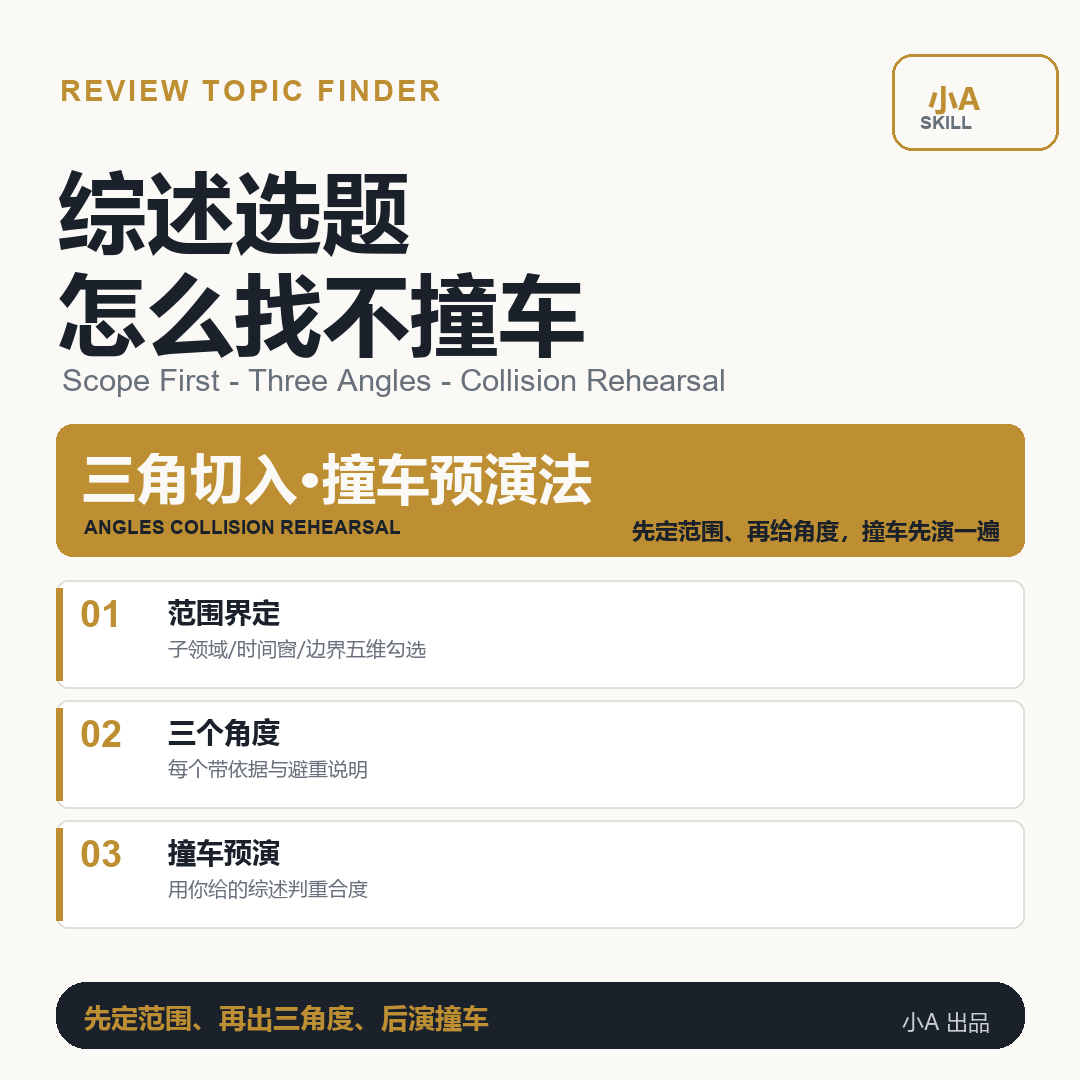
Literature Review Topic Scoping
Define scope, find angles, and pre-check overlap
Literature Review Topic Scoping
Define scope, find angles, and pre-check overlap
Showcase
Description
Literature Review Topic Scoping: Define the scope first, then provide three angles, and pre-check for overlap using your provided literature. No fabricated literature or third-party retrieval, tables generated upon authorization. **Core Selling Point**: While competing tools simply recommend a single title and stop there, this version first defines the scope, offers three angles with distinct avoidance notes, and pre-checks for overlap using your provided literature—delivering cards and tables directly to you after authorization. **Best For**: Graduate students writing coursework papers or thesis reviews, early-career researchers whose topics frequently overlap with existing work, and writers unsure of which angle to choose. **What to Input**: Your subfield and recent literature (titles/years) + core questions you care about + target journal scope or course requirements (optional). **What is Delivered**: 8 content pieces + 4 final products (12 pieces in total). All three angles come with evidence and overlap avoidance notes. Overlap checking uses only the literature you provide, without automated retrieval or fabricated sources. When tools are unavailable, pasteable finished content packages marked as "unproduced" are used as a fallback. ## [Exclusive Methodology] Triangular Entry & Overlap Pre-check Method Literature review topic selection is not about letting someone else give you a title, but about clearly defining the scope, giving yourself a few selectable angles, and checking for potential overlap in advance. 1. **Define Scope**: Five-dimensional selection covering subfield, time window, core questions, exclusion boundaries, and target scenario. Narrow down if too broad; 2. **Triangular Entry**: Provide three viable angles, each marked with evidence, avoidance notes, and writability for you to decide; 3. **Overlap Pre-check**: Compare scope and angles line-by-line using similar reviews you provided to judge the degree of overlap. Switch angles or narrow scope if overlap is high. Remember it in one sentence: **Define scope first, generate three angles second, and pre-check for overlap last; mark insufficient literature as pending verification without fabricating lists.** ## [How It Outperforms Competitors] Competing review topic tools focus on "one-click topic recommendation," giving a single title and ending there without mentioning scope or whether the topic has already been thoroughly covered. This version builds upon the core writing logic with three additional features: 1. **Three Selectable Angle Cards (each with evidence and avoidance notes)**: Instead of a single answer, you get three candidates, each explaining its basis and how it differs from existing reviews for you to decide; 2. **Overlap Pre-check Table**: Line-by-line comparison of user-provided similar reviews against scope and angles to pre-check overlap and prevent discovering duplication after finalizing the topic; 3. **Two-Step Gate**: The first step confirms the domain scope and core questions before generating angle cards, preventing recommendations before the scope is clear. - **Three Angles for You to Choose**: Each angle includes evidence and avoidance notes rather than forcing a single title upon you; - **Pre-check Overlap**: Compare against similar reviews you provided first, switching angles if overlap is high; - **Two-Step Delivery**: Define scope before generating angles, so you don't pick topics within a vague boundary. ## [Well-Founded] Rules Based on Current Official Standards Anchored strictly on real public standards: user-provided literature, target journal current scope or course requirements, database current interfaces, current citation formats, copyright law reproduction and fair use guidelines, AI-generated content identification requirements, and restrictions on absolute terms and earnings promises in marketing copy. **Uncertain terms or fields are strictly marked as "pending verification" and never filled in from memory.** Irrelevant standards are explicitly marked as not applicable without rigid application.
Recommended by
Dancang
Why we love this skill
Uses real literature to define scope, generate three angles, and pre-check overlap instead of random guessing, producing verifiable search frameworks.
Related Skills
View all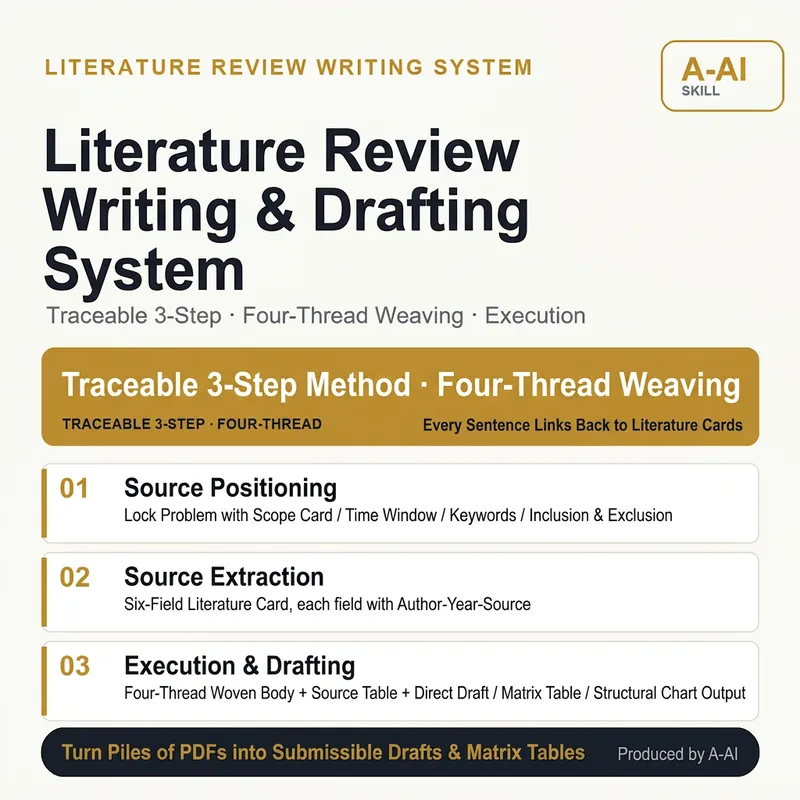 Write
Literature Review Builder
Struggling with a monotonous literature review or missing citations? The three-step provenance method and four-line weaving help you locate, extract, and weave content so every sentence links back to a literature card. Execution upgrade: upon authorization, directly receive a review draft, literature matrix table, and four-line structure diagram, organizing only what you have read without inventing citations. **Core Value**: Beyond templates—after authorization, receive the review draft, literature matrix table, and four-line weaving diagram directly; every step anchors to verifiable public standards without making up a single citation. **Best For**: Graduate students and early-career researchers writing research proposals, thesis chapters, or grant foundations; anyone with piles of unorganized literature, monotonous reviews, or unreferenced claims. **What to Input**: Service goal + concise research question + read literature list (PDF, notes, or citations) + discipline + target format. **What You Get**: 8 content items (verification card, scope card, 6-field card library, citation authenticity check, four-line outline, body draft, traceback table + gap, self-check + authoritative anchor check) + 5 finished items (authorization record, review draft, literature matrix table, four-line structure diagram, acceptance table). Replaced with a ready-to-paste content package when tools are unavailable. ## Exclusive Methodology: Three-Step Provenance & Four-Line Weaving Reviews read like laundry lists because claims lack sources and literature is not broken down. This method addresses precisely that: 1. **Provenance Location**: Scope cards lock in your research question, time window, keywords, database, and inclusions/exclusions to set boundaries. 2. **Provenance Extraction**: Create 6-field cards for each source—claim, method, finding, limitation, key quote, association—with (author, year, source). Never write about what you haven't read or invent page numbers. 3. **Provenance Weaving**: Weave timeline, theme, method, and debate into the body, linking each paragraph to card numbers for balanced critique. Output a citation traceback table and 3 gaps. Remember: Every claim links back to a literature card. ## Evidence-Based Public Standards Anchored in public standards rather than guesswork: GB/T 7714-2015, APA 7, COPE, PRISMA 2020 (applicable only to systematic or scoping reviews). Clear boundaries are marked, deferring to target school or journal requirements. ## Version 1 Update: From Templates to Finished Files This version turns content into usable files. It detects tool capabilities, informs you of generation plans, and proceeds upon confirmation: - **Review Draft**: Four-line format with provenance and references, ready for Word; - **Literature Matrix Table**: Row-by-row 6-field cards ready for Excel; - **Four-Line Structure Diagram**: Maps your cards and relationships. **No generation tools?** Receive a ready-to-paste content package with full text, Markdown matrix, and prompts. ## Details ### Why Reviews Become Laundry Lists It happens when you write without breaking down cards. The three-step method breaks down sources first, then weaves them logically. ### Three Steps 1. **Location**: Scope card + inclusion/exclusion. 2. **Extraction**: 6-field cards with source info and citation checks. 3. **Weaving**: Four-line body text + critique + traceback table + 3 gaps. + **Authoritative Anchoring**: Verifiable public standards. + **Execution Delivery**: Tool detection → authorization → output → acceptance. ### What It Does Not Do - **Only processes read content**: No invented citations, authors, years, sources, page numbers, or data. - **No fake generation**: Clearly marks missing tools and provides paste-ready packages. - **No publication guarantees**: Focuses on clarity and rigor. - **No forced authority**: Applies standards only when appropriate. - **Honest resource usage**.
 Research
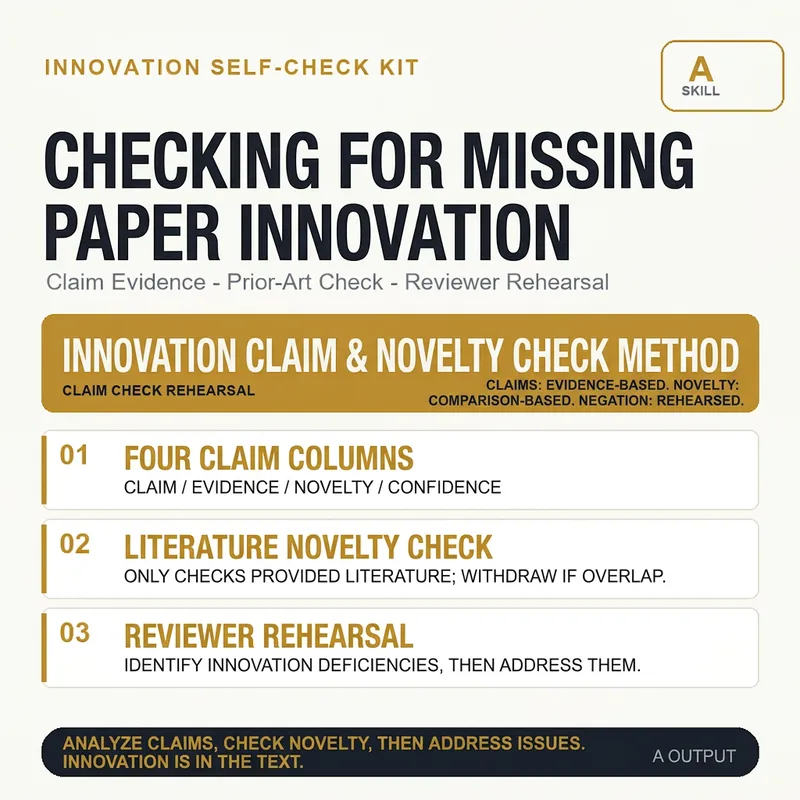
Paper Novelty and Review Rehearsal
Check your innovation points before submission: claims come with evidence and differentiators, overlap is checked against your literature, and peer review criticisms of lacking novelty are rehearsed. Tables are generated upon authorization; acceptance is not guaranteed. Key selling point: While competitors just give an innovation score, this version breaks down innovation into evidence-backed claims, runs overlap checks using your provided literature, and rehearses the reviewer's objection of lacking novelty—delivering ready-to-use tables directly to you after authorization. Who it's for: Graduate students and early-career researchers struggling to articulate innovation points before submission, those previously rejected due to perceived lack of novelty, and anyone needing a strong opening for abstracts or defenses. What to input: Paper body or abstract + closest reference literature (title/year/approach) + target journal submission guidelines (optional, marked as pending verification if unavailable). What is delivered: 8 content items + 4 finished items (12 in total). Claims feature individual evidence and differentiators, overlap is checked strictly against your provided literature, and remediation avoids fabricated data. If tools are unavailable, a paste-ready content package marked as unproduced is used instead. Exclusive Methodology: Paper Novelty and Review Rehearsal. Innovation isn't just writing that a paper is significantly novel; it's breaking down novelty into verifiable claims, checking literature overlap, and reinforcing weak spots. 1. Claims: Fill in each innovation with a claim, supporting text location, difference from closest work, and confidence level. 2. Overlap Check: Compare line-by-line using your provided literature, classifying as new, partially overlapping, or overlapping (remove if differences cannot be articulated). 3. Rehearsal and Remediation: Rehearse the reviewer's critique of lacking novelty, offering compliant remedies for weak points while strictly refusing data or literature fabrication. Remember it in one sentence: Break down claims first, check overlap second, and remediate third; every innovation points back to your own text and literature. How it upgrades on competitors: Most competitors only provide an innovation score or novelty conclusion without overlap processes or sources, leaving authors still wondering where the novelty lies. This version builds on its core mechanics with three unique additions: 1. Line-by-line evidence table for innovation claims indicating supporting text/data, differences, and confidence level, avoiding empty claims of significant novelty. 2. Peer review rehearsal for lack of novelty, self-critiquing against the target journal's standards to turn potential rejections into actionable remediation points. 3. Two-step gate: First outputs an innovation claim list for confirmation before running overlap checks and rehearsals, preventing wasted effort on incorrect directions. Traceable claims, preemptive self-critique, and two-step delivery. Grounded in rules: Anchored strictly in real public standards including current journal guidelines, user-provided literature and text, COPE, citation formats, copyright and fair use, AI generation disclosure requirements, and constraints against absolute terms or earnings promises. Items or fields that cannot be verified are marked as pending verification without relying on memory, and unrelated rules are marked inapplicable.
 Write
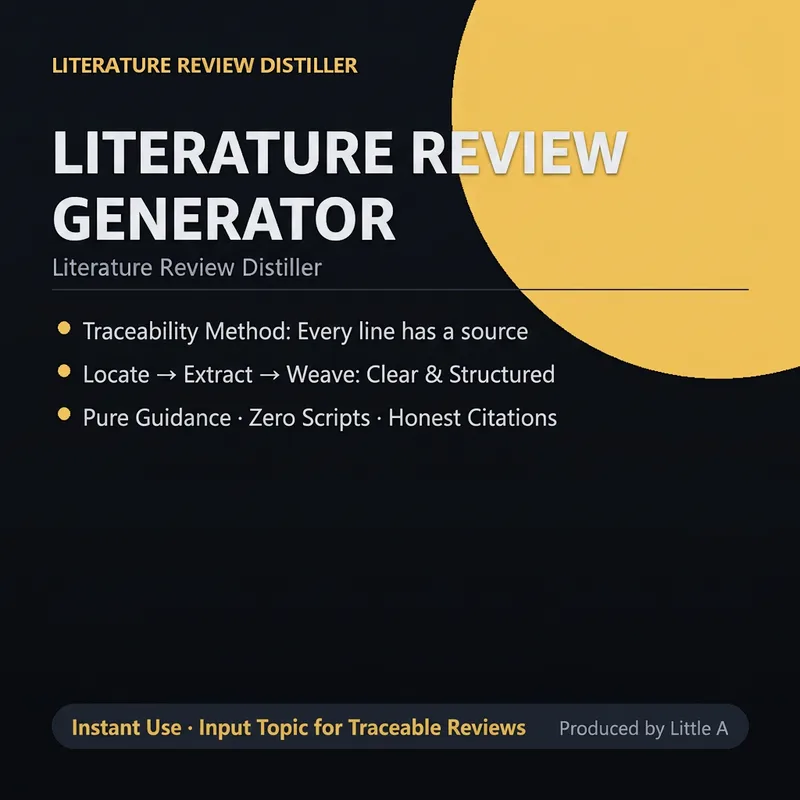
Literature Review Builder
Help graduate students, early-career faculty, and researchers turn a pile of scattered literature (PDFs, notes, keywords) into a logically clear literature review where every claim can be traced and used directly in a paper. The three-step source-tracing method guides you through scope definition, individual paper extraction, and four-line weaving, providing templates and editable intermediate outputs throughout without fabricating citations. Ideal for research proposals, thesis background chapters, and grant applications when you are stuck organizing too many papers or finding research gaps.
Information
- Version
- v3
- Last updated
- Runtime credits
- Usage-based
- Models
- Auto
