Literature Review Builder
Write evidenced literature reviews and map research gaps
Literature Review Builder
Write evidenced literature reviews and map research gaps
Showcase
Description
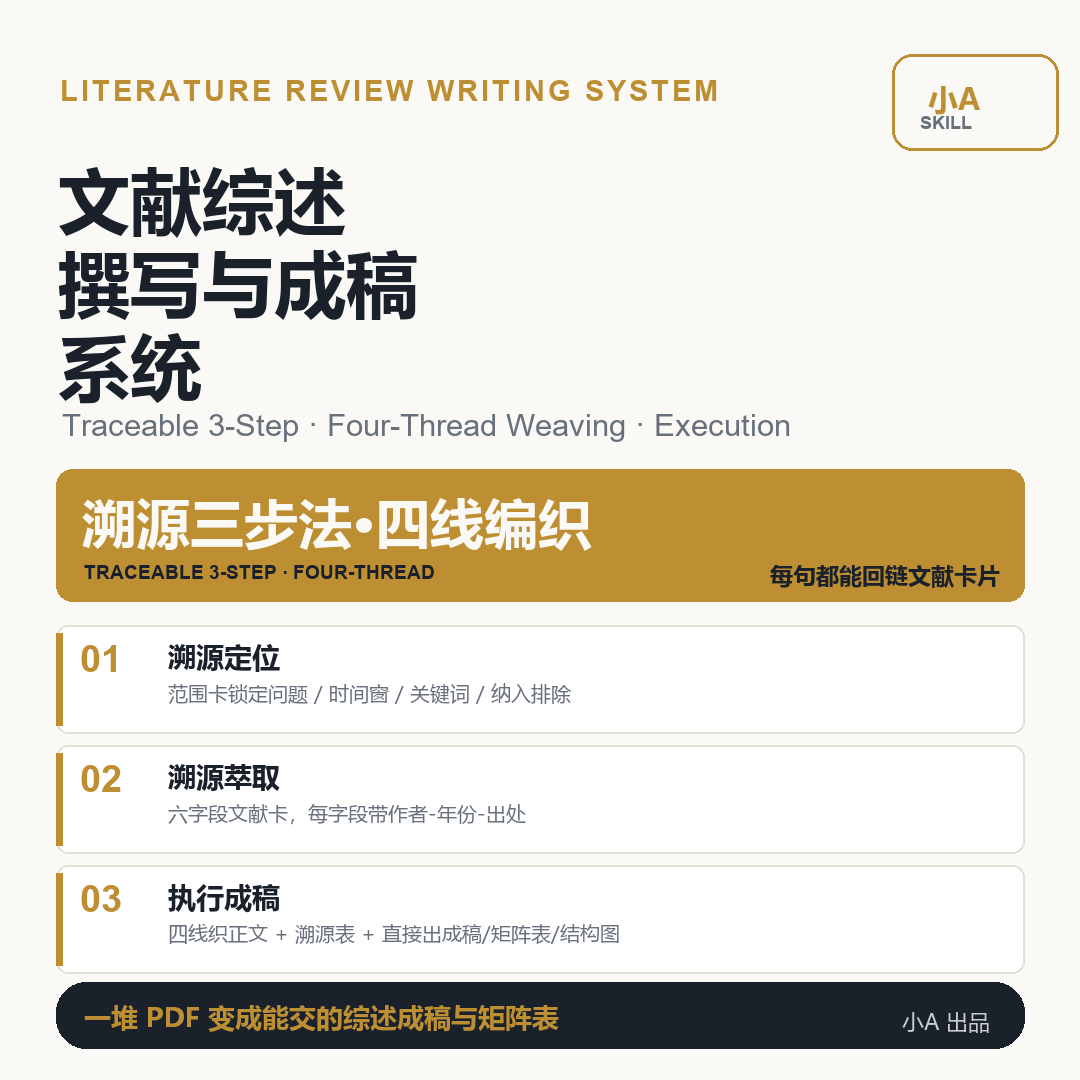
Struggling with a monotonous literature review or missing citations? The three-step provenance method and four-line weaving help you locate, extract, and weave content so every sentence links back to a literature card. Execution upgrade: upon authorization, directly receive a review draft, literature matrix table, and four-line structure diagram, organizing only what you have read without inventing citations. **Core Value**: Beyond templates—after authorization, receive the review draft, literature matrix table, and four-line weaving diagram directly; every step anchors to verifiable public standards without making up a single citation. **Best For**: Graduate students and early-career researchers writing research proposals, thesis chapters, or grant foundations; anyone with piles of unorganized literature, monotonous reviews, or unreferenced claims. **What to Input**: Service goal + concise research question + read literature list (PDF, notes, or citations) + discipline + target format. **What You Get**: 8 content items (verification card, scope card, 6-field card library, citation authenticity check, four-line outline, body draft, traceback table + gap, self-check + authoritative anchor check) + 5 finished items (authorization record, review draft, literature matrix table, four-line structure diagram, acceptance table). Replaced with a ready-to-paste content package when tools are unavailable. ## Exclusive Methodology: Three-Step Provenance & Four-Line Weaving Reviews read like laundry lists because claims lack sources and literature is not broken down. This method addresses precisely that: 1. **Provenance Location**: Scope cards lock in your research question, time window, keywords, database, and inclusions/exclusions to set boundaries. 2. **Provenance Extraction**: Create 6-field cards for each source—claim, method, finding, limitation, key quote, association—with (author, year, source). Never write about what you haven't read or invent page numbers. 3. **Provenance Weaving**: Weave timeline, theme, method, and debate into the body, linking each paragraph to card numbers for balanced critique. Output a citation traceback table and 3 gaps. Remember: Every claim links back to a literature card. ## Evidence-Based Public Standards Anchored in public standards rather than guesswork: GB/T 7714-2015, APA 7, COPE, PRISMA 2020 (applicable only to systematic or scoping reviews). Clear boundaries are marked, deferring to target school or journal requirements. ## Version 1 Update: From Templates to Finished Files This version turns content into usable files. It detects tool capabilities, informs you of generation plans, and proceeds upon confirmation: - **Review Draft**: Four-line format with provenance and references, ready for Word; - **Literature Matrix Table**: Row-by-row 6-field cards ready for Excel; - **Four-Line Structure Diagram**: Maps your cards and relationships. **No generation tools?** Receive a ready-to-paste content package with full text, Markdown matrix, and prompts. ## Details ### Why Reviews Become Laundry Lists It happens when you write without breaking down cards. The three-step method breaks down sources first, then weaves them logically. ### Three Steps 1. **Location**: Scope card + inclusion/exclusion. 2. **Extraction**: 6-field cards with source info and citation checks. 3. **Weaving**: Four-line body text + critique + traceback table + 3 gaps. + **Authoritative Anchoring**: Verifiable public standards. + **Execution Delivery**: Tool detection → authorization → output → acceptance. ### What It Does Not Do - **Only processes read content**: No invented citations, authors, years, sources, page numbers, or data. - **No fake generation**: Clearly marks missing tools and provides paste-ready packages. - **No publication guarantees**: Focuses on clarity and rigor. - **No forced authority**: Applies standards only when appropriate. - **Honest resource usage**.
Recommended by
Dancang
Why we love this skill
Transforms literature reviews from stacked summaries into arguable analyses using a locate-extract-weave approach. Every point links to a verified card while generating text, matrices, and diagrams without fabricating citations.
Best for
Graduate students and early-career researchers preparing thesis proposals, literature review chapters, or research foundations.
How to use this Skill
Provide your input
Provide your service goal, specific research question, read literature list or notes, academic field, and target citation format.
Run the Skill
The system first defines the review scope, then extracts literature claims, methods, findings, and limitations, organizing content by timeline, theme, method, or debate. Every argument links back to the provided literature info.
Review your result
Receive a ready-to-organize literature review draft, literature matrix table, and four-line structure diagram, complete with research gaps, citation tracebacks, and items to verify.
Related Skills
View all Write
Literature Review Builder
Help graduate students, early-career faculty, and researchers turn a pile of scattered literature (PDFs, notes, keywords) into a logically clear literature review where every claim can be traced and used directly in a paper. The three-step source-tracing method guides you through scope definition, individual paper extraction, and four-line weaving, providing templates and editable intermediate outputs throughout without fabricating citations. Ideal for research proposals, thesis background chapters, and grant applications when you are stuck organizing too many papers or finding research gaps.
 Write
NSSF Proposal Review & Audit
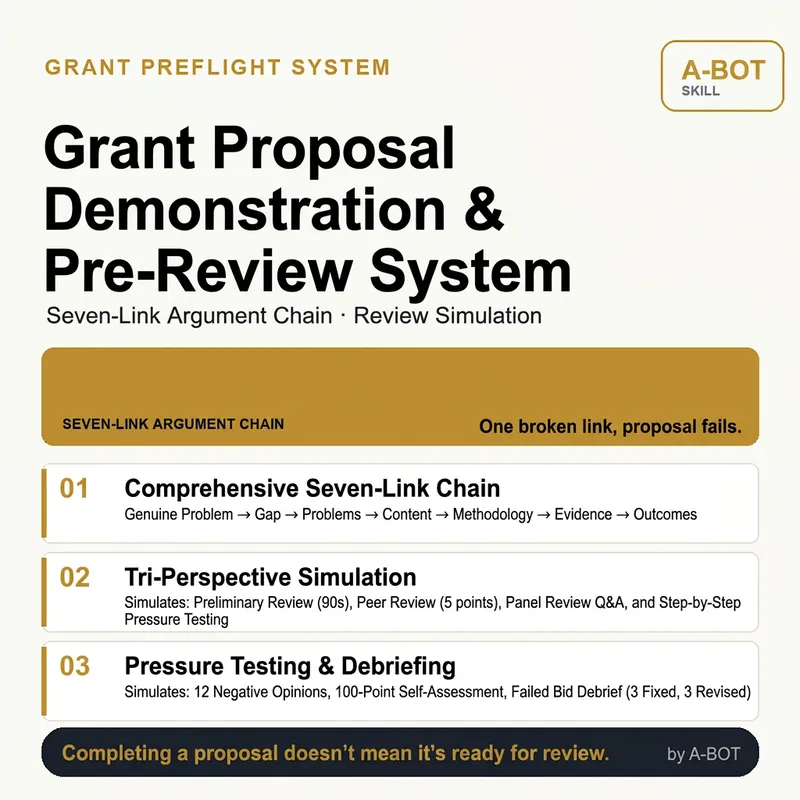
Does your proposal hold up under scrutiny? This skill compresses your National Social Science Fund or Ministry of Education humanities proposal into a one-page 7-ring logic chain, previews it from three review perspectives, and stress-tests it against 12 negative review opinions. With execution upgrades, it organizes your materials into a 7-ring argument table, a negative opinion comparison table, and a self-assessment form after authorization. It never ghostwrites text, fabricates facts, or guarantees approval. Key selling point: It doesn't just point out flaws—after authorization, it directly generates the 7-ring argument table, negative opinion comparison table, dual-track framework, and self-assessment form for you. Announcements for the current year apply; no preliminary results are fabricated. Best for: Applicants for National Social Science Fund or Ministry of Education humanities projects, early-career researchers looking to review rejected submissions, or anyone whose content resembles a textbook table of contents, whose innovations sound like slogans, whose main thread is broken, or who worries about identity disclosure in blind reviews. What to input: Discipline + category + batch (subject to the current year's announcement) + research direction + your actual completed work + draft (optional). What is delivered: 8 content items (identity card / rejection review / restriction checklist / three-perspective card / 7-ring one-pager / dual-track framework / 12 negative opinions / 100-point self-assessment / authoritative anchor check) + 5 finished items (authorization record / 7-ring argument table / negative opinion comparison + dual-track framework / self-assessment form / rejection review & acceptance sheet). If tools are unavailable, a copy-pasteable finished content package is provided with notes. ## Exclusive Methodology: The 7-Ring Logic Chain Most rejections aren't due to formatting, but fragile arguments. Before writing a single word of text, this method compresses your logic onto a single page: 1. 7-ring thread: True problem → literature gap → research question → content → methods → evidence → outcomes. Any broken ring is highlighted in red with a fix, and rings 3→4→5→7 must connect. 2. Three-perspective preview: 90-second initial review, five-item desk review, and panel review skepticism—each step highlights "who is being defended against," helping you understand why the check matters. 3. Stress testing and review: Check off 12 negative opinions one by one, take a 100-point self-assessment (submissions under 70 points are not recommended), and conduct a rejection review for secondary submissions adhering to "three unchanged, three must-change" principles to block skin-deep rejections. Remember this: Break one ring, and the proposal fails. ## Evidence-Based: Parameter Rules Follow Current Announcements Anchored strictly to authentic public guidelines: current year's NSSF application announcement / Ministry of Education humanities notification / institutional research office template (highest priority), historical approval libraries, and CNKI/Wanfang novelty checks (self-checked), plus standard publishing ethics (background only). Age limits, word counts, restrictions, columns, and deadlines that cannot be confirmed are marked as "pending verification"; numbers are never filled in from memory. Unrelated guidelines (PRISMA, ICMJE, etc.) are explicitly marked as not applicable. ## v1 Update: From Tables to Finished Files Older versions provided modifiable intermediates, but this version turns content into usable files: it first tests your current session's tool capabilities, tells you what will be generated and resource consumption, and only proceeds upon your confirmation. - One-page 7-ring argument table: 7 rows of arguments with broken rings highlighted in red and connectivity conclusions, ready for Excel. - Negative opinion preview comparison table: 12 rows checked one by one, hit location + one-sentence fix. - Dual-track framework + self-assessment form + rejection review table: Frameworks based on Type A blind review 8 sections / Type B form 5 columns, complete with self-assessment scores and secondary submission revision lists. No generation tool in the session? Delivered as a "ready-to-paste finished content package"—all five tables written in Markdown, ready to copy into Word or Excel. Never pretends to generate or fabricates file paths. ## Detail Page Text ### Proposal AIGC is a hard red line. How does this skill safeguard it? Its scope is narrow: it only organizes the authentic materials you provide into tables and frameworks. If you lack data, interviews, samples, preliminary results, literature, or approved entries, they remain "pending supplement / pending verification." The skill will not fabricate them just to make a table look good; the 7,000-word text is written by you. ### Five Steps 1. Identity card + rejection review (secondary submissions prioritize three unchanged, three must-change rules); 2. Track gate + restrictions + three perspectives (mutually exclusive blocking, age verification, current year parameters); 3. 7-ring one-pager (broken rings highlighted in red, connectivity must pass); 4. Dual-track framework (no ghostwriting of text); 5. Negative opinions + removing AI tone + formal review + 100-point self-assessment. + Authoritative anchoring layer + execution delivery layer (detect → authorize → generate finished file → accept/downgrade).
 Write
Course Distillation Studio
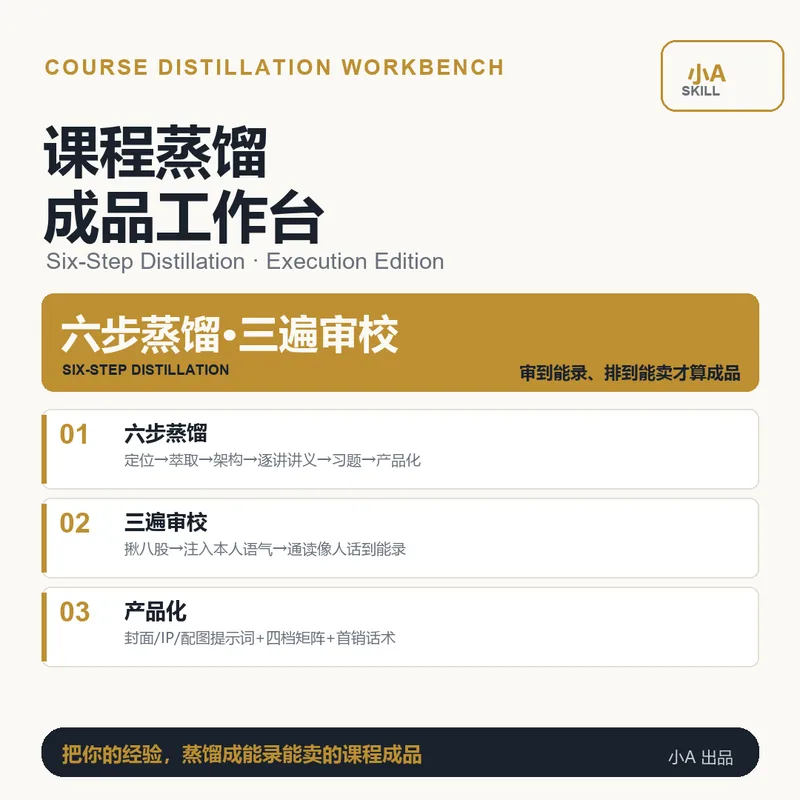
Distill your experience into a course you can record and sell. Using a six-step process with three review passes, this generates a complete outline, record-ready lecture scripts, visual assets, and launch sales copy directly from your personal expertise. **Core Value**: Beyond just a course skeleton—upon authorization, it delivers a positioning report, outline table, record-ready scripts with three review records, visual assets, a product matrix, and initial sales scripts, all derived from your own experience. **Best For**: Knowledge monetizers, trainers, and creators with professional expertise who want to build a course, as well as those who have an outline but find their teaching materials sound like AI and fail to sell. **Input Requirements**: Your genuine experience, articles, or materials, plus your desired topic. Leave placeholders marked as [To be filled] where real-world experience is missing. **Outputs Delivered**: 8 content pieces plus 5 finished products (13 items in total). Positioning report, outline, record-ready scripts, visual assets, product matrix, and initial sales scripts are produced individually as files. If tools are unavailable, a paste-ready content package is provided with an "Unproduced" label. ## 【Exclusive Methodology】Six-Step Distillation & Three Review Passes The six steps solve the outline, while the three review passes ensure the course is record-ready and sellable. Having a skeleton is not enough to make a finished product; this version embeds the final mile directly into the workflow. 1. **Six-Step Distillation**: Positioning (who it is for) -> Extraction (four questions for core insights) -> Architecture (3-5 modules x 2-4 lectures) -> Lecture handouts -> Takeaway exercises -> Productization. 2. **Three Passes to Remove AI Tone**: Eliminate cliché filler words -> Inject personal tone (at least 1 real experience per lecture; leave [Insert your case here] if missing) -> Read aloud naturally (phrase for reading, 600-900 words, include pause points). 3. **Productization**: Prompts for covers, instructor IP, and presentation illustrations provided all at once; a four-tier product matrix (lead-gen, trust, profit, premium) + 3 initial launch scripts (early-bird price, quota, deadline). Remember it in one sentence: **Building a skeleton is not enough; reviewing until it is record-ready and formatting until it sells makes a finished product.** ## 【Evidence-Based】Rules Follow Current Official Standards Anchored strictly in real, public standards: current skill package specifications of target platforms, copyright laws regarding copying and fair use, AI-generated content identification requirements, and restrictions on absolute terms and income promises in launch copywriting. Any unsure fields, clauses, or rules are strictly marked as "To be verified" without relying on memory. Rules unrelated to this scenario are explicitly marked as inapplicable. ## 【v1 New: From Intermediate Artifacts to Finished Files】 Older versions provided editable intermediate artifacts, but this version turns content into usable files. It first detects the tool capabilities of your current session, informs you what will be generated and what the consumption will be, and only proceeds after your confirmation. - **Record-Ready Lecture Scripts & Three Review Records**: Original draft -> changes made -> fully visible record-ready script process. Missing real experiences are left as placeholders without fabrication. - **Visual Asset Prompt Package**: Cover, instructor IP character, and lecture illustration prompts provided with stacking instructions only, without consuming image-generation credits. - **Product Matrix & Initial Sales Script Files**: Four-tier pricing matrix and 3 scripts including early-bird prices, quotas, and deadlines, ready to copy into your listing page. **No generation tools in the session?** A "Directly pasteable finished content package" is delivered in Markdown format so you can paste it straight into Word or spreadsheets. **Never pretends to generate and never fabricates file paths.** ## 【Details Page Body】 ### Boundaries It Maintains Its service scope is clear: **it only arranges your provided authentic materials into a course outline, record-ready lecture scripts, visual asset prompts, product matrix, and initial sales scripts**. Workflows, course content, cases, qualifications, data, and student reviews that you do not provide will be marked as [To be filled]; the Skill will not fabricate them just to make the table look good. It does not copy others' works, appropriately cites sources, and does not promise platform review or listing results. ### Core Workflow 1. Positioning + Four Extraction Questions -> Outline (Pyramid architecture); 2. Lecture handouts go through three review passes to remove the AI tone -> Record-ready scripts; 3. Takeaway exercise checklist + visual asset prompts + product matrix + initial sales scripts. + Authoritative anchoring layer + Execution delivery layer (detection -> authorization -> production output -> acceptance/downgrade).
Information
- Version
- v3
- Last updated
- Runtime credits
- Usage-based
- Models
- Auto
- Use cases
- Writing & contentResearch & analysisLearning & education
- What you get
- ArticleDiagramData
