Pre-Submission Flaw Check
Quickly check academic papers for fatal flaws before submission
Pre-Submission Flaw Check
Quickly check academic papers for fatal flaws before submission
Showcase
Description
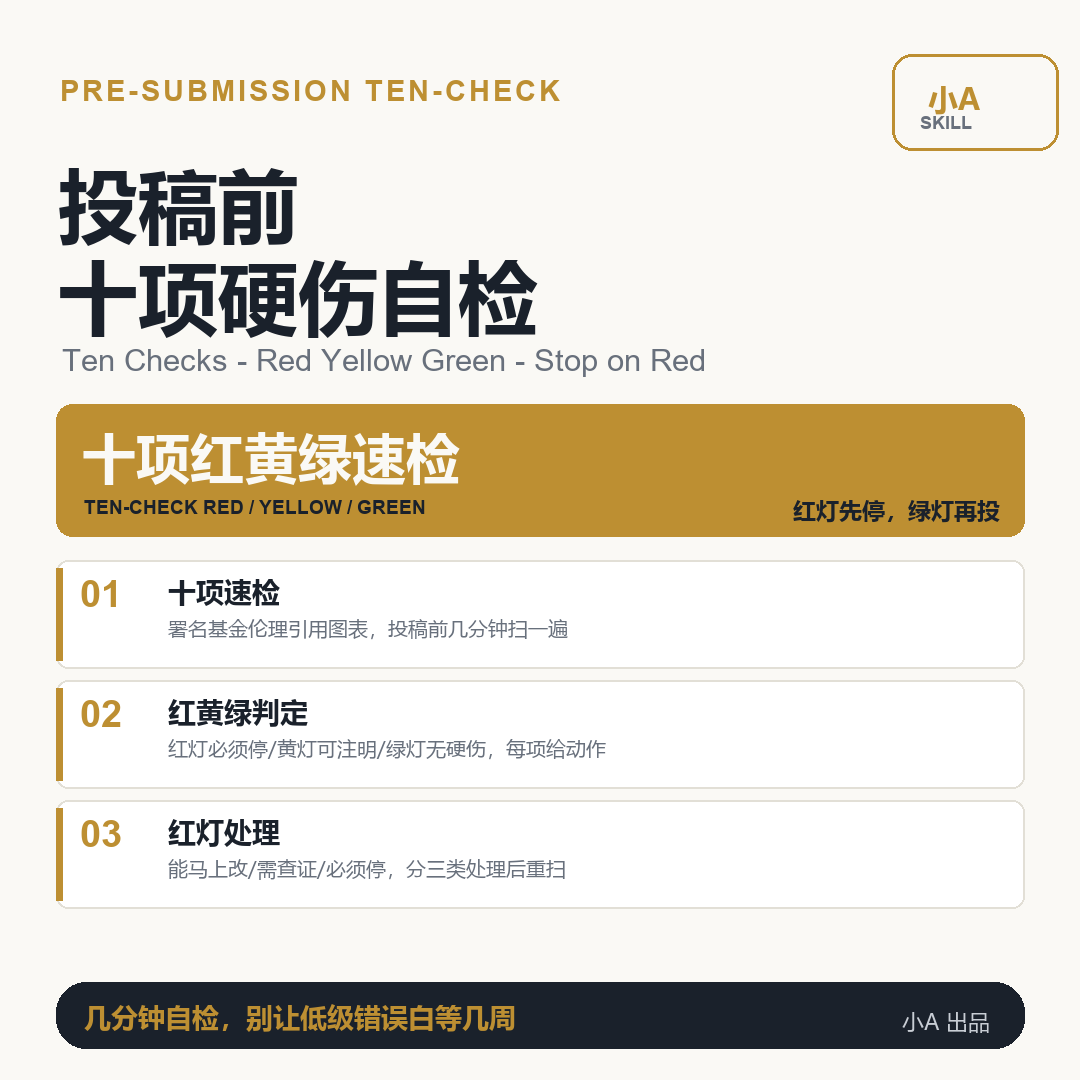
A few minutes before clicking submit, run this ten-point red-yellow-green checklist to scan for fatal rejection-level flaws: authorship, funding, duplicate submission, ethics, data, citations, figures, and length. Stop on a red light, proceed on a green light. Pure guidance only—no ghostwriting, no fabrication, and no acceptance guarantees. **One-Line Selling Point**: A quick pre-submission checklist to run through in minutes: stop on red, proceed on green, and catch amateur mistakes before wasting weeks waiting for a rejection. **Who It Is For**: Graduate students, early-career faculty, and researchers who have finished a draft and worry about missing authors, incorrect grant numbers, omitted ethics statements, or duplicate submissions. **What to Input**: The manuscript to submit + target journal author guidelines + author list + funding or ethics credentials (mark missing items as pending, do not fabricate). **What You Get**: A ten-point self-check list (red/yellow/green criteria + red-light actions) + deep authorship and ethics check + deep citation and data check + formatting and figure checklist + red-light handling quick reference + next-step guidance + 2 sample files. ## [Detail Page Content] ### Great Paper, Why Was It Desk-Rejected? Often it is not the research itself, but amateur pre-submission flaws: missing authors, wrong grant numbers, duplicate submissions, omitted ethics statements, unnumbered figures, or forgetting to remove author names from an anonymous draft. Editors spot these errors instantly, wasting weeks of your time and hurting your credibility. **This tool does only one thing: scans for fatal flaws a few minutes before submission.** ### How the Ten Points Are Checked Ordered from most to least severe: ① Author names and affiliations ② Funding acknowledgments ③ Duplicate submission and redundant publication ④ Ethics review and informed consent ⑤ Traceable data ⑥ Consistency between data and conclusions ⑦ Citation authenticity ⑧ Citation format and numbering ⑨ Figure and table standards ⑩ Length and submission format. Each point provides red (must stop) / yellow (known risk) / green (no fatal flaws) criteria and "what to do on a red light." ### Three Paired Deep Checks - **Authorship and Ethics**: Most severe consequences—missing an author is a retraction-level incident, and missing ethics leads to instant desk rejection. - **Citations and Data**: Most prone to stumbling—AI-generated fake references, mismatched data, and conclusions extending beyond the data. - **Red-Light Handling**: Divided into three categories: fix immediately / needs investigation / must stop. Re-scan after addressing. ### After Flaws Are Detected The checklist tells you what kind of advanced processing tool to use next (revisions, review rewriting, credential recognition, etc.), but **does not process it for you or promise results**. ### What It Does Not Do (Red Lines) - **No Ghostwriting**: Does not write body text, polish, or judge research value. - **No Fabrication**: Grant numbers, ethics approval letters, data, and citations—mark missing items as "pending verification." - **No Guarantees**: Does not guarantee acceptance, publication, or passing review. - **Official Guidelines Prevail**: Target journal and institutional requirements at the time of submission take precedence.
Recommended by
Dancang
Why we love this skill
Compresses ten categories of desk-rejection risks into a fast red-yellow-green checklist covering authorship, ethics, data, citations, and format.
Best for
Graduate students, early-career faculty, and researchers preparing to submit manuscripts who want to check for common rejection-level flaws.
How to use this Skill
Provide your input
Provide the manuscript, target journal author guidelines, author list, and funding or ethics credentials. Mark missing materials as pending.
Run the Skill
Checks authorship, funding, duplicate submission, ethics, data, citations, figures, and formatting against a 10-point list using red, yellow, and green flags.
Review your result
Receive a pre-submission self-check checklist with risk flags, red-light action steps, and items that need to be supplemented or verified further.
Related Skills
View all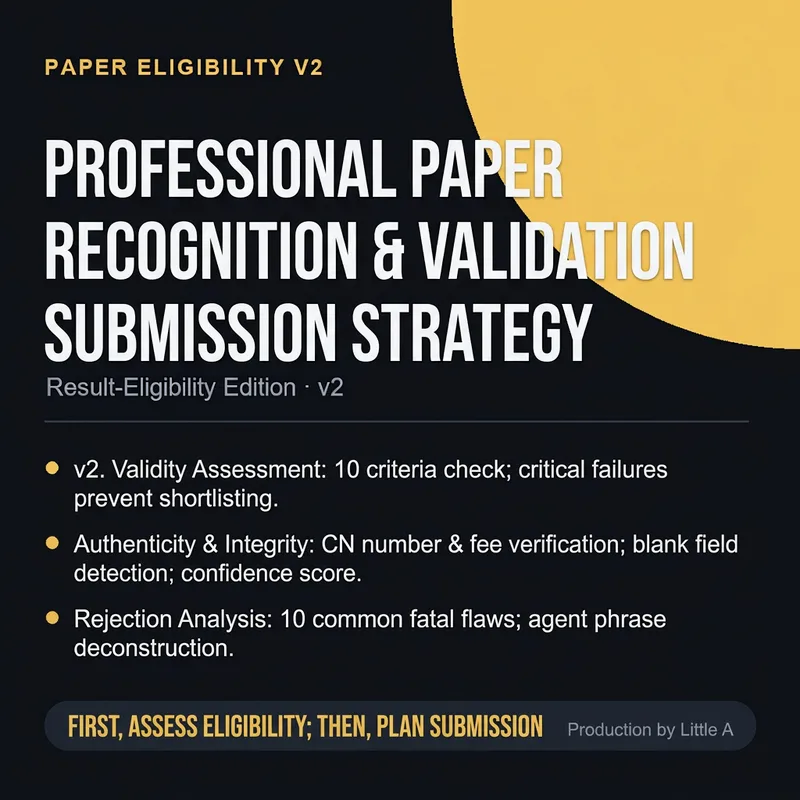
Professional Title Paper Evaluation and Submission Planner
v1 solved where to submit, common pitfalls, and scheduling. Real pain points usually surface beforehand: people spend thousands and wait months only to have materials rejected because the paper isn't recognized—wrong author order, mismatched affiliations, missing database indexing, supplements, duplicate submissions, or high AIGC/plagiarism scores. ## Quick Summary **Verify whether the paper qualifies before choosing a journal.** Many people waste a year not from picking the wrong journal, but due to author rank, affiliation mismatch, unindexed issues, supplements, duplicate use, etc. v2 prioritizes 10 validity checks and eliminates AI-generated journal numbers and fees. ## What Changed from v1 to v2 | Dimension | v1.0.0 | v2.0.0 | | --- | --- | --- | | Priority | Journal Selection: Red/Yellow/Green lists | **10 Validity Checks**: Red flags stop journal selection | | Journal Data | Recommended 5-10 journals with CN/fees/cycles | **Never generated**: Verification portals + blank fields + confidence ratings | | Insufficient Time | Margin warning only | 4 alternative path decision trees | | After Rejection | None | 10 hard-hit rejection reviews + agency phrasing breakdown | Retained: Institutional requirements, red/yellow/green ratings, comparison tables, countdown schedules, 4-step verification, audit trails, and agency red lines. ## What You Will Get 1. **10 Validity Check Items**: Author rank, affiliation, relevance, time window, indexing, regular issues, plagiarism/AIGC, reuse, word count, negative list. 2. **Rank Check Items**: What intermediate, associate, and senior titles need to confirm with their institution. 3. **Hard Criteria Checklist**: Translates institutional terms into 6 actionable constraints. 4. **Candidate Journal Verification Sheet**: Official verification portals with blank fields to prevent fabrication. 5. **Decision & Countdown Tables**: Reverse-calculates deadlines, separating publication and indexing. 6. **Rejection Review & Agency Phrasing**: Evaluates claims like fast indexing or guaranteed approval with ready-to-use replies. 7. **4-Step Verification & Audit Trail**: Official filing, directory checks, issue comparison, and report packaging. ## Who This Is For - Teachers in primary/secondary schools or universities, and engineering, healthcare, agricultural, or research professionals. - **Those with a paper who are unsure if it qualifies.** - Anyone confused by agency recommendations or timeframes. - **Those whose materials were rejected last year.** - Previous v1 users: updated via this skill, replacing outdated journal lists. ## Why No Recommended Journal List Journal data constantly changes, and AI-generated numbers and fees are risky. v2 provides verification portals and rules so you can check official sites and editor offices—taking 5 minutes to prevent rejection. > Pure guidance format · No ghostwriting · Output editable intermediate assets.
 Write
Peer Review Response & Revision
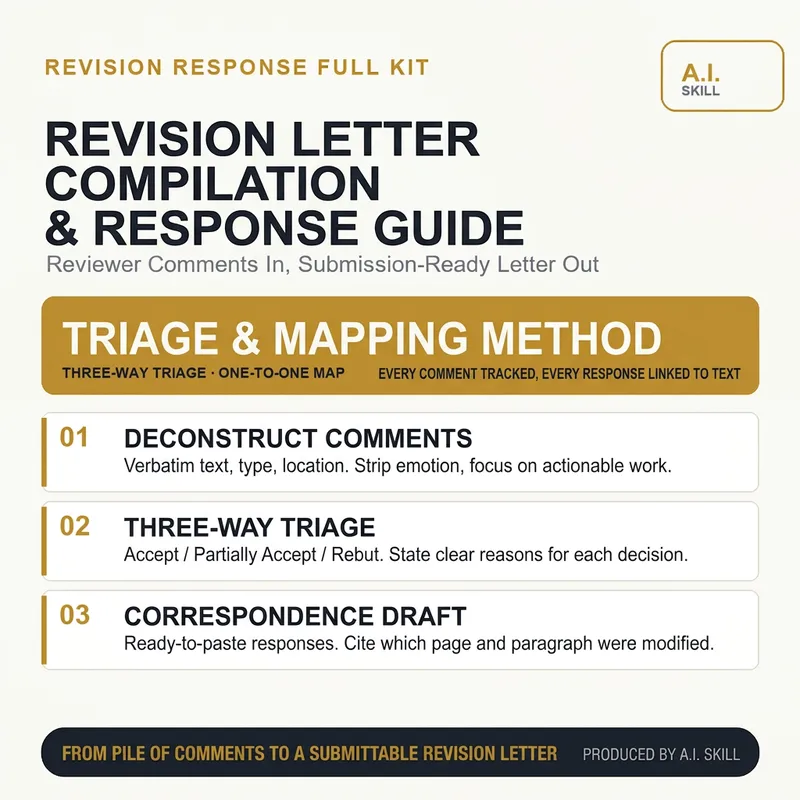
Struggling to organize dozens of reviewer comments into a cohesive response letter? The three-way triage and one-to-one matching method helps you break down, categorize, draft, and align every comment. With authorization, it generates ready-to-use response letters, item-by-item comparison tables, and revision checklists based strictly on your actual changes without fabricating data or reviewers. Key selling point: Goes beyond templates by delivering complete response letters, comparison tables, and checklists directly to you, backed by verifiable public guidelines and zero fabricated data. Best for: Graduate students and early-career researchers receiving major or minor revisions, resubmissions after rejection, or delayed responses; anyone struggling to organize multiple comments or respond without causing friction. Input: Original reviewer comments word for word, your planned changes (accept/partial/rebuttal), actual modification locations, and target journal requirements. Deliverables: 8 content items (comment breakdown, three-way triage, line-by-line responses, response-to-text comparison, revision checklist, response letter, follow-up letter plus log, compliance check) and 5 final items (authorization record, response letter file, response comparison table, revision checklist plus follow-up, sign-off sheet). When tools are unavailable, a ready-to-paste content package is provided instead. Methodology: Three-Way Triage & One-to-One Matching 1. Breakdown fields - Number each comment, keep verbatim text, type, location, and feasibility before writing. Isolate emotional remarks and focus solely on required actions. 2. Three-way triage - Accept, partially accept, or rebut, with clear justification for each. Rebuttals follow a framework of acknowledging valid points, presenting evidence, and explaining retention. 3. One-to-one matching - Generate paste-ready responses and create a comparison table with three valid status values, ensuring all promised changes appear in the text. Grounded in public guidelines: Based on journal author guidelines, COPE, ICMJE, APA 7, GB/T 7714-2015, and PRISMA 2020 where applicable. Every boundary is clearly marked, and authoritative sources are never fabricated.
 Write
NSSF Proposal Review & Audit
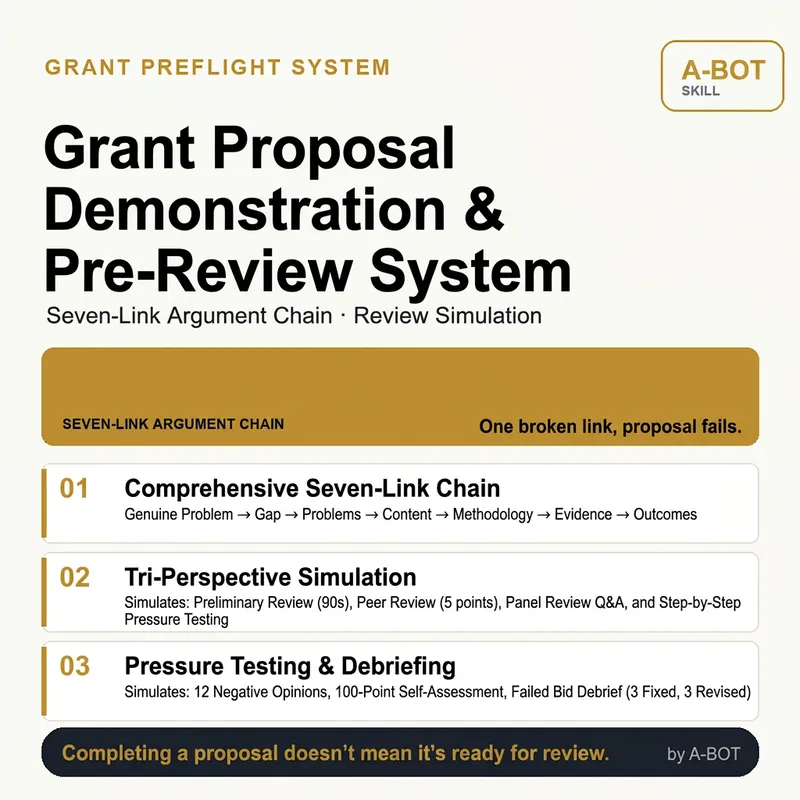
Does your proposal hold up under scrutiny? This skill compresses your National Social Science Fund or Ministry of Education humanities proposal into a one-page 7-ring logic chain, previews it from three review perspectives, and stress-tests it against 12 negative review opinions. With execution upgrades, it organizes your materials into a 7-ring argument table, a negative opinion comparison table, and a self-assessment form after authorization. It never ghostwrites text, fabricates facts, or guarantees approval. Key selling point: It doesn't just point out flaws—after authorization, it directly generates the 7-ring argument table, negative opinion comparison table, dual-track framework, and self-assessment form for you. Announcements for the current year apply; no preliminary results are fabricated. Best for: Applicants for National Social Science Fund or Ministry of Education humanities projects, early-career researchers looking to review rejected submissions, or anyone whose content resembles a textbook table of contents, whose innovations sound like slogans, whose main thread is broken, or who worries about identity disclosure in blind reviews. What to input: Discipline + category + batch (subject to the current year's announcement) + research direction + your actual completed work + draft (optional). What is delivered: 8 content items (identity card / rejection review / restriction checklist / three-perspective card / 7-ring one-pager / dual-track framework / 12 negative opinions / 100-point self-assessment / authoritative anchor check) + 5 finished items (authorization record / 7-ring argument table / negative opinion comparison + dual-track framework / self-assessment form / rejection review & acceptance sheet). If tools are unavailable, a copy-pasteable finished content package is provided with notes. ## Exclusive Methodology: The 7-Ring Logic Chain Most rejections aren't due to formatting, but fragile arguments. Before writing a single word of text, this method compresses your logic onto a single page: 1. 7-ring thread: True problem → literature gap → research question → content → methods → evidence → outcomes. Any broken ring is highlighted in red with a fix, and rings 3→4→5→7 must connect. 2. Three-perspective preview: 90-second initial review, five-item desk review, and panel review skepticism—each step highlights "who is being defended against," helping you understand why the check matters. 3. Stress testing and review: Check off 12 negative opinions one by one, take a 100-point self-assessment (submissions under 70 points are not recommended), and conduct a rejection review for secondary submissions adhering to "three unchanged, three must-change" principles to block skin-deep rejections. Remember this: Break one ring, and the proposal fails. ## Evidence-Based: Parameter Rules Follow Current Announcements Anchored strictly to authentic public guidelines: current year's NSSF application announcement / Ministry of Education humanities notification / institutional research office template (highest priority), historical approval libraries, and CNKI/Wanfang novelty checks (self-checked), plus standard publishing ethics (background only). Age limits, word counts, restrictions, columns, and deadlines that cannot be confirmed are marked as "pending verification"; numbers are never filled in from memory. Unrelated guidelines (PRISMA, ICMJE, etc.) are explicitly marked as not applicable. ## v1 Update: From Tables to Finished Files Older versions provided modifiable intermediates, but this version turns content into usable files: it first tests your current session's tool capabilities, tells you what will be generated and resource consumption, and only proceeds upon your confirmation. - One-page 7-ring argument table: 7 rows of arguments with broken rings highlighted in red and connectivity conclusions, ready for Excel. - Negative opinion preview comparison table: 12 rows checked one by one, hit location + one-sentence fix. - Dual-track framework + self-assessment form + rejection review table: Frameworks based on Type A blind review 8 sections / Type B form 5 columns, complete with self-assessment scores and secondary submission revision lists. No generation tool in the session? Delivered as a "ready-to-paste finished content package"—all five tables written in Markdown, ready to copy into Word or Excel. Never pretends to generate or fabricates file paths. ## Detail Page Text ### Proposal AIGC is a hard red line. How does this skill safeguard it? Its scope is narrow: it only organizes the authentic materials you provide into tables and frameworks. If you lack data, interviews, samples, preliminary results, literature, or approved entries, they remain "pending supplement / pending verification." The skill will not fabricate them just to make a table look good; the 7,000-word text is written by you. ### Five Steps 1. Identity card + rejection review (secondary submissions prioritize three unchanged, three must-change rules); 2. Track gate + restrictions + three perspectives (mutually exclusive blocking, age verification, current year parameters); 3. 7-ring one-pager (broken rings highlighted in red, connectivity must pass); 4. Dual-track framework (no ghostwriting of text); 5. Negative opinions + removing AI tone + formal review + 100-point self-assessment. + Authoritative anchoring layer + execution delivery layer (detect → authorize → generate finished file → accept/downgrade).
Information
- Version
- v3
- Last updated
- Runtime credits
- Usage-based
- Models
- Auto
- Use cases
- Research & analysis
- What you get
- Document
