
Academic Research Question
Focus multiple ideas into one submission-ready research question
Academic Research Question
Focus multiple ideas into one submission-ready research question
Showcase
Description
• Diagnose candidate topics: Identify overly broad topics, unclear subjects, uncontrolled boundaries, and false novelty before determining whether the topic is ready to be finalized. • Narrow the research scope: Remove nonessential subjects, variables, and objectives to reduce “trying to study everything” to one central question. • Derive the core question: Identify a single research direction based on subject clarity, question sharpness, scope control, and fit with available materials. • Generate a standardized title: Produce one Chinese title aligned with the research question, with an English title and a specific contribution statement when needed. After opening, say: “I have 3 candidate topics and want to submit to a CSSCI journal. Help me finalize the topic.” It will first check the research subject, core question, scope, and practical constraints, then provide a well-supported final research question. If information is insufficient, it will ask follow-up questions instead of forcing a polished title. Suitable for: Researchers with candidate topics who are struggling to choose one / scholars who need to focus quickly before submission / anyone who does not want to be rejected by a reviewer’s one-line criticism that the research question is unclear. ✅ This version has undergone two months of refinement, testing, and iteration.
Why we love this skill
It goes beyond polishing titles by diagnosing each candidate topic and narrowing it to one defensible research question through structured reasoning and reverse checks.
Related Skills
View all
Quantitative Topic Selection
Turn a vague research interest into a testable, feasible quantitative paper topic tailored to your target journal. Whether you plan to submit to a CSSCI or SSCI journal, or are comparing cross-sectional and longitudinal research, this Skill helps clarify your research direction, population, and scope while building a clear variable framework around independent, dependent, mediating, and moderating variables. As your topic takes shape, you can develop research questions, a theoretical framework, formal research hypotheses, measurement instruments, sampling and data collection plans, and statistical analysis approaches aligned with your hypotheses. If you already have a policy project or research keywords, you can use them to identify directions with academic publication potential. If you have not yet settled on a specific angle, you can generate and compare multiple candidate topics. The final output focuses on topic feasibility and publication potential: whether the data can be obtained, whether the variables can be operationalized, whether the theory, hypotheses, and methods form a coherent chain, whether the target journal is a good fit, and where the topic can occupy a distinct niche relative to existing research. You will receive a complete topic finalization plan covering the research direction, variable relationships, theoretical hypotheses, cross-sectional or longitudinal design, data and analysis plan, risk considerations, and feasibility recommendations—ready to share with your advisor or use as the basis for a literature review.

STEM PhD Topic Diagnostician
Already have a PhD dissertation topic but unsure whether it is rigorous, innovative, and feasible? This Skill is designed to diagnose existing topics—not randomly generate topics from scratch or merely polish the wording. It breaks down the research subject, core variables, mechanisms, outcome measures, and research boundaries in your topic. Based on the Chinese and English literature, experimental foundation, samples, methods, equipment, timeline, and budget you provide, it assesses the topic’s rigor, novelty, and feasibility, while identifying risks such as “innovation” based only on changing materials, confounded variables, insufficient evidence for the proposed mechanism, an uncontrolled sample matrix, and chapters that cannot build progressively. The final output is a STEM PhD Topic Health Check Report, which clearly recommends whether to: retain the topic with minor adjustments; retain the research subject while strengthening its dimensions; retain the research problem and reconstruct the subject; or stop patching and redesign the topic. It is intended for STEM PhD students in food science, chemistry, materials science, biology, basic medical sciences, environmental science, agriculture, energy, and engineering. It is especially useful for those preparing a proposal defense, revising a topic at an advisor’s request, who have already defended their proposal but lack a clear central thread, or who have existing experiments but are unsure whether they can support an entire PhD dissertation.
 Research
Literature Review Topic Scoping
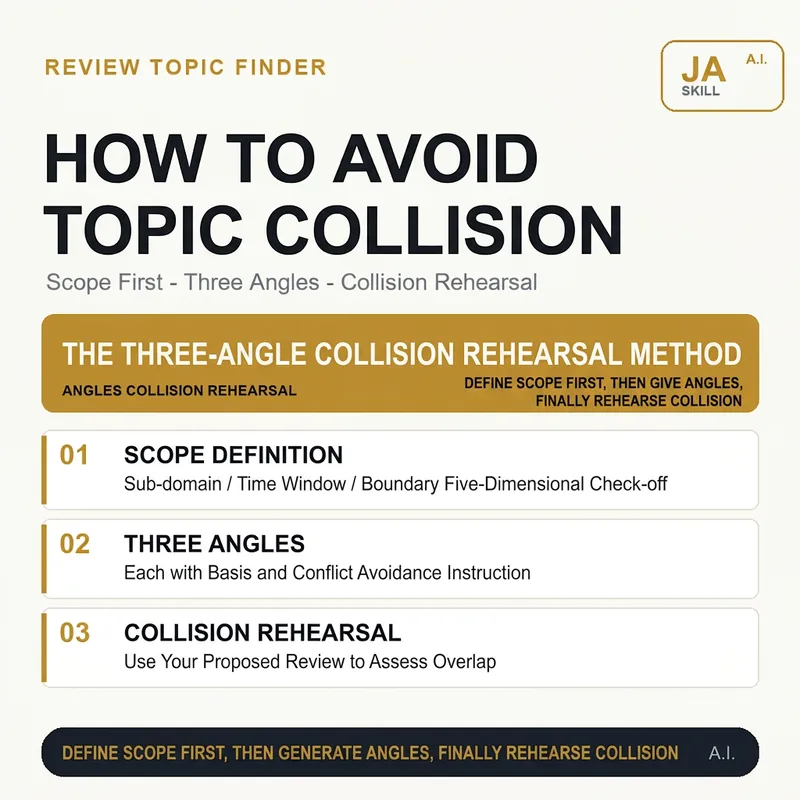
Literature Review Topic Scoping: Define the scope first, then provide three angles, and pre-check for overlap using your provided literature. No fabricated literature or third-party retrieval, tables generated upon authorization. **Core Selling Point**: While competing tools simply recommend a single title and stop there, this version first defines the scope, offers three angles with distinct avoidance notes, and pre-checks for overlap using your provided literature—delivering cards and tables directly to you after authorization. **Best For**: Graduate students writing coursework papers or thesis reviews, early-career researchers whose topics frequently overlap with existing work, and writers unsure of which angle to choose. **What to Input**: Your subfield and recent literature (titles/years) + core questions you care about + target journal scope or course requirements (optional). **What is Delivered**: 8 content pieces + 4 final products (12 pieces in total). All three angles come with evidence and overlap avoidance notes. Overlap checking uses only the literature you provide, without automated retrieval or fabricated sources. When tools are unavailable, pasteable finished content packages marked as "unproduced" are used as a fallback. ## [Exclusive Methodology] Triangular Entry & Overlap Pre-check Method Literature review topic selection is not about letting someone else give you a title, but about clearly defining the scope, giving yourself a few selectable angles, and checking for potential overlap in advance. 1. **Define Scope**: Five-dimensional selection covering subfield, time window, core questions, exclusion boundaries, and target scenario. Narrow down if too broad; 2. **Triangular Entry**: Provide three viable angles, each marked with evidence, avoidance notes, and writability for you to decide; 3. **Overlap Pre-check**: Compare scope and angles line-by-line using similar reviews you provided to judge the degree of overlap. Switch angles or narrow scope if overlap is high. Remember it in one sentence: **Define scope first, generate three angles second, and pre-check for overlap last; mark insufficient literature as pending verification without fabricating lists.** ## [How It Outperforms Competitors] Competing review topic tools focus on "one-click topic recommendation," giving a single title and ending there without mentioning scope or whether the topic has already been thoroughly covered. This version builds upon the core writing logic with three additional features: 1. **Three Selectable Angle Cards (each with evidence and avoidance notes)**: Instead of a single answer, you get three candidates, each explaining its basis and how it differs from existing reviews for you to decide; 2. **Overlap Pre-check Table**: Line-by-line comparison of user-provided similar reviews against scope and angles to pre-check overlap and prevent discovering duplication after finalizing the topic; 3. **Two-Step Gate**: The first step confirms the domain scope and core questions before generating angle cards, preventing recommendations before the scope is clear. - **Three Angles for You to Choose**: Each angle includes evidence and avoidance notes rather than forcing a single title upon you; - **Pre-check Overlap**: Compare against similar reviews you provided first, switching angles if overlap is high; - **Two-Step Delivery**: Define scope before generating angles, so you don't pick topics within a vague boundary. ## [Well-Founded] Rules Based on Current Official Standards Anchored strictly on real public standards: user-provided literature, target journal current scope or course requirements, database current interfaces, current citation formats, copyright law reproduction and fair use guidelines, AI-generated content identification requirements, and restrictions on absolute terms and earnings promises in marketing copy. **Uncertain terms or fields are strictly marked as "pending verification" and never filled in from memory.** Irrelevant standards are explicitly marked as not applicable without rigid application.
Information
- Version
- v10
- Last updated
- Runtime credits
- Usage-based
- Models
- Auto
