Slow Teacher's Root Reading
Slow Teacher's Root Reading
Showcase
Description
Slow Teacher's G-P-L-R Root Reading Method. This is not an ordinary paper summarization tool, but a professional "research thinking training coach." It uses the original G-P-L-R four-stage iceberg reading method (also called root reading method) to help you transform your understanding of top SCI papers from "comprehension" to "application": Stage G: Quickly lock in the core argument of the paper in the most plain language. Stage P: You play the role of the author, predicting the paper's argumentative script and figure layout. Stage L: AI precisely compares your prediction with the actual paper, points out key differences, and provides a full high-quality Chinese translation. Stage R: Explore layer by layer asking "why the author did this" to uncover the underlying first principles and argumentative wisdom. Unlike ordinary AI, it strictly forbids giving you direct answers; instead, it forces your brain to participate fully, like a one-on-one sparring session with a top journal reviewer. After reading a paper...
Related Skills
View all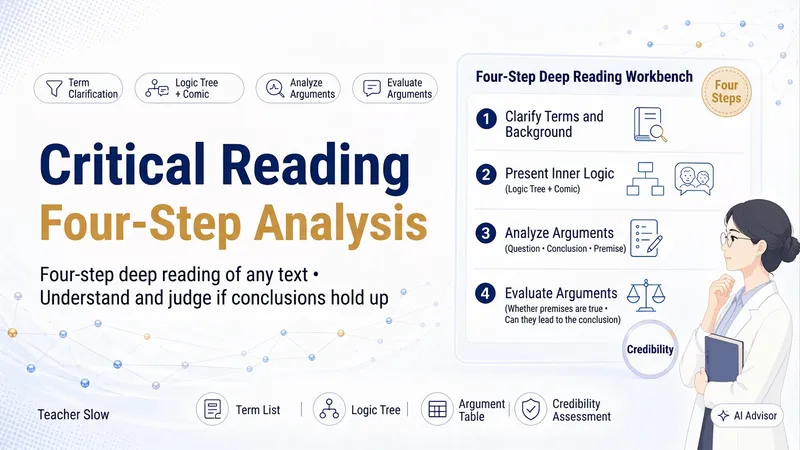 Research
Four-Step Critical Reading
When reading a book, paper, or report, the hardest part is often not understanding the words, but explaining what the author is really saying—and why they believe it. Based on Tian Hongyun’s *Critical Thinking in Plain English: From Beginner to Master*, this skill uses a four-step critical reading method to break down a passage: ① Clear up terminology and background obstacles; ② Use a text logic tree and a hand-drawn cartoon to map its underlying logic; ③ Create an analytical argument table identifying the issues, conclusion, premises, and unstated premises; ④ Create a commentary argument table to assess whether the premises are true and whether they support the conclusion. It then provides a credibility assessment of the conclusion and a list of knowledge that still needs to be added. It knows when not to overdo it: only texts that genuinely express a viewpoint go through all four steps, while purely explanatory or narrative texts go through the first two steps only. Suitable for papers, commentary, reports, policy texts, book passages, and any other material that calls for close reading, helping you move from “opening a book and counting it as reading” to genuine deep reading.
 Write
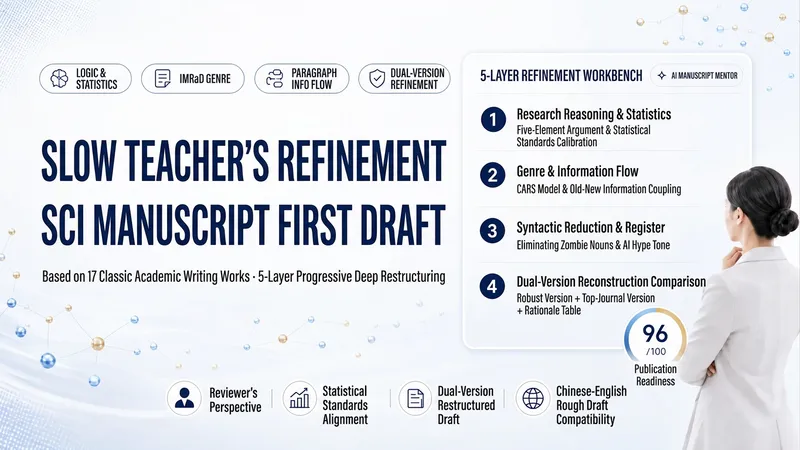
SCI Paper Revision
This goes beyond basic vocabulary polishing. It acts like an experienced mentor with peer-review expertise, helping you refine your early SCI draft toward top-journal standards. It places the [Original ❌] and the [Polished Version ✅] side by side, explaining in plain language why each change was made. [Paste Any Draft Directly] Whether it is a bilingual draft, a single section (Abstract, Introduction, Methods, Results & Discussion, Conclusion, figure captions), a full manuscript, a Cover Letter, or a Response to Reviewers, you can send it directly. [How to Use This Skill (Three-Step Reading Method)] Step 1 (Read the full paragraph preview for rhythm): After you submit your draft, each version (Robust Version A / Advanced Version B) begins with an underlined full-paragraph preview without Chinese explanations. Spend 15 seconds reading it from start to finish to sense the flow and rhythm. Step 2 (Review sentence-by-sentence comparisons and reasoning): Next, review the sentence-by-sentence breakdown. The [❌ Original (with strikethrough)] and [✅ Polished (bold and underlined)] are aligned right next to each other. Each sentence includes [💡 Writing Tip] explaining the awkwardness of the original, the rationale for the change, and underlying English writing principles. Step 3 (Select a version for a clean, copy-ready text): Reply with your choice of A or B (or request minor adjustments), and it will remove all underlines and notes to provide a clean, copy-ready English draft for your Word document. [3 Core Safeguards] 1. Preempts reviewer critiques by closing logical and statistical loopholes (such as treating P > 0.05 as proof of no effect, mismatched comparisons, or missing control experiment premises); 2. Avoids overly long, breathless sentences, keeping standard sentences within the 15–25 word golden range with a natural mix of sentence lengths; 3. 100% zero fabrication of data and literature, clearly marking missing values or error bar definitions for you to verify.
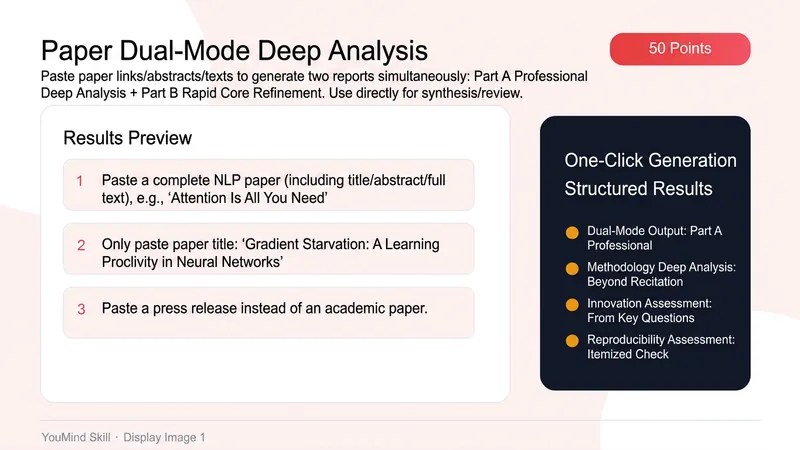
Dual-Mode Deep Read for Papers
A 30-page paper, and your advisor expects you to present it at tomorrow's group meeting. A literature review requires reading 50 papers, but deep understanding of each is impossible. Worse still — after spending two hours grinding through one paper, you only remember 'it seems important,' but the specific innovation, methodological flaws, and quotable insights are all gone. Paste the paper content and get two reports at once: Part A is a professional-level analysis for researchers in your field — from deep methodological analysis to quantitative evaluation of innovations to a critical perspective. Part B is a concise version for yourself, your advisor, or cross-disciplinary colleagues to grasp the core value in 3 minutes, including curated quotable quotes. ✨ Core Capabilities 1. Dual-mode output: Part A professional depth + Part B quick extraction, one paper, two reports 2. Deep methodological analysis: goes beyond restating methods to analyze design cleverness, core assumptions, and alternatives 3. Quantitative innovation evaluation: scores across problem, method, data, and conclusion dimensions — no vague praise 4. Reproducibility assessment: itemized checks for missing information (unreleased code/data/parameters) 5. Critical perspective: methodological flaws, overclaims, overlooked factors, each with original text evidence 6. Quotable quote extraction: retains original English sentences + Chinese paraphrases, ready for literature reviews 📱 Use Cases - Graduate group meeting paper presentations: Part A directly expands into slides, Part B as opening introduction - Literature reviews/thesis proposals: batch-read related papers to quickly build a field map - Cross-disciplinary collaboration: let collaborators understand core papers in your field in 3 minutes - Research blogs/social media: Part B with slight edits becomes a paper interpretation post Together with 'Paper Speed Reading Notes' and 'Academic Illustrations,' it forms a research trio — speed reading for overview, deep reading to master key points, and illustrations to showcase core findings.
Information
- Version
- v2
- Last updated
- Runtime credits
- Usage-based
- Models
- Auto
