
Dual-Mode Deep Read for Papers
Paste paper for dual reports: deep & quick.
Dual-Mode Deep Read for Papers
Paste paper for dual reports: deep & quick.
Showcase
Description
A 30-page paper, and your advisor expects you to present it at tomorrow's group meeting. A literature review requires reading 50 papers, but deep understanding of each is impossible. Worse still — after spending two hours grinding through one paper, you only remember 'it seems important,' but the specific innovation, methodological flaws, and quotable insights are all gone. Paste the paper content and get two reports at once: Part A is a professional-level analysis for researchers in your field — from deep methodological analysis to quantitative evaluation of innovations to a critical perspective. Part B is a concise version for yourself, your advisor, or cross-disciplinary colleagues to grasp the core value in 3 minutes, including curated quotable quotes. ✨ Core Capabilities 1. Dual-mode output: Part A professional depth + Part B quick extraction, one paper, two reports 2. Deep methodological analysis: goes beyond restating methods to analyze design cleverness, core assumptions, and alternatives 3. Quantitative innovation evaluation: scores across problem, method, data, and conclusion dimensions — no vague praise 4. Reproducibility assessment: itemized checks for missing information (unreleased code/data/parameters) 5. Critical perspective: methodological flaws, overclaims, overlooked factors, each with original text evidence 6. Quotable quote extraction: retains original English sentences + Chinese paraphrases, ready for literature reviews 📱 Use Cases - Graduate group meeting paper presentations: Part A directly expands into slides, Part B as opening introduction - Literature reviews/thesis proposals: batch-read related papers to quickly build a field map - Cross-disciplinary collaboration: let collaborators understand core papers in your field in 3 minutes - Research blogs/social media: Part B with slight edits becomes a paper interpretation post Together with 'Paper Speed Reading Notes' and 'Academic Illustrations,' it forms a research trio — speed reading for overview, deep reading to master key points, and illustrations to showcase core findings.
Related Skills
View all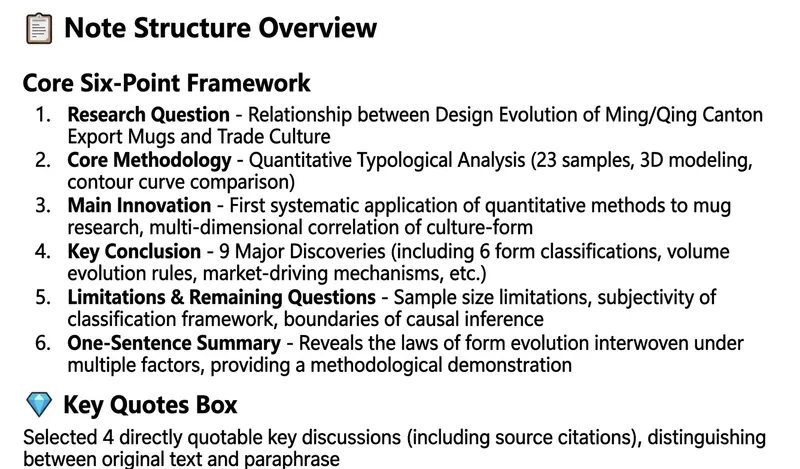
Paper Quick Note Generator
A 30-page paper due for tomorrow's group meeting; 40 papers to review for literature survey, each read from scratch, only to forget key points and lose that quotable line. Half of research time is spent on 'reading.' Paste an arXiv link or paper text and instantly receive a structured speed-reading note ready for use. ✨ Core Capabilities 1. Six-part speed-reading framework: Research Question / Core Method / Main Innovation / Key Conclusion / Limitations & Doubts / One-Sentence Summary 2. Automatically extracts 'quotable quotes' with location markers; copy directly for literature reviews. 3. Contribution breakdown: What's new compared to existing work, explained in plain language. 4. Critical perspective: Methodological flaws, overclaims, reproducibility risks pointed out point by point. 5. Optional outputs: Group meeting presentation outline / literature card / draft review paragraph / multi-paper comparison table. 6. Chinese-English terminology glossary, not machine-translated. 📱 Use Cases Graduate student thesis proposals and literature reviews, group meeting paper sharing, researchers tracking frontiers, tech professionals diving into technical papers; output can be posted on Zhihu or WeChat public accounts as academic content to attract readers. Make papers thinner—so you spend more time thinking than slogging through text.
 Research
One-Page Research Paper
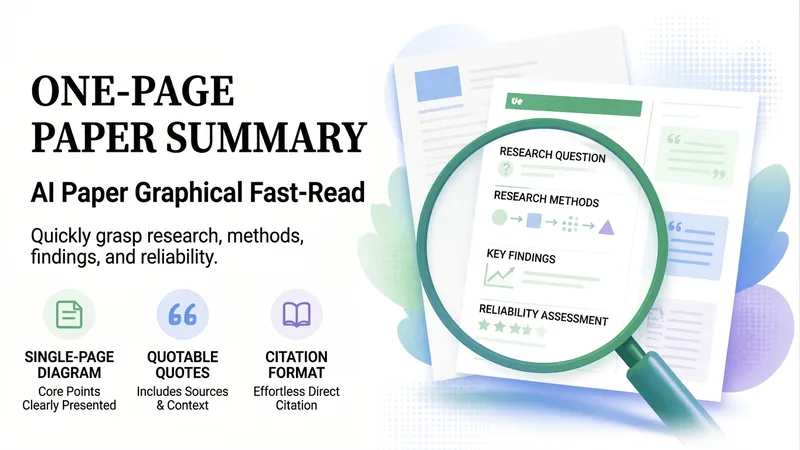
# One-Page Research Paper Upload a paper PDF or link to quickly understand what it studied, how it was done, what it found, and how reliable it is. All figures and citations are annotated with sources, and a one-page diagram is generated at the end. ## What You Get - **Quick Read**: One-sentence conclusion, research questions, methods, main findings, and author-stated limitations, each with a source - **Credibility Check**: First identifies the paper type (quantitative, qualitative, review, theoretical, technical), then checks with corresponding criteria: are samples sufficient, is correlation confused with causation, is comparison fair, can it be replicated - **Inconsistency Check**: Contradictory numbers between sections are pointed out, such as differences between the abstract and main text - **Quotable Sentences**: Verbatim excerpts with sources, indicating whether they fit the introduction, methods, or discussion - **Glossary and References**: Both GB/T 7714 and APA formats, missing fields are marked without fabrication - **Tailored Additions**: For writing literature reviews, finding methods, or preparing lab meeting reports (includes a 5-slide PPT outline and a 2-minute speech script) - **One-Page Diagram**: Research question → method → findings → limitations, all explained in a single chart ## Who It Is For Undergraduates, graduate students, researchers, and anyone who needs to quickly determine whether a paper is worth reading and citing. Supports both Chinese and English papers. ## Tips - Uploading a PDF works best; when providing a link, the PDF version is prioritized - State your purpose to make the content more targeted, such as "preparing a lab meeting presentation" or "writing a literature review" - All content comes strictly from the paper itself, and missing parts are stated honestly - Each run consumes about 100–200 credits (including 1 diagram generated)
Literature Review Assistant
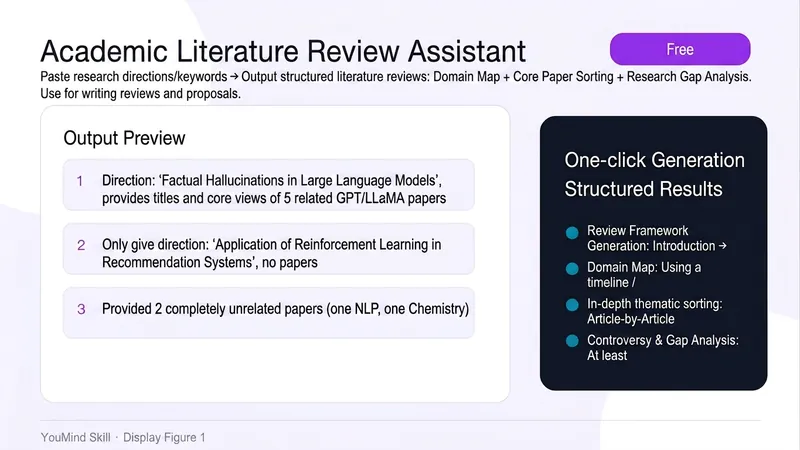
Writing a literature review is an inevitable challenge for graduate students—but turning information from 50 papers into a logically structured review, rather than a mere summary list, relies on methodology, not brute force. Tell it your research direction and the core papers you've already read. It first builds a framework—field map, thematic sorting, debates and gaps—then, after your confirmation, helps organize the language chapter by chapter. It doesn't write the paper for you, but helps you present the papers you've read with academic logic. ✨ Core Capabilities 1. Review framework generation: Introduction → Field map → Thematic sections → Debates and gaps → Outlook, standard academic structure 2. Field map: Sort domain development by timeline/school of thought, highlight milestone papers 3. In-depth thematic analysis: Individual paper introduction + intra-group comparison + overall contributions and limitations 4. Debate and gap analysis: At least 3 points of debate + 3 research gaps, with specific literature sources 5. Academic writing norms: Citation format, bilingual terminology, critical language rather than mere description 📱 Use Cases - Literature review chapter for graduate thesis/proposal writing - Related Work section of journal papers - Quick literature overview + structured notes when entering a new field - Used in combination with "论文速读笔记" and "论文双模研读" to form a "Read → Analyze → Synthesize" literature workflow ⚠️ Note: This skill does not perform real-time academic search. You need to provide information on papers you have already read (title/author/key points), and it helps you organize and write.
Information
- Version
- v3
- Last updated
- Runtime credits
- Usage-based
- Models
- Auto
