
Research Value Red Team
Research Value Red Team
Showcase
Description
An expert skill for the research value section of National Social Science Fund and Ministry of Education Humanities and Social Sciences applications—the Topic Collision Radar edition. Built on Lecture 8, Lecture 64, a case library of five winning proposal templates, and a knowledge base of 535 funded-project lists, it provides: topic-collision radar searches across three comparison levels (National Social Science Fund → Ministry of Education → provincial philosophy and social sciences), with project status labels → six-dimensional difference analysis and collision warnings → T1–T5 academic value formulas and A1–A4 applied value formulas → format-adaptive output ("Academic Value + Applied Value" for the National Social Science Fund application’s free-form section / "Theoretical Value + Practical Application Value" for Ministry of Education Form B, limited to 2,000 Chinese characters). Includes a four-sentence template for "new progress compared with similar projects already funded." Confirm each step with a button to proceed. The term "空白" is prohibited in the output and is always replaced with specific wording such as "blind spots," "gaps," "weak areas," or "research limitations."
Related Skills
View all
Doomsday Research Content Gen
Expert skill for National Social Science Fund (NSSF) or Ministry of Education (MOE) humanities and social science project applications. Based on the methodology from the 4th lecture on 'Research Content' (five pillars, problem tree and problem chain, six techniques, and intuitive clarity), it generates research objects, research objectives (two versions: lecture style and expert standard style), overall framework, key points and difficulties, research plan, and feasibility through multi-round interaction. Each step requires the user to confirm and proceed.

Doomsday Innovation Expert
An expert skill for writing the “Innovations” section of applications to the National Social Science Fund of China and the Ministry of Education’s Humanities and Social Sciences programs. Based on the Lecture 8 methodology and the 2024 revised application-form standards, it covers two major categories: academic viewpoints and research methods. Academic viewpoint innovations follow three models: theoretical integration, contextual modification, and problem reframing. Methodological innovations follow three paths: data sources, analytical tools, and interdisciplinary integration. It uses a “viewpoint statement + brief explanation” writing technique, with button confirmation at each step before proceeding.
 Write
Social Science Grant Proposal Generator
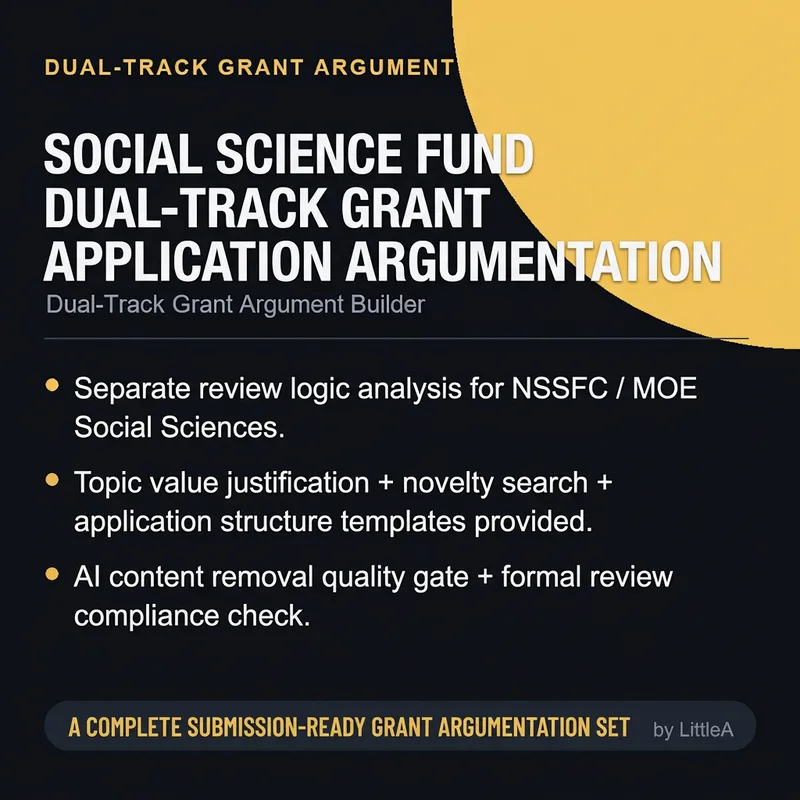
A combined grant proposal generator for the National Social Science Fund and the Ministry of Education Humanities and Social Sciences Research Projects, using the dual-track proposal method. Triggered when users ask about applying for national social science grants, writing Ministry of Education project proposals, simultaneous applications, word count allocation for blind review forms, feasibility sections, narrowing broad topics, drafting the background section, removing AI phrasing in proposals, literature searches, quota limits, youth project selection, anonymizing blind review forms, or project proposal generators. Using the dual-track proposal method (eligibility gate, topic argument, dual-track generation, AI phrasing removal, and formal review), it produces topic value arguments, literature search conclusions, the full proposal text (formatted for social science blind review forms or Ministry of Education Form B), an AI-phrasing-revised edition, and formal review red-line self-checks. Version 2.0.0. ## Overview A combined project proposal generator for the National Social Science Fund and Ministry of Education review tracks: clears prerequisite exclusion gates, helps narrow broad directions into specific genuine research questions, generates full proposal texts according to dual-track formats, and passes the AIGC < 10% quality gate and rejection-level formal reviews. Covers frequent pain points such as application procedures, simultaneous submissions, word count distribution, narrowing topics, removing AI tone, quota calculations, and blind review anonymization. ## What You Will Get 1. Topic value argument and literature search conclusions (3 targeted topic options, search comparison, and gap positioning) 2. Full proposal text (according to the selected track: 8 sections for social science blind review forms or 5 columns for Ministry of Education Form B) 3. AI-phrasing-revised edition (machine tone scan and natural phrasing comparison) 4. Formal review red-line self-check checklist (quotas, anonymity, word counts, and disciplines, rejection-level) ## Best For University humanities and social science faculty (lecturers and associate professors), early-career researchers, regional college teachers, postdoctoral researchers, and research administrators applying for national, ministry, or provincial social science planning grants.
Information
- Version
- v7
- Last updated
- Runtime credits
- Usage-based
- Models
- Auto
