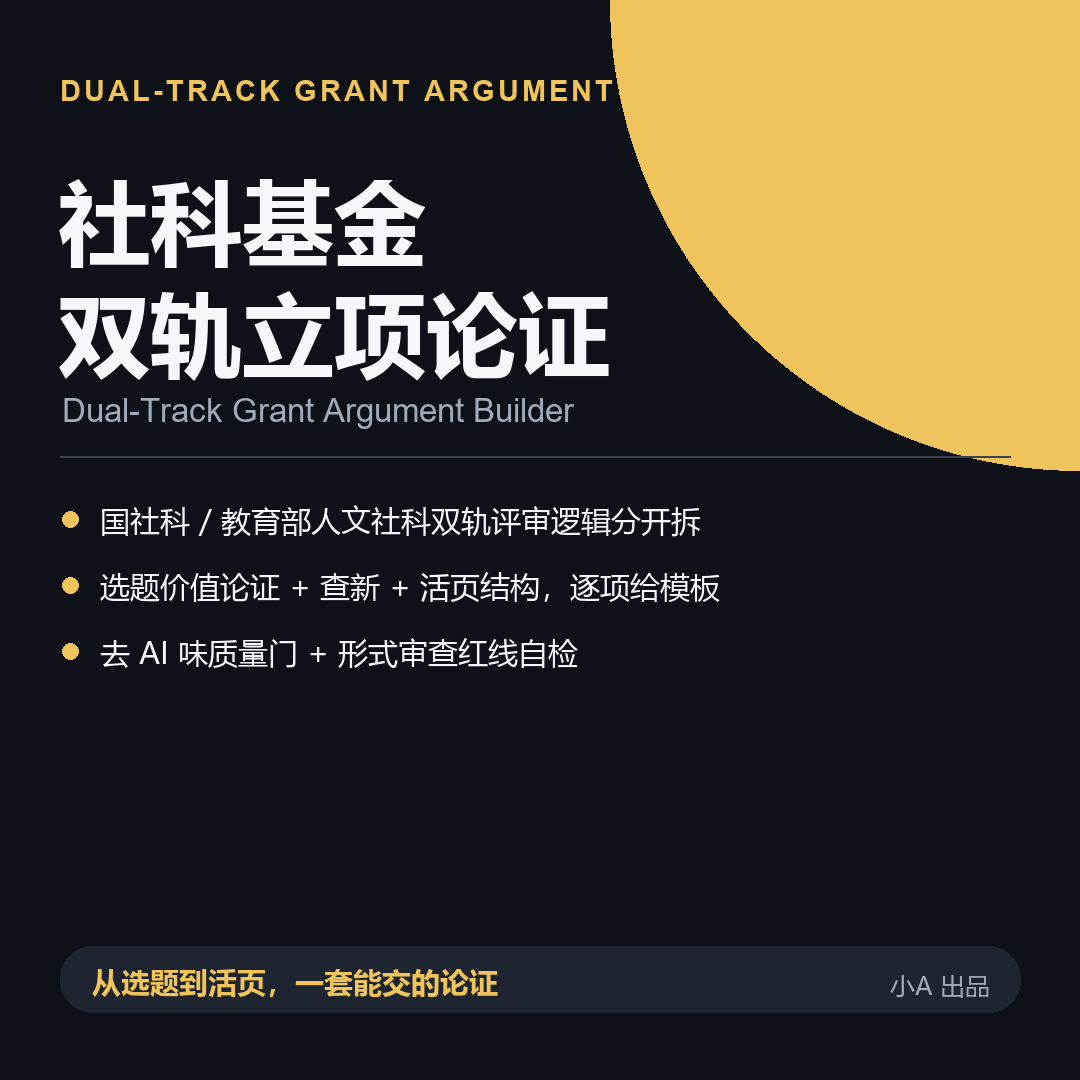
Social Science Grant Proposal Generator
Generate dual-track grant proposals, literature search advice, and compliance checks
Social Science Grant Proposal Generator
Generate dual-track grant proposals, literature search advice, and compliance checks
Showcase
Description
A combined grant proposal generator for the National Social Science Fund and the Ministry of Education Humanities and Social Sciences Research Projects, using the dual-track proposal method. Triggered when users ask about applying for national social science grants, writing Ministry of Education project proposals, simultaneous applications, word count allocation for blind review forms, feasibility sections, narrowing broad topics, drafting the background section, removing AI phrasing in proposals, literature searches, quota limits, youth project selection, anonymizing blind review forms, or project proposal generators. Using the dual-track proposal method (eligibility gate, topic argument, dual-track generation, AI phrasing removal, and formal review), it produces topic value arguments, literature search conclusions, the full proposal text (formatted for social science blind review forms or Ministry of Education Form B), an AI-phrasing-revised edition, and formal review red-line self-checks. Version 2.0.0. ## Overview A combined project proposal generator for the National Social Science Fund and Ministry of Education review tracks: clears prerequisite exclusion gates, helps narrow broad directions into specific genuine research questions, generates full proposal texts according to dual-track formats, and passes the AIGC < 10% quality gate and rejection-level formal reviews. Covers frequent pain points such as application procedures, simultaneous submissions, word count distribution, narrowing topics, removing AI tone, quota calculations, and blind review anonymization. ## What You Will Get 1. Topic value argument and literature search conclusions (3 targeted topic options, search comparison, and gap positioning) 2. Full proposal text (according to the selected track: 8 sections for social science blind review forms or 5 columns for Ministry of Education Form B) 3. AI-phrasing-revised edition (machine tone scan and natural phrasing comparison) 4. Formal review red-line self-check checklist (quotas, anonymity, word counts, and disciplines, rejection-level) ## Best For University humanities and social science faculty (lecturers and associate professors), early-career researchers, regional college teachers, postdoctoral researchers, and research administrators applying for national, ministry, or provincial social science planning grants.
Recommended by
Dancang
Why we love this skill
This skill effectively processes National Social Science and Ministry of Education projects across dual tracks, integrating topic selection, novelty checks, and proposal generation, while offering quota screening, evidence chain feasibility, AI removal, and rejection-level self-checks to form a complete compliance workflow.
Related Skills
View all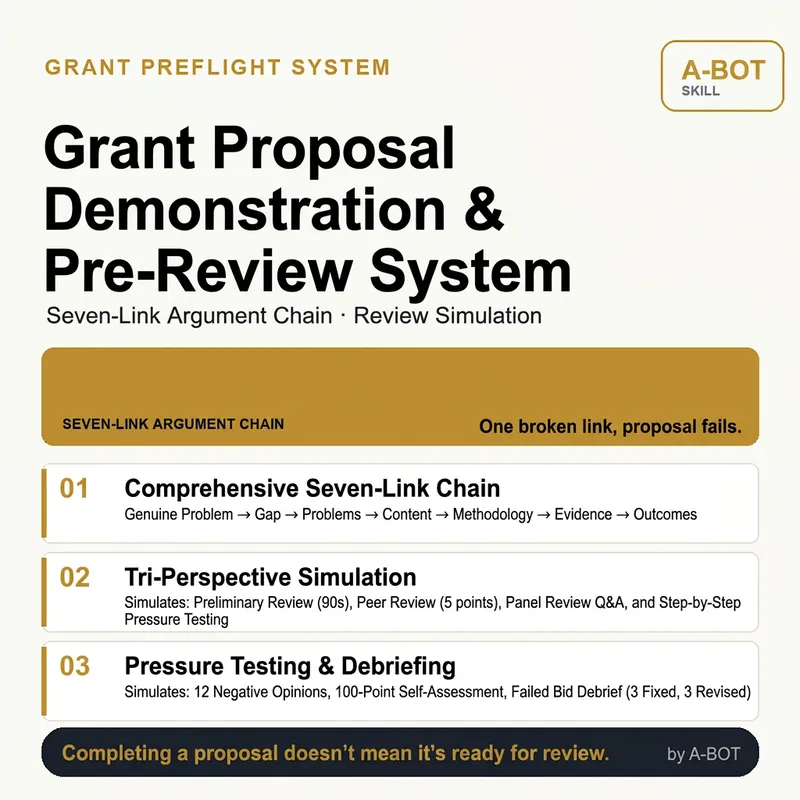 Write
NSSF Proposal Review & Audit
Does your proposal hold up under scrutiny? This skill compresses your National Social Science Fund or Ministry of Education humanities proposal into a one-page 7-ring logic chain, previews it from three review perspectives, and stress-tests it against 12 negative review opinions. With execution upgrades, it organizes your materials into a 7-ring argument table, a negative opinion comparison table, and a self-assessment form after authorization. It never ghostwrites text, fabricates facts, or guarantees approval. Key selling point: It doesn't just point out flaws—after authorization, it directly generates the 7-ring argument table, negative opinion comparison table, dual-track framework, and self-assessment form for you. Announcements for the current year apply; no preliminary results are fabricated. Best for: Applicants for National Social Science Fund or Ministry of Education humanities projects, early-career researchers looking to review rejected submissions, or anyone whose content resembles a textbook table of contents, whose innovations sound like slogans, whose main thread is broken, or who worries about identity disclosure in blind reviews. What to input: Discipline + category + batch (subject to the current year's announcement) + research direction + your actual completed work + draft (optional). What is delivered: 8 content items (identity card / rejection review / restriction checklist / three-perspective card / 7-ring one-pager / dual-track framework / 12 negative opinions / 100-point self-assessment / authoritative anchor check) + 5 finished items (authorization record / 7-ring argument table / negative opinion comparison + dual-track framework / self-assessment form / rejection review & acceptance sheet). If tools are unavailable, a copy-pasteable finished content package is provided with notes. ## Exclusive Methodology: The 7-Ring Logic Chain Most rejections aren't due to formatting, but fragile arguments. Before writing a single word of text, this method compresses your logic onto a single page: 1. 7-ring thread: True problem → literature gap → research question → content → methods → evidence → outcomes. Any broken ring is highlighted in red with a fix, and rings 3→4→5→7 must connect. 2. Three-perspective preview: 90-second initial review, five-item desk review, and panel review skepticism—each step highlights "who is being defended against," helping you understand why the check matters. 3. Stress testing and review: Check off 12 negative opinions one by one, take a 100-point self-assessment (submissions under 70 points are not recommended), and conduct a rejection review for secondary submissions adhering to "three unchanged, three must-change" principles to block skin-deep rejections. Remember this: Break one ring, and the proposal fails. ## Evidence-Based: Parameter Rules Follow Current Announcements Anchored strictly to authentic public guidelines: current year's NSSF application announcement / Ministry of Education humanities notification / institutional research office template (highest priority), historical approval libraries, and CNKI/Wanfang novelty checks (self-checked), plus standard publishing ethics (background only). Age limits, word counts, restrictions, columns, and deadlines that cannot be confirmed are marked as "pending verification"; numbers are never filled in from memory. Unrelated guidelines (PRISMA, ICMJE, etc.) are explicitly marked as not applicable. ## v1 Update: From Tables to Finished Files Older versions provided modifiable intermediates, but this version turns content into usable files: it first tests your current session's tool capabilities, tells you what will be generated and resource consumption, and only proceeds upon your confirmation. - One-page 7-ring argument table: 7 rows of arguments with broken rings highlighted in red and connectivity conclusions, ready for Excel. - Negative opinion preview comparison table: 12 rows checked one by one, hit location + one-sentence fix. - Dual-track framework + self-assessment form + rejection review table: Frameworks based on Type A blind review 8 sections / Type B form 5 columns, complete with self-assessment scores and secondary submission revision lists. No generation tool in the session? Delivered as a "ready-to-paste finished content package"—all five tables written in Markdown, ready to copy into Word or Excel. Never pretends to generate or fabricates file paths. ## Detail Page Text ### Proposal AIGC is a hard red line. How does this skill safeguard it? Its scope is narrow: it only organizes the authentic materials you provide into tables and frameworks. If you lack data, interviews, samples, preliminary results, literature, or approved entries, they remain "pending supplement / pending verification." The skill will not fabricate them just to make a table look good; the 7,000-word text is written by you. ### Five Steps 1. Identity card + rejection review (secondary submissions prioritize three unchanged, three must-change rules); 2. Track gate + restrictions + three perspectives (mutually exclusive blocking, age verification, current year parameters); 3. 7-ring one-pager (broken rings highlighted in red, connectivity must pass); 4. Dual-track framework (no ghostwriting of text); 5. Negative opinions + removing AI tone + formal review + 100-point self-assessment. + Authoritative anchoring layer + execution delivery layer (detect → authorize → generate finished file → accept/downgrade).
 Write
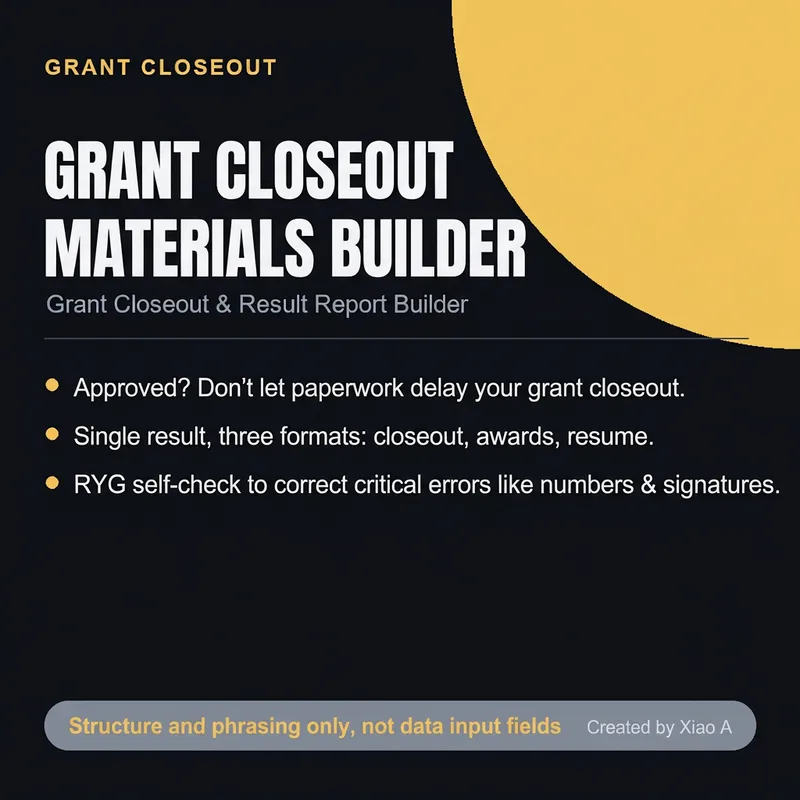
Project Completion Generator
While the Social Science Fund Dual-Track Application Argumentation Generator handles applications, this skill handles completion. For university faculty, early-career researchers, and graduate students who have secured project approval, the most time-consuming part is often not the research itself, but the administrative paperwork: completion reports, achievement submissions, award materials, promotion forms, and CV entries. They have rigid formats, strict phrasing conventions, require the same achievement to be rewritten in three different ways, and are easily rejected over minor details like serial numbers, dates, or authorship. ## Quick Overview **Application approved? Don't let the paperwork block completion.** Turn your project approval info and achievement list into a completion report skeleton, three-angle achievement descriptions, scenario-based submission checklists, and a red-yellow-green self-check table. It provides structure and phrasing only, does not invent table fields or achievements, and does not guarantee review approval. ## What You Get 1. **Completion ID card and achievement inventory**: Align serial numbers, dates, members, and achievement counts at once, marking missing items as needs verification. 2. **One achievement, three angles**: Academic completion angle, award contribution angle, and CV/promotion entry angle, with traceable facts, phrasing, and evidence for each column. 3. **Six-section completion report skeleton**: Objective review, execution process, main conclusions, achievements and impact, funding and progress, and challenges and next steps, complete with writing points, customizable starting sentences, and common reasons for rejection. 4. **Scenario-based material checklist**: Common items for project completion, awards, promotions, CVs, and annual reviews, plus common format issues. 5. **Red-yellow-green self-check table**: Catch hard errors like inconsistent serial numbers, dates, or authorship first, with a printable version. 6. **Exaggerated phrasing replacement table**: Replace phrases like filling a gap or remarkable results with verifiable, review-friendly wording. ## Who It Is For - University faculty, early-career researchers, and project leaders: When projects are due for completion and you are worried about mismatched serial numbers, authorship, or achievements. - Graduate students and research assistants: Helping advisors organize achievement submissions, award applications, and annual review materials. - Previous users of the Social Science Fund Dual-Track Application Argumentation Generator: Moving naturally from application to completion.
 Write
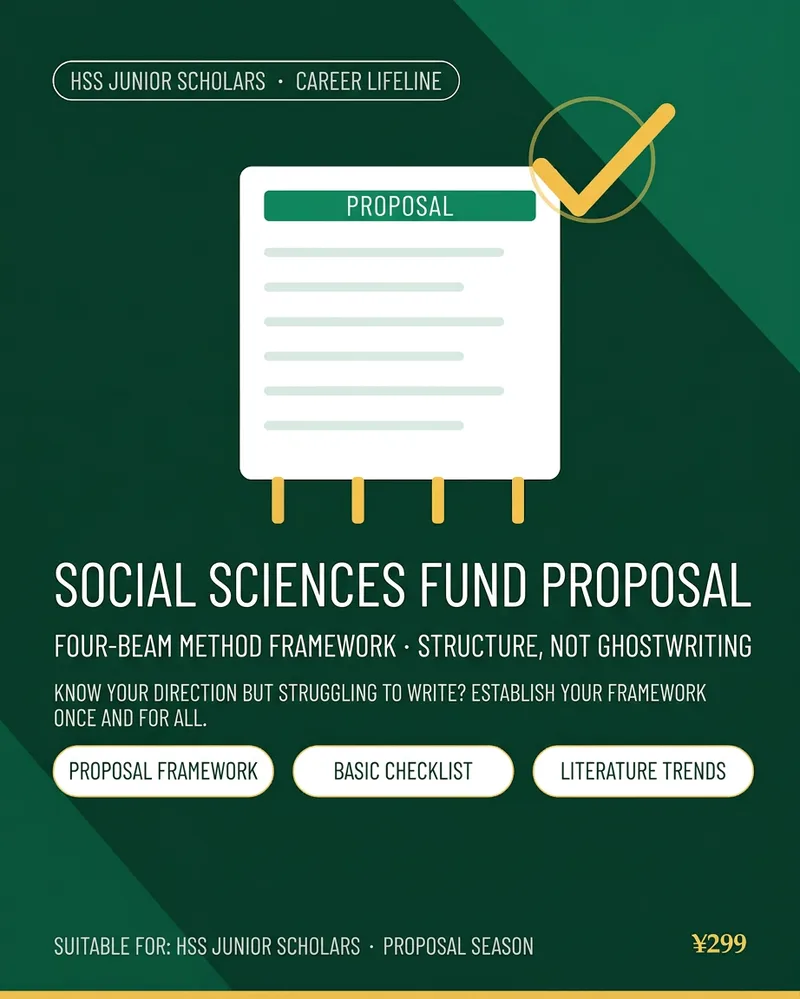
Social Science Grant Application Framework
Designed for young faculty in humanities and social sciences, this Skill uses the Four Pillars method to help build grant application frameworks and material checklists. It triggers when you need help with application strategies, literature reviews, research gaps, weak foundation handling, innovation points, blind review preparation, or restriction checks. By organizing your application into four solid pillars—foundation, content, background, and feasibility—plus restriction and anonymization checks, it turns a scattered draft into a robust proposal. Version 1.0.0. Your personal grant application framework generator: transforms weak literature reviews, unorganized content, thin preliminary records, vague innovation claims, and compliance risks into four sturdy pillars, ensuring your application stands strong. How to Use the Four Pillars Method: 1. Foundation Pillar: Ground your opening in top-level policies and build a four-part literature review to locate your research gap; 2. Content Pillar: Establish a clear objective-framework-difficulty logic chain where each section addresses your gap; 3. Background Pillar: Expand limited preliminary achievements honestly across four methods without falsification; 4. Feasibility Pillar: Select from four innovation angles and apply quantitative expected outcome templates; 5. Review Check: Self-check for grant restrictions and anonymization compliance. What You Receive: An application skeleton filled across the four pillars, a preliminary research checklist for limited backgrounds, and a literature dynamics table with gap identification and reference outlines, forming a three-piece toolkit for your proposal. Compliance Notice: This Skill does not write full proposals but generates frameworks and checklists. Falsification of preliminary results, unauthorized names, or fabricated data is strictly prohibited. AI usage should be noted, and all literature and preliminary results must be verified individually. Approval is not guaranteed. Prioritize compliance with your research office and mentor guidelines, and follow your institution's template.
Information
- Version
- v3
- Last updated
- Runtime credits
- Usage-based
- Models
- Auto
