
Customer Follow-Up Emails
Plan emails for every customer lifecycle stage
Customer Follow-Up Emails
Plan emails for every customer lifecycle stage
Showcase
Description
What should you email users when they sign up, start a trial, or have not returned for a while? Customer Follow-Up Emails designs welcome, nurture, onboarding, retention, billing, win-back, and promotional emails based on your product information, user stage, and goal. Each email includes a subject line, preview text, full body copy, primary action, and clear send, skip, and exit conditions. When users complete an action, skip irrelevant reminders. When they pay or restore payment, exit the relevant promotional or collection flow. Use only confirmed features, benefits, and policies; do not invent discounts, case studies, or data when they are unavailable. You can also rewrite individual emails, audit existing flows, and plan tests. For independent developers of products for international markets, small SaaS teams, and subscription content creators. Actual configuration and sending depend on your email platform and authorization; without an integration, this Skill delivers copy and a configuration table and does not promise conversion improvements. Published under the leowang brand, adapted from emails v2.1.4 under the MIT license with the copyright and license retained.
Recommended by
Dancang
Why we love this skill
Connects welcome, trial, retention, billing, and win-back emails into executable lifecycle flows with clear triggers, exits, deduplication, permissions, and measurement rules.
Best for
Independent developers, SaaS teams, and subscription content creators planning customer lifecycle emails.
How to use this Skill
Provide your input
Provide product details, user stage, email goal, brand voice, language, quantity, and approved benefits or policies. You can also submit an email or existing flow for rewriting, auditing, or test planning.
Run the Skill
Organize welcome, onboarding, retention, billing, win-back, or promotional emails based on recipient stage and goal. Define trigger, skip, exit, and cross-flow rules.
Review your result
Get an email plan with subject lines, preview text, full copy, primary actions, fields, link lists, and configuration rules. Without an email platform, receive platform-agnostic copy and a configuration table.
Related Skills
View all Write
Don't Send Yet
After writing a cold email, first find out why the customer should keep reading. “Don't Send Yet” diagnoses your draft, rewrites your English subject line and body, plans follow-ups, and connects sending setup, LinkedIn, multichannel outreach, and customer replies. It supports drafting from scratch as well as checking the setup of existing campaigns and classifying replies. Provide your real product information, customer background, draft, or reply to receive the corresponding copy, plans, and operational suggestions. Prices, case studies, and customer observations without supporting evidence will be flagged. Writing and planning can begin immediately; sending, email setup, CRM, and calendar actions require the platform's existing tools and your authorization. Published by: leowang. Adapted from the MIT-licensed cold-email v2.2.0, with the required license notices included.
 Write
Payment Collection Coach
The work is done, but the payment hasn’t arrived—that’s a hurdle no one who takes on client work can avoid. The hardest part isn’t waiting; it’s not knowing how to bring it up. Push too gently and it feels like you’re begging. Push too hard and you worry about losing the client. They say, “Finance is processing it,” and you wait another two weeks. When payment finally comes through, part of the balance is withheld for “poor results.” This Skill helps you collect what you’re owed professionally. Share the details—who owes you, how much, when payment was promised, and how much you’ve already received. It will reconcile the account first, then give you the one message to send today. ✨ Core capabilities 1. Reconcile before requesting payment: Check the amount due, invoices issued, and payments received item by item. Classify the difference into five categories (invoice not issued / invoice issued but unpaid / payment terms not triggered / disputed deduction / inconsistent figures). Requesting payment before the account is clear means giving away your leverage. 2. Escalate in stages: L0 heads-up → L1 friendly → L2 firm → L3 serious → L4 formal. Set the level based on days overdue, then adjust it according to the importance of the relationship—so you know what to say at each stage. 3. Give you only the message to send today: One version each for WeChat, email, and a phone opening, with the tone and risks labeled, plus three likely responses from the other party. 4. Handle final-payment disputes: Separate approaches for clients withholding payment over “poor results,” saying “Finance is processing it,” going silent, or leaving the money stuck with an MCN. 5. Accounts receivable overview: See all unsettled jobs in one table, sorted by days overdue, with the most urgent at the top. 6. Preserve evidence and facts: When agreements were only verbal and there is no contract, learn how to clearly state the facts shown in your chat history (not legal advice). 🛡️ Three firm principles · Reconcile first, then request payment · No legal advice and no threatening language; the highest level is only “Handle this according to the contract.” · If the amount or name is missing, always ask—never use placeholders like “Dear Customer.” 📱 Who it’s for Creators whose payments are overdue, YouTubers, freelance designers, writers, photographers, indie developers, and small studio owners. 💡 How to use it Describe your situation; you can also use /对账 /催 /升级 /争议 /序列 /总览 /档案 for precise actions. The goal of requesting payment isn’t to win an argument—it’s to get your money back.
 Write
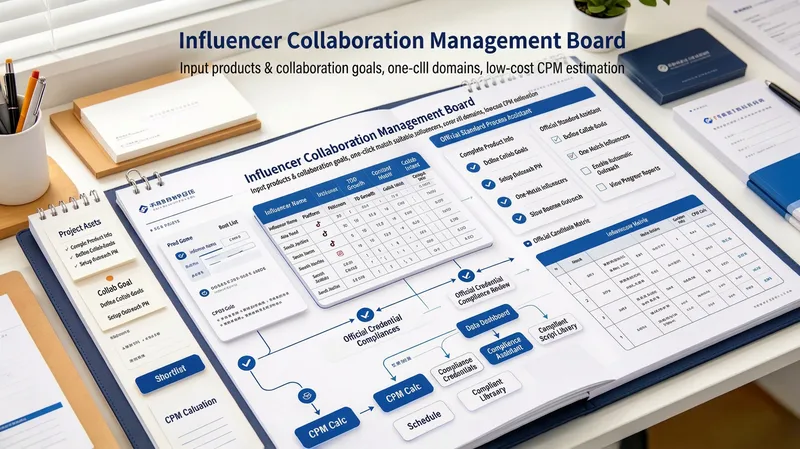
Creator Outreach Pro
SKILL FEATURES Reverse-engineer your creator profile: Start with goals such as promoting a mini program or driving product sales, then determine the creator category, follower range, content format (short video, image-and-text, or livestream), and price range—so you do not start by aimlessly searching for big-name creators. Candidate shortlist: Organize 10–30 candidates using public information, including platform, follower range, category, content style, estimated rate range, recommendation, and official outreach channels (Xingtu homepage, Pugongying creator marketplace, or a publicly listed MCN business email). Rate and budget model: Estimate costs using flat fees, CPM, CPE, and commission (CPS), then show “total budget → creator tier allocation (top-tier 10% / mid-tier 60% / long-tail 30%) → expected impression range,” with platform service fees noted (about 5% for Xingtu and 10% for Pugongying). Tiered outreach script package: Generate four versions—a Xingtu task Brief, a Pugongying brand invitation, an MCN business email, and a first-contact direct message to the creator—each checked for platform-restricted terms. Brief generator: Automatically create a complete Brief covering product benefits, required and prohibited talking points, number of verbal mentions, publishing window, retention period, component linking (shopping cart / LINK / anchor), and data tracking requirements. Three-part compliance check: Check ad identifiability (clearly labeling content as “Advertisement”), platform disclosure rules (mandatory disclosure on Pugongying; disclosure required for product exchanges valued at ¥500 or more), and prohibited absolute claims or efficacy promises. When a risk is found, provide rewrite suggestions. Follow-up CRM sheet: Output fields that can be pasted into a spreadsheet (creator / platform / follower count / rate / outreach date / channel / reply status / script pending confirmation / publish date / acceptance / review data), with support for updating statuses through follow-up questions. Post-campaign review template: Compare views, engagement, conversions, CPM, and CPE with expectations, then build reusable creator whitelists and blacklists. Suggested prompts I want to promote a bookkeeping mini program with a ¥30,000 budget, mainly on Douyin and Xiaohongshu. Create a shortlist and estimate rates. Write a Pugongying brand invitation and post Brief for a low-sugar snack category, and run the three-part compliance check. I have a list of 20 creator accounts. Assess which are worth investing in and how to allocate the budget. For product sales, should I use a flat fee or commission? Compare CPM/CPE estimates for both options. Rewrite this outreach direct message so it does not trigger restricted terms or get treated as spam. How should I review creator content after publishing? Give me a post-campaign data review template and whitelist criteria.
Information
- Version
- v2
- Last updated
- Runtime credits
- Usage-based
- Models
- Auto
- Use cases
- Writing & contentMarketing & growthBusiness & strategy
- What you get
- ReportDocumentPlan
