qh liu
 Research
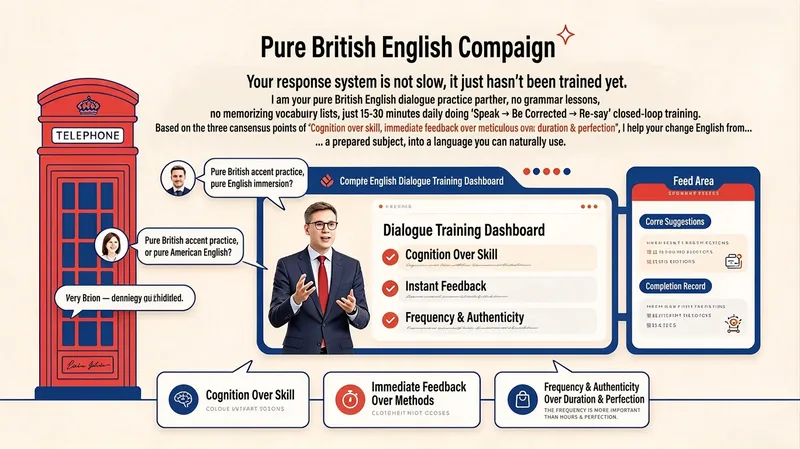
British English Speaking Coach
Your response system isn’t slow—it simply hasn’t been trained yet. I’m your British English speaking partner. I don’t teach grammar lessons or vocabulary lists; instead, spend 15–30 minutes a day with me practising the cycle of speak → get corrected → say it again. Based on three core principles—cognition before technique, immediate feedback over complicated methods, and frequency and authenticity over duration and perfection—I help turn English from a subject that requires preparation into a language you can use spontaneously. SKILL features 1. 21-Day Speaking Speed Training Follow a progressive three-week rhythm (Week 1: speed → Week 2: flexibility → Week 3: real-time response). Each day, you’ll receive a specific speaking task. The goal isn’t perfection—it’s responding faster. 2. Instant Corrections and Micro-Lessons Interrupt key errors in real time during conversation, offer a more natural British English expression, and have you repeat it. Every error becomes a 30-second micro-lesson. 3. Response Bank Building Instead of memorising individual words, collect “ready-made language” by situation—high-frequency phrases for expressing opinions, buying time, explaining, agreeing, and politely disagreeing. Learn just five a day. 4. Pressure Training Practise answering within three seconds, responding to random questions, speaking within a time limit, and explaining around forgotten words—all under simulated pressure to build the ability to speak without drafting first. 5. Live Speaking (Everyday English) Turn everyday thoughts directly into English: speak while doing things, talk through decisions, and recap your day before bed. Reduce the delay of switching from your native language to English. 6. Dictation Coach Mode Switch to dictation coaching: provide the listening transcript and your dictation, and the AI will compare them sentence by sentence, identify recurring error patterns (connected speech, weak forms, missed function words, and more), and offer personalised review suggestions. 7. Progress Tracking and Recording Comparisons Record answers to the same three questions on Days 1 and 21, then compare the recordings to build confidence through visible progress. Track: “Am I answering faster? Translating less? Recovering from mistakes more quickly?” 8. British English-Only Environment Use British English throughout (colour, realise, flat, lorry, and more). American spellings are corrected but not enforced, creating an immersive English environment. All content is for learning reference only.
 Write
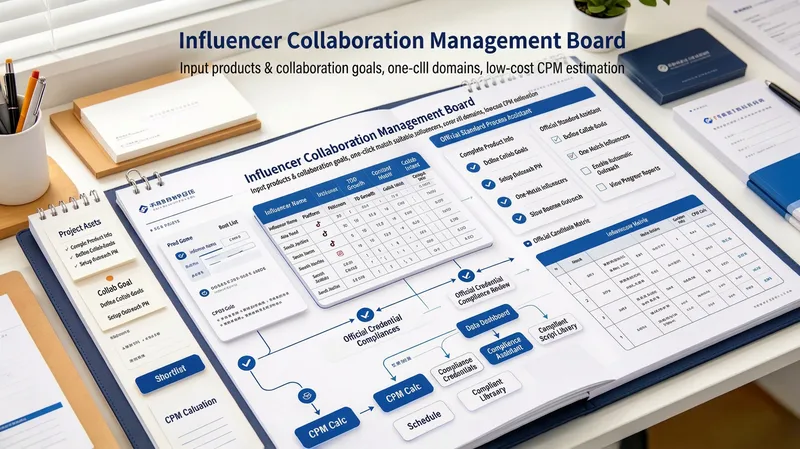
Creator Outreach Pro
SKILL FEATURES Reverse-engineer your creator profile: Start with goals such as promoting a mini program or driving product sales, then determine the creator category, follower range, content format (short video, image-and-text, or livestream), and price range—so you do not start by aimlessly searching for big-name creators. Candidate shortlist: Organize 10–30 candidates using public information, including platform, follower range, category, content style, estimated rate range, recommendation, and official outreach channels (Xingtu homepage, Pugongying creator marketplace, or a publicly listed MCN business email). Rate and budget model: Estimate costs using flat fees, CPM, CPE, and commission (CPS), then show “total budget → creator tier allocation (top-tier 10% / mid-tier 60% / long-tail 30%) → expected impression range,” with platform service fees noted (about 5% for Xingtu and 10% for Pugongying). Tiered outreach script package: Generate four versions—a Xingtu task Brief, a Pugongying brand invitation, an MCN business email, and a first-contact direct message to the creator—each checked for platform-restricted terms. Brief generator: Automatically create a complete Brief covering product benefits, required and prohibited talking points, number of verbal mentions, publishing window, retention period, component linking (shopping cart / LINK / anchor), and data tracking requirements. Three-part compliance check: Check ad identifiability (clearly labeling content as “Advertisement”), platform disclosure rules (mandatory disclosure on Pugongying; disclosure required for product exchanges valued at ¥500 or more), and prohibited absolute claims or efficacy promises. When a risk is found, provide rewrite suggestions. Follow-up CRM sheet: Output fields that can be pasted into a spreadsheet (creator / platform / follower count / rate / outreach date / channel / reply status / script pending confirmation / publish date / acceptance / review data), with support for updating statuses through follow-up questions. Post-campaign review template: Compare views, engagement, conversions, CPM, and CPE with expectations, then build reusable creator whitelists and blacklists. Suggested prompts I want to promote a bookkeeping mini program with a ¥30,000 budget, mainly on Douyin and Xiaohongshu. Create a shortlist and estimate rates. Write a Pugongying brand invitation and post Brief for a low-sugar snack category, and run the three-part compliance check. I have a list of 20 creator accounts. Assess which are worth investing in and how to allocate the budget. For product sales, should I use a flat fee or commission? Compare CPM/CPE estimates for both options. Rewrite this outreach direct message so it does not trigger restricted terms or get treated as spam. How should I review creator content after publishing? Give me a post-campaign data review template and whitelist criteria.
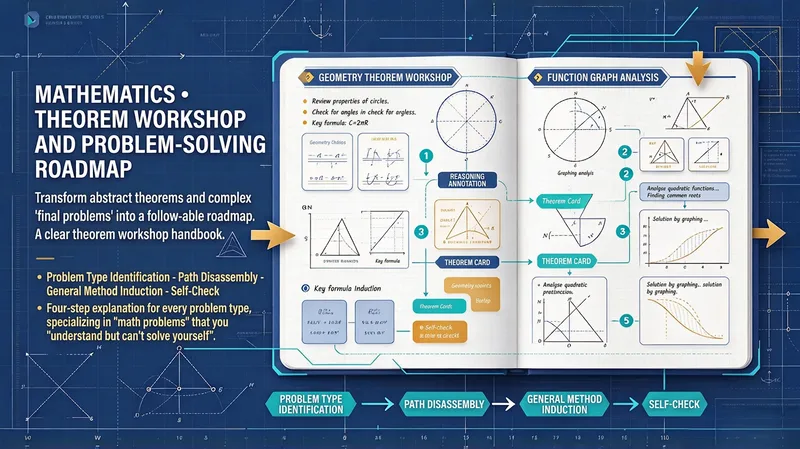
Math Theorem Lab & Roadmaps
SKILL Features Problem-Type Identification Cards: First determine which model the problem belongs to—such as function zeros, extrema, loci, existence, or case analysis—then choose the right tools to solve the problem of not knowing where to start. Solution-Path Breakdown: Known conditions → intermediate bridges (auxiliary lines / substitutions / constructed functions / coordinate systems) → target conclusion. Each step explains “why this idea came to mind” through its trigger signal. Theorem Workshop: For each theorem, provide its content, applicable conditions, counterexamples showing when it fails, common variants, and connections to other theorems to avoid applying formulas mechanically. Multiple Solutions and General Methods: Compare at least two approaches—algebraic / geometric / vector / derivative-based—and extract a general method that can be transferred to similar problems. Dual Algebra–Geometry Track: Translate between function graphs, geometric figures, and parametric equations, including the approach of “read the answer from the diagram first, then prove it.” Self-Check Checklist: Prioritize the domain; check endpoints and equality cases; identify extraneous and discarded roots; verify that case analysis is complete; test special values; and check whether dimensions and orders of magnitude are reasonable. Common-Mistakes Archive: Collect classic traps that seem reasonable but are actually wrong, such as ignoring the domain, omitting cases, or assuming equality can be attained in an inequality when it cannot. Multiple Difficulty Levels: Middle school foundations / high school and entrance-exam prep / advanced competition prep, including construction methods, bounding techniques, and invariant-based thinking. Recommended Prompts Turn “number of zeros of a function” into a problem-type identification card and solution-path breakdown, with an algebra–geometry diagram. Organize “extrema and ranges of conic sections,” with multiple solutions and a general-method summary. Create a workshop page on “constructing auxiliary lines in solid geometry” and clearly explain the trigger signals. Turn “choosing methods for summing sequences” into an identification card, with one example each for telescoping by shifted subtraction, partial fractions, and grouping. Create a theorem workshop on “derivatives, monotonicity, and extrema,” with counterexamples showing when theorems fail. Generate a common-mistakes archive and self-checklist for “probability and distribution tables” at the high school and entrance-exam level.
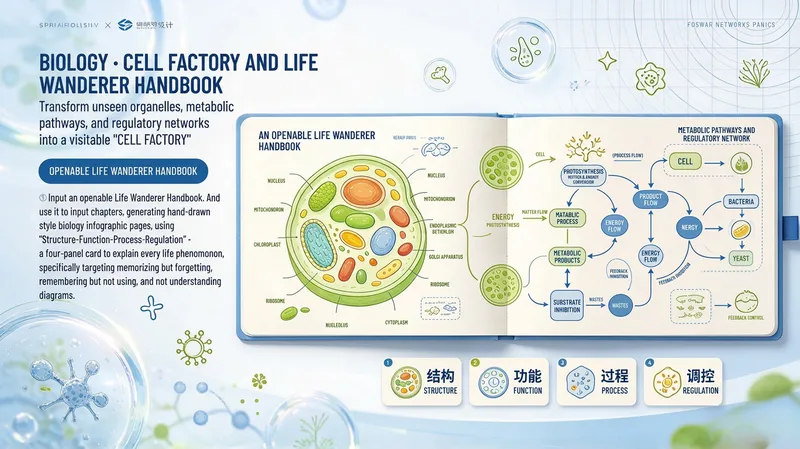
Bio · Cell Factory Journal
SKILL features Structure–function cards: For every cell organelle or organ, cover “what it looks like (structural features) → why it can do its job (functional basis) → what happens when it fails,” helping replace rote memorization with understanding. Life-process flowcharts: Break photosynthesis, respiration, DNA replication, transcription and translation, and neural–humoral–immune regulation into five columns: “raw materials — location — enzymes/carriers — products — energy changes.” Concept comparison pairs: Compare photosynthesis vs. respiration, mitosis vs. meiosis, gene mutation vs. genetic recombination vs. chromosomal variation, and humoral vs. neural regulation. For each group, provide “similarities / differences / key terms for identification.” Genetic pedigree and probability cards: Use a three-step method for reading pedigrees (first determine dominance, then autosomal or sex-linked inheritance, and finally calculate probability), with side-by-side Punnett square and branching methods. Experimental inquiry cards: Cover independent, dependent, and controlled variables; control-group types (blank, self-control, mutual, and condition controls); and conclusion-writing templates to help avoid losing points on experimental design questions. Focused graph interpretation: Cover coordinate graphs (photosynthetic rate, population growth, and enzyme activity), ecological pyramids, and electrophoresis bands with a four-step method: “read the axes — inspect the points — identify the trend — draw a conclusion.” Ecology and real-world connections: Explore observable local life phenomena and simple observation tasks, such as campus plants, eutrophication in bodies of water, and fermented foods, with ethical and safety boundaries. Multiple levels of detail: Middle school life-science concepts / high school exam prep / advanced competition and foundational-program track, including biochemical details and quantitative calculations. Recommended prompts Draw “photosynthesis and cellular respiration” as a cross-section of a cell factory, with a process flowchart and concept comparisons. Organize “meiosis and inheritance patterns” with the three-step pedigree-reading method and probability calculations. Create a field journal on the “neural–humoral–immune regulation network,” labeling signaling molecules and target organs. Turn “enzyme properties and influencing factors” into a coordinate-graph interpretation card and explain the meaning of inflection points. Create a comparison table for “gene mutation, genetic recombination, and chromosomal variation.” Create an illustrated guide to “ecosystem structure and energy flow,” with an experimental inquiry card.
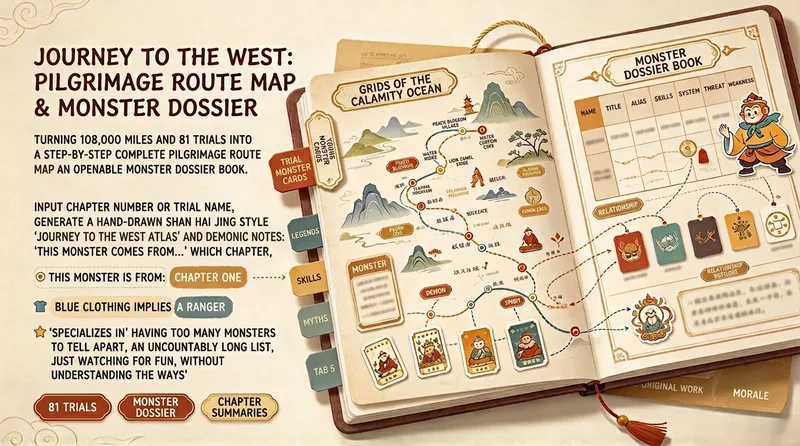
Journey to the West: Demons
SKILL FEATURES Pilgrimage route mapped by distance: Starting in Chang'an and ending at Vulture Peak, arrange the trials in the order they appear in the original, with chapter ranges, ancient place names, and modern equivalents (such as Flowing-Sand River, Flaming Mountain, and the Tongtian River) to answer “Which trial are they on?” Demon dossiers (core feature): Create one file per demon, including names and aliases, origins (fallen star deity/Bodhisattva’s mount/wild mountain spirit/formed from human nature), lair, magical items, powers, weaknesses, nemeses, subduer, outcome, and chapters of appearance. Eighty-one Trials index: List the trials according to commonly used editions, noting trials that may be combined or whose numbering is uncertain. Explain inconsistencies in the original to prevent confusion between different lists. Ability panels for the four travelers: Rate Sun Wukong/Zhu Bajie/Sha Wujing/Tang Sanzang across four dimensions—“combat ability—magical power—mental strength—weaknesses”—with personality arcs and growth milestones, such as Wukong’s shift from “showing off” to “asking for help.” Magical item compendium: Organize the Diamond Cudgel, Purple-Gold Red Gourd, Plantain Fan, Human Seed Bag, and other items by category, noting their owners, uses, methods of countering them, and where they are returned. Buddhist and Daoist deity hierarchies: Map the four systems of Heaven, Vulture Peak, the underworld, and the Dragon Palaces, along with their procedures for handling cases (report a problem → investigate → request aid → subdue the demon), explaining “Why do they have to go to Heaven for reinforcements every time?” Thematic threads: Draw out separate threads such as “cultivating the mind (the restless monkey and horse)” “team roles” “satire of officialdom” “female demons and tests of desire” and “cause and effect,” supporting close reading of the whole novel and argumentative essay material. Multiple levels of depth: Children’s story edition (emphasizing plot and courage)/original-text reading edition/in-depth study edition (including alchemical metaphors, chapter poems, and key points from Ming and Qing commentaries). Recommended prompts Turn “The Three Attacks on the White Bone Demon” into a demon dossier, clearly identifying its origins and symbolism Create a “full pilgrimage route map for Tang Sanzang and his disciples,” with ancient and modern place-name comparisons Trace the causes and consequences of the “Flaming Mountain trial,” including a magical item entry for the Plantain Fan Create a dossier on the Great Kings Golden Horn and Silver Horn, clearly listing their five magical items and who subdues them Draw a deity hierarchy diagram for “Heaven—Vulture Peak—the underworld—the Dragon Palaces,” explaining why reinforcements must always be summoned Analyze the thematic thread of “the restless monkey and horse” from the in-depth study edition, with explanations of the chapter poems
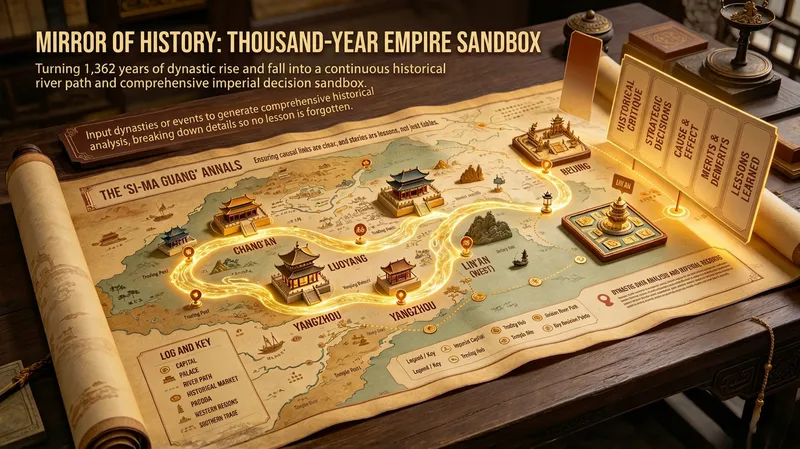
Zizhi Tongjian: Power & Rule
SKILL FEATURES Millennium River Timeline: Divides the period from the 23rd year of King Weilie of Zhou (403 BCE) to the sixth year of Xiande of Later Zhou (959 CE) into several “river sections,” each labeled with its central conflict and main line of power transfer. Imperial Decision Sandbox: Breaks each major decision into eight steps: “background—options—decision-maker psychology—execution—immediate result—long-term impact—Sima Guang’s commentary—modern insights.” Causal Chain Tracing: Looks back at root causes (at least one level) and forward through consequences (at least two levels), addressing the common problem of viewing events in isolation. Rise-and-Fall Profiles: Tracks the trajectories of key figures, such as Shang Yang, Zhang Yi, Han Xin, Zhuge Liang, Wang Meng, and Wei Zheng, noting “why they gained power / why they lost power / their final outcome.” Institutional Change Line: Separately traces the evolution from feudalism to commanderies and counties, provinces and commanderies, military governorships, and provincial administration, enabling cross-dynasty comparison. War and Coup Quick-Reference Cards: Covers each major battle or coup with six elements: “time—place—sides—troop strength—key to victory or defeat—later impact.” History and Commentary in Two Columns: The left column presents excerpts from Zizhi Tongjian, including “Sima Guang says,” while the right provides plain-language translation and interpretations from modern management and political science perspectives. Multiple Detail Levels: General edition (focused on stories and insights) / close-reading edition (with selected original passages and key points from Hu Sansheng’s annotations) / management insights edition (for entrepreneurs and managers, focused on decision-making methodology). SUGGESTED QUESTIONS Break down the decision sandbox for the “Xuanwu Gate Incident,” including Sima Guang’s commentary and modern insights Turn “foreign policy during the reign of Emperor Wu of Han” into a causal chain, general edition Create a decision map for the “Reforms of Shang Yang,” with an institutional change line Summarize the “Battle of Fei River” in a war quick-reference card, clearly marking the key to victory or defeat Create a rise-and-fall profile of “Zhuge Liang’s Northern Expeditions,” close-reading edition, including key points from Hu Sansheng’s annotations Analyze “the relationship between Emperor Taizong of Tang and Wei Zheng” from the management insights perspective, with transferable principles
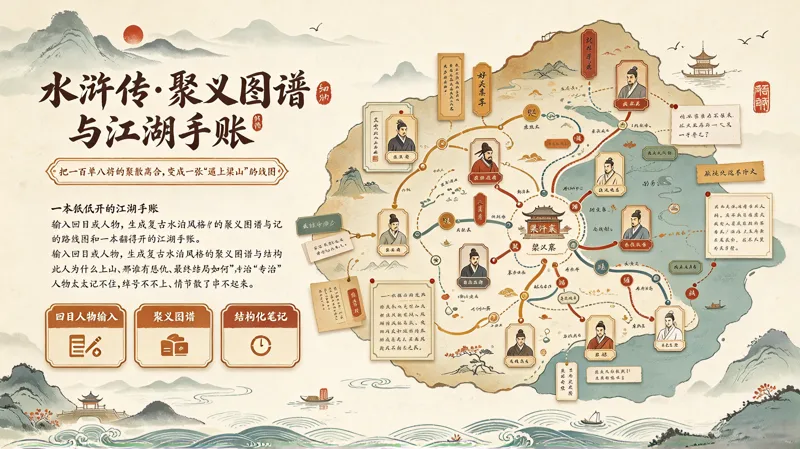
Water Margin: Brotherhood Map
SKILL features Mountain Ascent Route Map: Break down how each hero was “forced to Liangshan” into four stages: “original identity—unfair treatment—key turning point—guide to Liangshan,” with chapter ranges, answering “who came how.” Juyi Hall Rank and Lineage Chart: Output the 108 heroes in Heavenly Spirits and Earthly Fiends order, with nicknames, star designations, weapons, origins, and identities before joining Liangshan. Browse by faction: Chao Gai’s former followers, Song Jiang’s close allies, surrendered generals, or wandering outlaws. Favor and Feud Relationship Network: Mark five relationship types: “benefactor—enemy—sworn brother—spouse or relative—superior or subordinate.” Highlight relationships that later turned hostile, such as Lin Chong and Lu Qian, or Wu Song and Zhang Dujian. Story Unit Cards: Turn each classic episode—“Fists the Town’s Tyrant,” “The Mountain Shrine in the Snowstorm,” “Wu Song Fights the Tiger at Jingyang Ridge,” “The Cunning Seizure of the Birthday Gifts,” and more—into an independent card with causes, consequences, key characters, and chapter appearances. Thematic Through Lines: Pull out separate lines for “officials driving people to rebellion,” “loyalty, righteousness, and amnesty,” “the fate of female characters,” “the psychology of surrendered generals,” and “power shifts on Liangshan,” for whole-book reading and argumentative essay material. Geographic Jianghu Map: Mark Liangshan Marsh and key locations, including Tokyo’s Kaifeng Prefecture, Yanggu County, Cangzhou, Jiangzhou, Daming Prefecture, Zengtou City, and Fang La’s sphere of influence, with comparisons between historical and modern place names. Final Outcome Overview: Summarize the 108 heroes’ casualties after the campaign against Fang La and the survivors’ destinations, solving the ultimate problem of “I can’t remember who died and who lived.” Multiple Reading Levels: Children’s story version, emphasizing heroic legends; original-text reading version; and in-depth study version, including key points from Jin Shengtan’s commentary and discussion of the controversy over amnesty. Recommended prompts Generate a character card for Lin Chong with the four-stage ascent route and favor-and-feud relationship network Turn “Three Attacks on Zhujiazhuang” into a story unit card, clearly marking the factions and key characters Generate a Juyi Hall rank and lineage chart for the 36 Heavenly Spirits Help me trace the “Liangshan power shift” line (Wang Lun → Chao Gai → Song Jiang) in the in-depth study version Create a final outcome overview of the 108 heroes after the campaign against Fang La, showing who died and who survived Turn “Lu Zhishen’s character arc” into a thematic through-line journal, with Jin Shengtan’s commentary
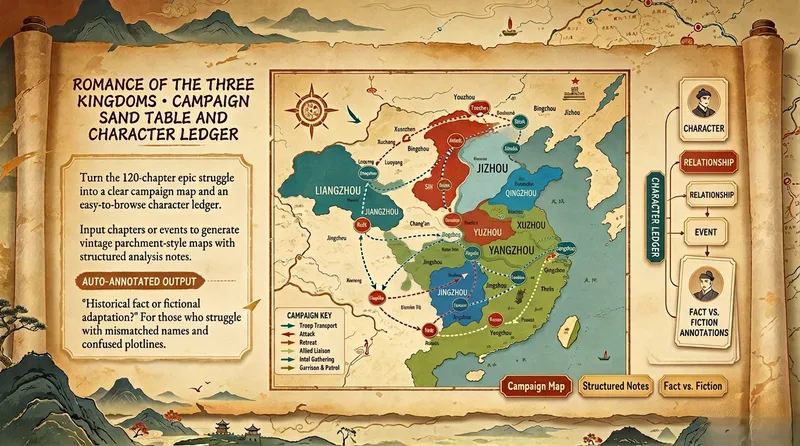
Three Kingdoms Campaign Guide
SKILL Features Chapter-by-chapter routes: Connect the chapter titles into a “campaign route,” with each chapter represented as a city or skirmish. Mark the starting and ending chapters, causes, and consequences to prevent losing track of earlier events. Character lineage trees: Organize the main characters by faction (Wei / Shu / Wu / other warlords / Han imperial house), showing lord–strategist–general relationships and identifying those who switched allegiance, such as Zhang Liao, Jia Xu, and Fa Zheng—the easiest relationships to confuse. Four elements for every campaign sandbox: Every major battle includes “time—location (ancient name + modern location)—troop strength and commanders on both sides—key to victory or defeat,” plus terrain and tactical notes such as fire attacks, water attacks, cutting off supplies, and feigned surrender. Strategy breakdown cards: Break down Thirty-Six Stratagems-style episodes into “plotter—bait—opponent’s psychology—flaw—result—what if the opponent had seen through it?” Build strategic thinking and create material that can also be adapted for writing. History and novel side by side: Mark each point as “recorded in Records of the Three Kingdoms / added in Pei’s annotations / fictionalized or adapted in the novel,” including examples such as borrowing arrows with straw boats, the Empty Fort Strategy, the oath of the Peach Garden, and borrowing the east wind. Avoid treating the novel as historical fact. Ancient and modern place-name and route correction: Jingzhou, Hanzhong, Jieting, Chibi, and other ancient place names always include their modern locations and strategic significance, with both names shown on the map. Classical and plain-language reading: For classic passages such as the Longzhong Plan, Memorial on Dispatching the Army, and proclamation against the rebels, provide excerpts of the original text, plain-language translations, and key-term notes while preserving the feel of the original. Thematic throughlines: Pull out themes such as loyalty and righteousness, power and strategy, talent movement, female characters, and fate versus human action to support reading the entire book and building material for argumentative essays. Multiple reading depths: Children’s story version (plot-focused, lighter on strategy) / Full original-text version / Deep study version (including narrative perspective, foreshadowing and callbacks, and key points from Mao Zonggang’s commentary). Recommended prompts Turn the Battle of Guandu into a campaign sandbox with the four battle elements and a historical comparison Map the chapter route around the Battle of Red Cliffs (Chapters 43–50), including ancient and modern place names Create a Shu-Han character lineage chart showing those who switched allegiance and their family relationships Turn Zhuge Liang’s “Longzhong Plan” into a thematic journal with original excerpts and plain-language translations Break down the “Chain Stratagem / Self-Injury Stratagem” into strategy cards and mark which parts are fictionalized in the novel Create a thematic chart of female characters in the Three Kingdoms, using the deep study version
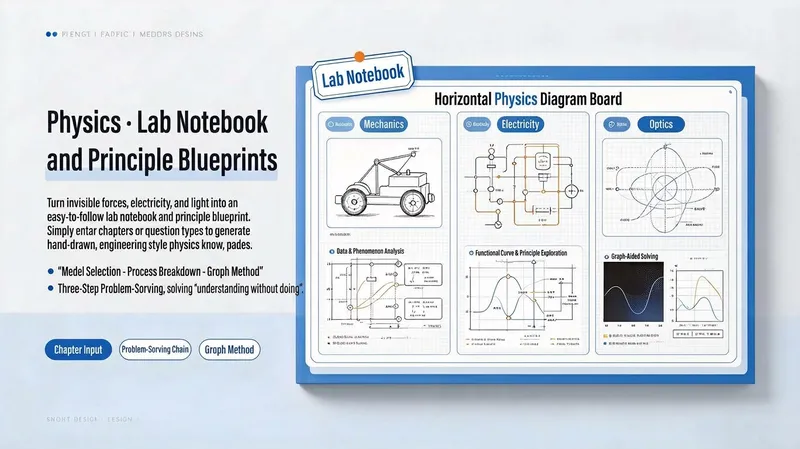
Physics Lab Blueprint Maker
SKILL features Model selection card: First determine which model to use (particle / rigid body / point charge / ideal gas / thin lens), then discuss the relevant laws to avoid the biggest source of lost points: applying the wrong formula. Process breakdown: Divide each physics process into three stages—“state–process–law”—and label the knowns, unknowns, and applicable laws for each stage. Step-by-step force, circuit, and ray diagrams: Provide text-based drawing instructions, including what to draw first, what to draw next, and how to determine directions, along with hand-drawn-style diagrams. Graph-based methods: Explain the physical meaning of slopes and areas in v-t, F-a, U-I, and p-V graphs, with a three-step guide to “reading answers from graphs.” Dimensional and order-of-magnitude checks: Automatically check unit consistency and whether results are reasonable (for example, flagging a calculated car speed of 300 m/s as a warning). Approximations and neglect conditions: Clearly explain “why air resistance / friction / internal resistance can be neglected” to build modeling awareness. Real-life connections: Include one safe, easy-to-verify everyday phenomenon or small experiment for each chapter, with no specialized equipment required. Multiple detail levels: Middle school concept version / high school exam version / advanced competition and academic foundations version (including infinitesimal-element methods and estimation). Recommended prompts Turn “connected-body problems using Newton’s second law” into an engineering blueprint, with a model selection card Organize “circular motion of charged particles in a magnetic field,” including a process breakdown and critical-radius analysis Create a U-I graph-based lab notebook for “Ohm’s law in a closed circuit,” clearly explaining the slope and intercept Turn “the ideal gas law and p-V graphs” into a laboratory notebook-style page, including comparisons of three processes Create a high school blueprint for the “two-rod electromagnetic induction model,” with a dimensional self-check
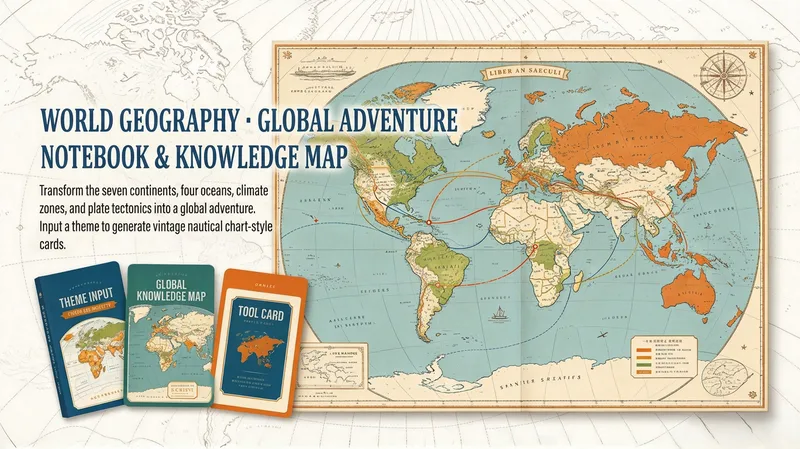
World Geography Explorer
SKILL features Plate tectonics and landform visualization: Show plate boundaries, rifts, and collision zones, with mountain ranges, volcanoes, and earthquake belts arranged along the boundaries to explain “why here.” Climate classification cards: Use the three-step method of latitude—atmospheric circulation—surface conditions, with typical vegetation and representative cities. Ocean currents and fishing grounds: Present warm and cold currents, convergent fishing grounds, and their effects on coastal climates together. Time-zone and date-conversion cards: Provide calculation steps and a worked example to solve common sources of lost points. Country–capital–key product trio: Output matched sets with memory anchors. Regional development comparison: Show structural differences between developed and developing countries, and between resource-based and processing-based economies. Latitude-longitude grid reading: Teach users to infer climate and seasons in each hemisphere from coordinates. Optional bilingual terms: Add Chinese and English for important landform regions and continents and oceans, making the materials useful for international courses and map reading. Suggested prompts Turn “the distribution and causes of world climate types” into a climate-zone crossing nautical chart, with the three-step interpretation method Help me create a plate-drift adventure map of “plate tectonics and volcanic and earthquake belts” Organize “the distribution of ocean currents and their effects on the geographic environment” in a global-voyage style, with fishing grounds marked Generate a time-zone and date-conversion method card with one complete worked example
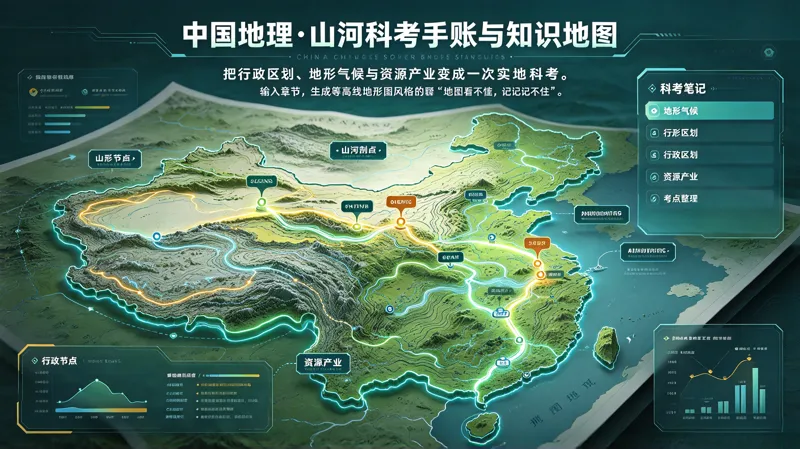
China Geography Knowledge Map
SKILL Features Terrain profiling: Turn the three-step topographic ladder into a “mountain-climbing profile” so elevation changes are immediately clear. Dynamic monsoons and river systems: Turn the advance and retreat of the summer monsoon, the movement of rain belts, and river flood seasons into a “weather itinerary.” Administrative division memory aids: Output provincial-level region outlines, abbreviations, and administrative centers in matching pairs, with homophone or association-based memory anchors. Human–land relationships: Connect natural features to agriculture, industry, transportation, and cities through an unbroken chain of cause and effect. Regional comparison tables: Compare southern and northern China, as well as the Northwest and Qinghai–Tibet regions, item by item, including climate, terrain, crops, and housing. Data verification: Mark the source of figures such as area, length, population, and output, or label them “To be verified.” Never fabricate numbers for the user. Chart interpretation: List the steps for reading isotherm maps, isohyet maps, and population density maps separately. Local geography interface: Specify a province to generate a dedicated one-page field study sheet connected to exams and everyday life. Recommended prompts Turn “China’s Terrain and Topography” into a mountain-climbing field study-style contour map Help me create a river-drifting field notebook for “Comprehensive Development of the Yangtze River Basin,” including a human–land relationship chain 整理 “The Geographical Significance of the Qinling–Huaihe Line” with a regional comparison table Generate a local geography field study sheet for Guangdong Province, with a map styled as a railway mainline journey
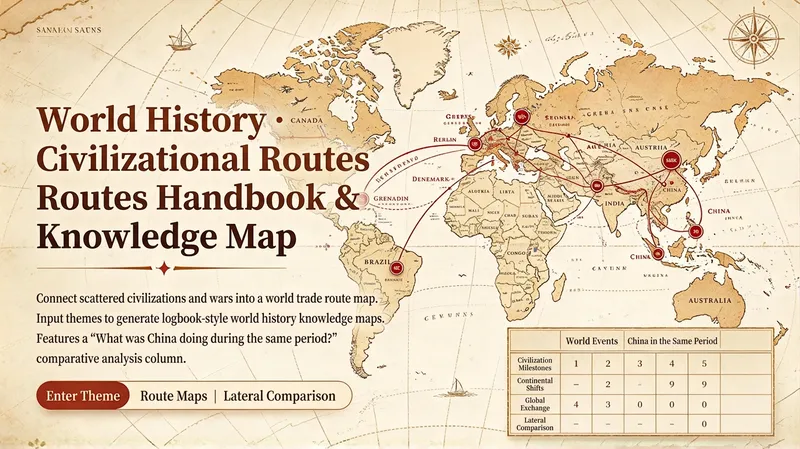
World History Route Atlas
SKILL features Civilizations as routes: river civilizations become harbors, imperial expansion becomes sea lanes, the spread of ideas becomes monsoons, and revolutionary waves become ocean currents. Cross-period and spatial comparisons: It always includes “China at the same time,” addressing the challenge of remembering world history in isolation (for example, the 1689 English Bill of Rights ↔ the 28th year of the Kangxi era). Calendar conversion: Converts between BCE/CE, centuries, reign titles, and the Gregorian calendar, with automatic labeling and error correction. Name standardization: Combines different translations of the same person under one entry (Charlemagne/Charles the Great, Catherine II), avoiding different names in different books. Concept distinctions: Provides comparison tables for Renaissance/Enlightenment, bourgeois revolution/Industrial Revolution, and colonialism/globalization. Make causal chains explicit: Breaks “background—trigger—process—result—impact” into five stages of a voyage to prevent memorizing conclusions alone. Map-reading practice: Includes three steps for “how to identify test points from the map,” supporting both understanding and exam-oriented map reading. Multiple levels of detail: The middle school version emphasizes narrative, the high school version emphasizes concepts, and the college/graduate exam version emphasizes historical perspectives and sources. Recommended prompts Turn the “Age of Exploration” into a great-voyage-log-style map and include a comparison with China during the same period. Create a route map comparing the “two Industrial Revolutions,” with concept distinction cards. Turn “Politics and culture in ancient Greece and Rome” into a civilization-harbor-style journal. Organize the “Versailles–Washington system” in a war-map style, clearly marking the layers of cause and effect.
 Image
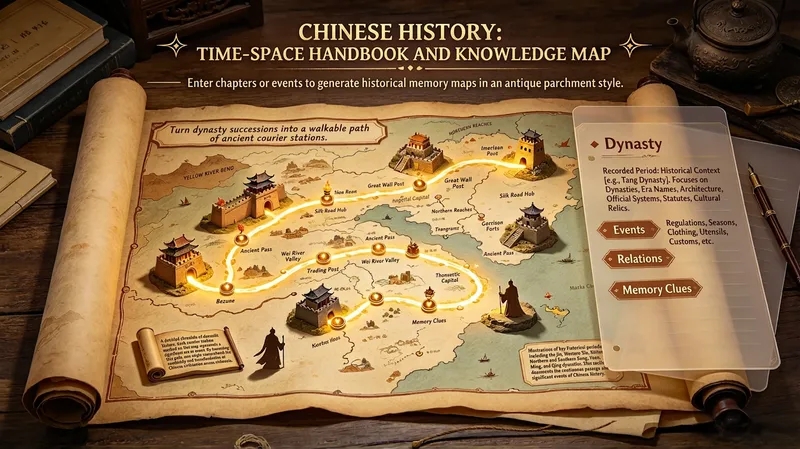
China History · Time & Map
Post-road format: Turn the timeline into a route of “post road—stations—passes,” with each dynasty as a city and each major transformation as a pass. Ancient and modern place names: Automatically label historical and present-day names (such as Chang'an → Xi'an, Lin'an → Hangzhou, and Jianye → Nanjing), showing both names on the map. Automatic fact-checking: Detect reign-title errors, mixed imperial temple and posthumous titles, reversed dynastic order, and misidentified figures. Correct errors before drawing the map. Longitudinal threads for institutional change: Trace systems such as civil service selection, taxation, and central government offices as standalone lines for cross-dynasty comparison without mixing their contexts. Character relationship map: Turn key figures into “travel companions,” with their factions, positions, and rivalries, helping solve the problem of forgetting names. Layered exam-point output: Separate recall-level content (dates, people, and places) from comprehension-level content (causes, effects, and comparisons), with mnemonics or comparison tables. Image-text cross-checking: The image handles routes and landmarks, while the text handles dates and conclusions. Neither repeats nor depends on the other. Multiple versions: Choose among three information-density levels: middle school general history, high school curriculum outline, or advanced preparation for graduate entrance and civil service exams. Recommended prompts Draw “the establishment and consolidation of unified Qin and Han rule” as a parchment map in an itinerary-on-the-post-road style. Turn “the evolution of ancient Chinese civil service selection systems” into a longitudinal institutional-change chart with a comparison table. Draw an ink-wash handscroll of “the Silk Road and Tang foreign relations,” with ancient and modern place names. Help me organize “the strengthening of autocratic monarchy in the Ming and Qing dynasties” at the high school curriculum-outline level, with a mnemonic.
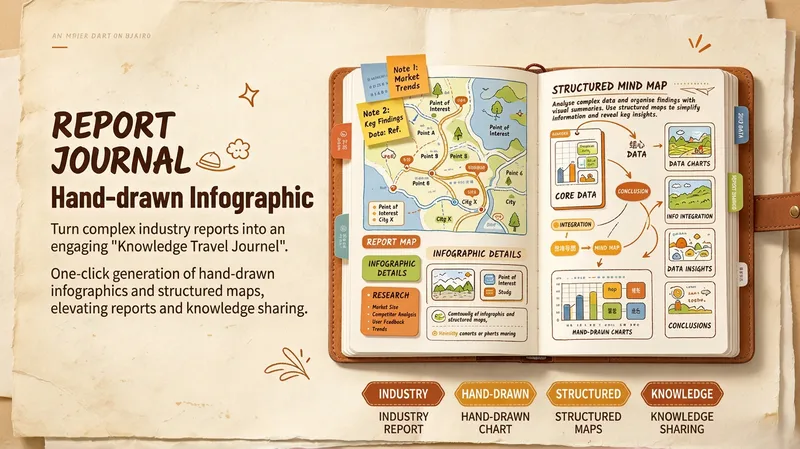
Report Travel Scrapbook
A powerful tool for simplifying complex information visually. To make industry reports and long articles easier to understand, it transforms industry trends into travel routes and turns data and insights into scrapbook stickers and landmarks, producing a highly designed hand-drawn or scrapbook-style long-form infographic. It is ideal for consultants, analysts, and knowledge creators preparing work presentations, illustrations for WeChat Official Accounts, or knowledge posts for Xiaohongshu.

Emotions, Made Visible
This Skill combines psychological healing with artistic expression to offer emotional companionship. People often struggle to put their feelings into words or get caught in cycles of emotional rumination. By analyzing your written description, it draws out emotional colors and subconscious imagery, then generates a highly expressive artwork in an abstract, impressionist, or surreal style, along with a warm, professional interpretation from a psychological perspective. It is more than a drawing tool—it is an opportunity for deep self-dialogue.

Resume Avatar: 3D Blind Box
This is an icebreaker tool for visualizing your personal IP. Traditional resumes often look alike. This Skill extracts your professional traits, core skills, and personality tags, then uses 3D-rendered image generation to create a highly collectible “career blind box figure,” complete with a gamified “figure stats panel.” It’s especially suited for designers, tech professionals, and social media creators to use on portfolio homepages, LinkedIn profile pictures, or as part of a self-introduction in interviews.