
Bio · Cell Factory Journal
Explore cell biology through visual guides
Bio · Cell Factory Journal
Explore cell biology through visual guides
Showcase
Description
SKILL features Structure–function cards: For every cell organelle or organ, cover “what it looks like (structural features) → why it can do its job (functional basis) → what happens when it fails,” helping replace rote memorization with understanding. Life-process flowcharts: Break photosynthesis, respiration, DNA replication, transcription and translation, and neural–humoral–immune regulation into five columns: “raw materials — location — enzymes/carriers — products — energy changes.” Concept comparison pairs: Compare photosynthesis vs. respiration, mitosis vs. meiosis, gene mutation vs. genetic recombination vs. chromosomal variation, and humoral vs. neural regulation. For each group, provide “similarities / differences / key terms for identification.” Genetic pedigree and probability cards: Use a three-step method for reading pedigrees (first determine dominance, then autosomal or sex-linked inheritance, and finally calculate probability), with side-by-side Punnett square and branching methods. Experimental inquiry cards: Cover independent, dependent, and controlled variables; control-group types (blank, self-control, mutual, and condition controls); and conclusion-writing templates to help avoid losing points on experimental design questions. Focused graph interpretation: Cover coordinate graphs (photosynthetic rate, population growth, and enzyme activity), ecological pyramids, and electrophoresis bands with a four-step method: “read the axes — inspect the points — identify the trend — draw a conclusion.” Ecology and real-world connections: Explore observable local life phenomena and simple observation tasks, such as campus plants, eutrophication in bodies of water, and fermented foods, with ethical and safety boundaries. Multiple levels of detail: Middle school life-science concepts / high school exam prep / advanced competition and foundational-program track, including biochemical details and quantitative calculations. Recommended prompts Draw “photosynthesis and cellular respiration” as a cross-section of a cell factory, with a process flowchart and concept comparisons. Organize “meiosis and inheritance patterns” with the three-step pedigree-reading method and probability calculations. Create a field journal on the “neural–humoral–immune regulation network,” labeling signaling molecules and target organs. Turn “enzyme properties and influencing factors” into a coordinate-graph interpretation card and explain the meaning of inflection points. Create a comparison table for “gene mutation, genetic recombination, and chromosomal variation.” Create an illustrated guide to “ecosystem structure and energy flow,” with an experimental inquiry card.
Best for
Students, teachers, and science learners who want to understand and organize middle and high school biology visually.
How to use this Skill
Provide your input
Provide a biology topic, learning stage, and focus areas such as cell processes, inheritance, experimental design, or graph interpretation. You can also specify a preferred guide format.
Run the Skill
Break the topic into structure, function, processes, and regulation; create illustrated biology guides and structured study content while checking key facts, concepts, and experimental boundaries.
Review your result
Get life-science guides, structure–function cards, process flowcharts, and concept comparisons. Add focused modules for genetics, experiments, or graph interpretation when relevant.
Related Skills
View all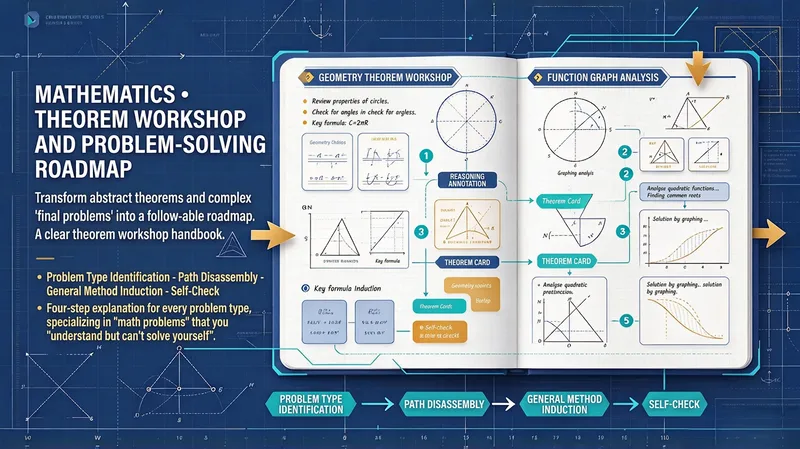
Math Theorem Lab & Roadmaps
SKILL Features Problem-Type Identification Cards: First determine which model the problem belongs to—such as function zeros, extrema, loci, existence, or case analysis—then choose the right tools to solve the problem of not knowing where to start. Solution-Path Breakdown: Known conditions → intermediate bridges (auxiliary lines / substitutions / constructed functions / coordinate systems) → target conclusion. Each step explains “why this idea came to mind” through its trigger signal. Theorem Workshop: For each theorem, provide its content, applicable conditions, counterexamples showing when it fails, common variants, and connections to other theorems to avoid applying formulas mechanically. Multiple Solutions and General Methods: Compare at least two approaches—algebraic / geometric / vector / derivative-based—and extract a general method that can be transferred to similar problems. Dual Algebra–Geometry Track: Translate between function graphs, geometric figures, and parametric equations, including the approach of “read the answer from the diagram first, then prove it.” Self-Check Checklist: Prioritize the domain; check endpoints and equality cases; identify extraneous and discarded roots; verify that case analysis is complete; test special values; and check whether dimensions and orders of magnitude are reasonable. Common-Mistakes Archive: Collect classic traps that seem reasonable but are actually wrong, such as ignoring the domain, omitting cases, or assuming equality can be attained in an inequality when it cannot. Multiple Difficulty Levels: Middle school foundations / high school and entrance-exam prep / advanced competition prep, including construction methods, bounding techniques, and invariant-based thinking. Recommended Prompts Turn “number of zeros of a function” into a problem-type identification card and solution-path breakdown, with an algebra–geometry diagram. Organize “extrema and ranges of conic sections,” with multiple solutions and a general-method summary. Create a workshop page on “constructing auxiliary lines in solid geometry” and clearly explain the trigger signals. Turn “choosing methods for summing sequences” into an identification card, with one example each for telescoping by shifted subtraction, partial fractions, and grouping. Create a theorem workshop on “derivatives, monotonicity, and extrema,” with counterexamples showing when theorems fail. Generate a common-mistakes archive and self-checklist for “probability and distribution tables” at the high school and entrance-exam level.
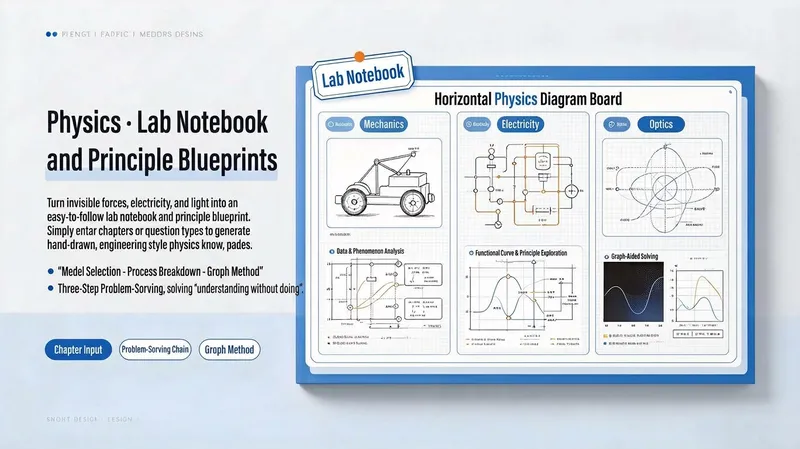
Physics Lab Blueprint Maker
SKILL features Model selection card: First determine which model to use (particle / rigid body / point charge / ideal gas / thin lens), then discuss the relevant laws to avoid the biggest source of lost points: applying the wrong formula. Process breakdown: Divide each physics process into three stages—“state–process–law”—and label the knowns, unknowns, and applicable laws for each stage. Step-by-step force, circuit, and ray diagrams: Provide text-based drawing instructions, including what to draw first, what to draw next, and how to determine directions, along with hand-drawn-style diagrams. Graph-based methods: Explain the physical meaning of slopes and areas in v-t, F-a, U-I, and p-V graphs, with a three-step guide to “reading answers from graphs.” Dimensional and order-of-magnitude checks: Automatically check unit consistency and whether results are reasonable (for example, flagging a calculated car speed of 300 m/s as a warning). Approximations and neglect conditions: Clearly explain “why air resistance / friction / internal resistance can be neglected” to build modeling awareness. Real-life connections: Include one safe, easy-to-verify everyday phenomenon or small experiment for each chapter, with no specialized equipment required. Multiple detail levels: Middle school concept version / high school exam version / advanced competition and academic foundations version (including infinitesimal-element methods and estimation). Recommended prompts Turn “connected-body problems using Newton’s second law” into an engineering blueprint, with a model selection card Organize “circular motion of charged particles in a magnetic field,” including a process breakdown and critical-radius analysis Create a U-I graph-based lab notebook for “Ohm’s law in a closed circuit,” clearly explaining the slope and intercept Turn “the ideal gas law and p-V graphs” into a laboratory notebook-style page, including comparisons of three processes Create a high school blueprint for the “two-rod electromagnetic induction model,” with a dimensional self-check
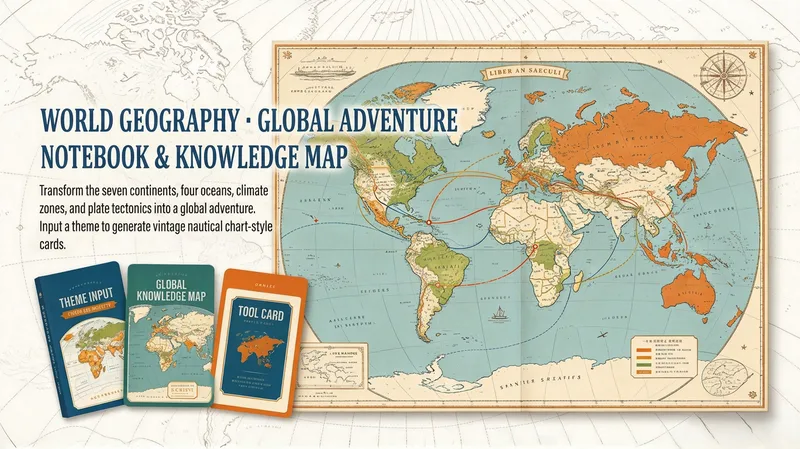
World Geography Explorer
SKILL features Plate tectonics and landform visualization: Show plate boundaries, rifts, and collision zones, with mountain ranges, volcanoes, and earthquake belts arranged along the boundaries to explain “why here.” Climate classification cards: Use the three-step method of latitude—atmospheric circulation—surface conditions, with typical vegetation and representative cities. Ocean currents and fishing grounds: Present warm and cold currents, convergent fishing grounds, and their effects on coastal climates together. Time-zone and date-conversion cards: Provide calculation steps and a worked example to solve common sources of lost points. Country–capital–key product trio: Output matched sets with memory anchors. Regional development comparison: Show structural differences between developed and developing countries, and between resource-based and processing-based economies. Latitude-longitude grid reading: Teach users to infer climate and seasons in each hemisphere from coordinates. Optional bilingual terms: Add Chinese and English for important landform regions and continents and oceans, making the materials useful for international courses and map reading. Suggested prompts Turn “the distribution and causes of world climate types” into a climate-zone crossing nautical chart, with the three-step interpretation method Help me create a plate-drift adventure map of “plate tectonics and volcanic and earthquake belts” Organize “the distribution of ocean currents and their effects on the geographic environment” in a global-voyage style, with fishing grounds marked Generate a time-zone and date-conversion method card with one complete worked example
Information
- Version
- v2
- Last updated
- Runtime credits
- Usage-based
- Models
- Auto
- Use cases
- Images & designLearning & education
- What you get
- DocumentImageDiagram
- Visual styles
- Hand-drawn
