
Career Experience Analyzer
Turn real work into evidence cards and a 7-day test
Career Experience Analyzer
Turn real work into evidence cards and a 7-day test
Showcase
Description
After years of work, the real challenge is often not a lack of experience, but knowing which parts are facts, which are your interpretations, and which experiences are still worth validating outside your original company. This Skill works with one anonymized, real-life experience: it organizes evidence cards, explains what the current material can and cannot prove, identifies the earliest evidence gap, and provides one low-cost validation path, one thing to hold off on, and a 7-day action plan. It is not a psychological test and does not assign an overall experience-asset score. It does not use your job title, years of experience, salary, certifications, praise from colleagues, or a single internal success as substitutes for external demand and payment evidence. When the material is insufficient, it will say directly: “Insufficient material; no judgment for now.” Please do not submit names, companies, clients, phone numbers, WeChat IDs, email addresses, government ID numbers, contracts, or unpublished business data. If identifiable information is detected, the Skill will stop the analysis and ask you to anonymize the material locally before resubmitting it. This is a preliminary self-guided assessment. It does not replace a professional evaluation, does not include manual review by Kevin, and does not promise income, traffic, career transitions, or business results.
Related Skills
View all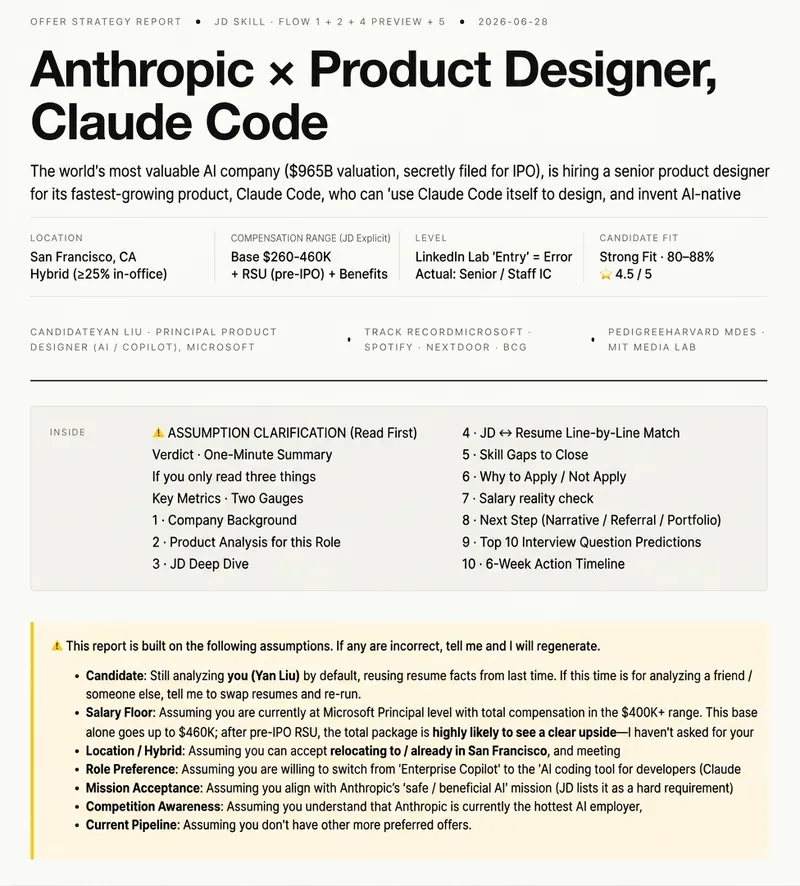 Research
Offer Toolkit
A job search system backed by 10 years of experience at a major Silicon Valley company, packaging genuine hiring insights and job search methodologies into AI. Offer Toolkit | AI Job Search Assistant From "discovering your dream job" to "landing the offer," it breaks down the entire job search process into three smart modules: ① JD Decoder Deeply analyze the job description and generate a personalized Offer Strategy Report: - Whether it's worth applying - Role fit assessment - Core strengths and skill gaps - Interview focus and high-probability question predictions ② Resume Builder Transform your experience from a "job description" into a compelling impact story that recruiters recognize: - Automatically structure your personal experience - Optimize project descriptions and quantify achievements - Generate ATS-friendly, high-quality resumes - Supports 11+ print-ready professional templates ③ Behavioral Story Library Mine your real experiences to build reusable interview story assets: - Extract key projects and growth experiences - Automatically convert to STAR Framework - Build a personal Behavioral Interview Story Bank - Efficiently handle "Tell me about a time..." questions Whether you're debating "should I apply for this job," want to "optimize your resume," need to "analyze a JD," or are preparing for your next behavioral interview, Offer Toolkit will automatically identify your needs and route you to the most suitable AI module. Keywords: Job Search, Offer, Career, Job Hunt, JD, Job Description, Resume, CV, Behavioral Interview, STAR, Tell me about a time, Interview Preparation ------------------------------------- job-description-skill: Paste a JD and your resume, and you'll get an HTML report telling you: whether you should apply for this job, how well you match, what gaps exist, what the interview will likely ask, whether the salary is reasonable, and what to do in the next 6 weeks. resume-skill: Helps you polish your existing resume, import from LinkedIn, or write one from scratch through conversation. Provides 11 print-ready templates (Classic-ATS, Ledger, Tech Compact, Modern Sidebar, Pillar, Elegant Serif, Atelier, Timeline, Swiss, Executive, Color-block). Each time, it provides two files: one directly printable as PDF, and one you can edit by clicking words in the browser. bq-skill: It doesn't give you ready-made answers; instead, it helps you dig out things you've actually done and organize them into a reusable story library. It will ask about your experiences step by step, help you clarify your thinking using STAR/CAR, and tag them with labels like "decision-making" and "overcoming adversity." It saves one copy in Chinese and one in English, so you can use the same story for different behavioral questions next time. It can also look at a JD and predict 20 questions the company might ask, helping you prepare one by one. Three shared rules: 1. No fabrication. All experiences, responsibilities, and numbers come from what the user has actually said. It can help rephrase weak expressions, but it will never invent companies, positions, achievements, or quantified numbers. Numbers must be verified with the user. 2. Ask only one question at a time. Digging stories, building resumes, and preparing BQs are conversations, not questionnaires. 3. Structure first, then output. First convert to a standard data model, confirm it's correct, then render HTML or generate answers.
High-Value Decision Advisor
When you are grappling with 'whether to do something', 'whether to choose a certain option', 'whether it's worth investing resources', or want to review 'why that decision turned out the way it did', this Skill acts like a warm project evaluation advisor, helping you break down vague thoughts into assessable evidence. It is suitable for: - Career choices: whether to change jobs, switch careers, join a startup, pursue graduate studies; - Education and growth investments: whether to enroll children in classes, buy courses, commit to a long-term learning plan; - Project and opportunity evaluation: whether to start a project, take on a partnership, invest resources; - Relationships and life choices: whether to confess feelings, move, change living arrangements; - Historical decision review: review a resignation, postgraduate exam, investment, partnership, or relationship choice. It automatically adjusts the depth of reasoning based on the decision magnitude: - Lightweight decisions: quickly clarify key variables and give brief advice; - Medium-weight decisions: structured analysis around necessity, feasibility, risk, timing, and alternatives; - Heavyweight decisions: full project-style reasoning, outputting risk warnings, directional recommendation, and action paths; - Review-type questions: helps you reconstruct the judgment chain at that time, identify prediction biases and transferable lessons. You can start like this: - 'Should I sign my child up for a 20,000 per year English class?' - 'Should I leave my stable job for a startup?' - 'I want to review my decision last year to resign and study for graduate exams.' - 'I'm not sure whether to confess my feelings, can you help me analyze it?' - 'Is this opportunity worth my time and money?' In the end you will get: - A clear directional recommendation: recommend to proceed / recommend to hold off / recommend to gather more information before deciding; - The confidence level and key uncertainties for each recommendation; - The risks you most easily overlook; - The next minimal validation step. Note: It will not pretend to be certain with insufficient information and make decisions for you; it will help you see the decision basis, risk boundaries, and what to verify next.
 Research
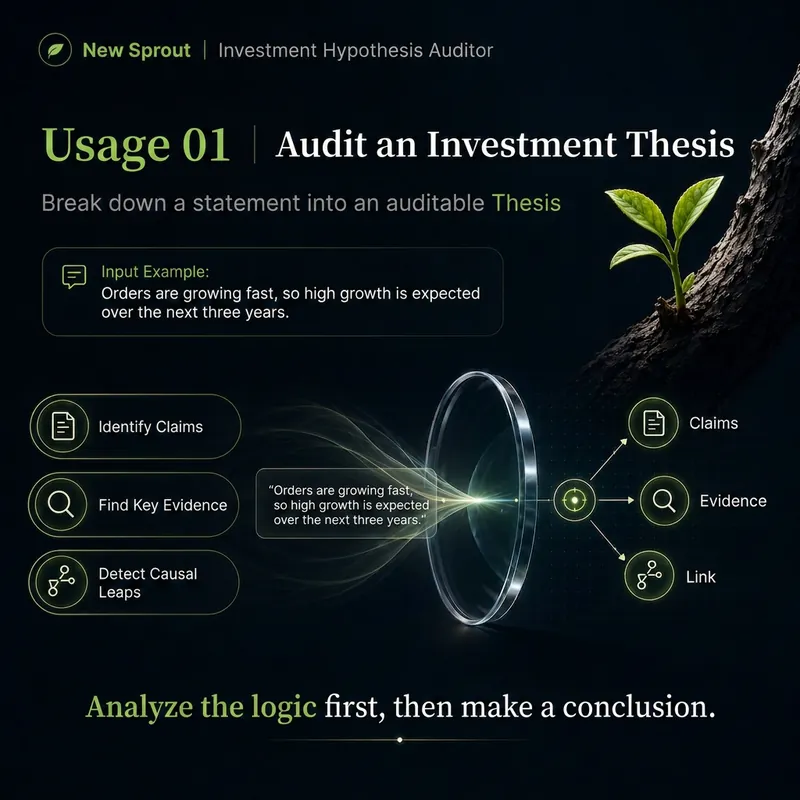
Sprout | Thesis Auditor
Don't help prove my thesis. Help audit it. Many investment judgments fail not because the data is entirely wrong, but because accurate data supports an overextended conclusion. For example: “AI orders are abundant, so profits will definitely grow rapidly over the next three years.” “The company's business is strong, so the stock is cheap right now.” “Customers keep increasing, so the company has already achieved network effects.” “Management says the technology is leading, and it is stated in the financial report, so the moat has been proven.” 「Sprout | Thesis Auditor」does not help you find more reasons to prove yourself right. It breaks your investment thesis into an auditable Critical Path and checks each layer: Facts → Evidence → Causal Relationships → Hidden Assumptions → Commercialization → Economic Outcomes → Valuation By prioritizing primary sources, it answers the questions that truly matter: Which parts have already been supported by evidence? Which are merely reasonable inferences? Which necessary link is most fragile? Is there counterevidence that genuinely attacks the Thesis? What evidence is most likely to change the conclusion? It ultimately assigns one of five ratings: SUPPORTED / PARTIALLY SUPPORTED / FRAGILE / BROKEN / INSUFFICIENT DATA The conclusion must be traceable to specific Necessary Claims and evidence, rather than a vague “on balance” assessment.
Information
- Version
- v3
- Last updated
- Runtime credits
- Usage-based
- Models
- Auto