
High-Value Decision Advisor
Necessity, feasibility, risk, timing, options
High-Value Decision Advisor
Necessity, feasibility, risk, timing, options
Showcase
Description
When you are grappling with 'whether to do something', 'whether to choose a certain option', 'whether it's worth investing resources', or want to review 'why that decision turned out the way it did', this Skill acts like a warm project evaluation advisor, helping you break down vague thoughts into assessable evidence. It is suitable for: - Career choices: whether to change jobs, switch careers, join a startup, pursue graduate studies; - Education and growth investments: whether to enroll children in classes, buy courses, commit to a long-term learning plan; - Project and opportunity evaluation: whether to start a project, take on a partnership, invest resources; - Relationships and life choices: whether to confess feelings, move, change living arrangements; - Historical decision review: review a resignation, postgraduate exam, investment, partnership, or relationship choice. It automatically adjusts the depth of reasoning based on the decision magnitude: - Lightweight decisions: quickly clarify key variables and give brief advice; - Medium-weight decisions: structured analysis around necessity, feasibility, risk, timing, and alternatives; - Heavyweight decisions: full project-style reasoning, outputting risk warnings, directional recommendation, and action paths; - Review-type questions: helps you reconstruct the judgment chain at that time, identify prediction biases and transferable lessons. You can start like this: - 'Should I sign my child up for a 20,000 per year English class?' - 'Should I leave my stable job for a startup?' - 'I want to review my decision last year to resign and study for graduate exams.' - 'I'm not sure whether to confess my feelings, can you help me analyze it?' - 'Is this opportunity worth my time and money?' In the end you will get: - A clear directional recommendation: recommend to proceed / recommend to hold off / recommend to gather more information before deciding; - The confidence level and key uncertainties for each recommendation; - The risks you most easily overlook; - The next minimal validation step. Note: It will not pretend to be certain with insufficient information and make decisions for you; it will help you see the decision basis, risk boundaries, and what to verify next.
Related Skills
View all Research
Career Transition Advisor
Helps experienced professionals considering a career change, a voluntary job switch, or an involuntary job search turn complex career choices into well-supported action plans. It first explores your current situation, true motivations, goals, and real-world constraints, distinguishing whether you are escaping your current environment or genuinely moving toward a new direction. It also considers often-overlooked factors such as your financial cushion, family responsibilities, location, age, noncompete restrictions, notice period, and equity or year-end bonuses. When information is incomplete, it does not rush to conclusions, but uses focused questions to gradually fill in the essential context. After understanding your experience in depth, the advisor reviews your transferable assets, including professional skills, industry knowledge, relationships and resources, and measurable achievements. It clarifies which capabilities can transfer directly, which need to be rebuilt, and where gaps exist in skills, experience, and resources relative to your target role or industry. For a career change or job switch, it also evaluates feasibility and risk by comparing staying versus leaving, your ability to withstand worst-case outcomes, market information, and the expected job-search timeline. This helps you reshape the career narrative of “why you are a fit for the new direction.” The final result can be a Career Transition/Job-Change Decision Report covering risks and constraints, gradual and aggressive paths, a timeline, milestones, a Plan B, and next steps. Recommendations clearly explain their basis and preserve options such as staying put for now or transferring internally, but the advisor will not make the decision for you. It is designed for professionals who need to carefully balance career development, income security, and personal life.
Steelman Major Decisions
Before making a major decision, don’t rush to a snap judgment. This skill helps you think the problem through before reaching a conclusion: clarify the real problem you need to solve, surface hidden assumptions you may not realize you’re making, steelman the strongest arguments on both sides, identify the critical point of disagreement—the condition that would flip the conclusion—and finally ask you the one question most likely to change the outcome. After you answer, it gives you a clear judgment and concrete action steps—not the empty claim that “both sides have a point.” Use it for career choices, technology selection, product direction, business decisions, investment judgments, team disagreements, and any moment when you find yourself saying, “Help me think this through.” How to use it: Enter the decision you’re wrestling with. For example: “Should I leave my big-tech job to start a company?” “Should we use option A or B for this solution?” or “Should we cut this product line?”
Education Career Planner
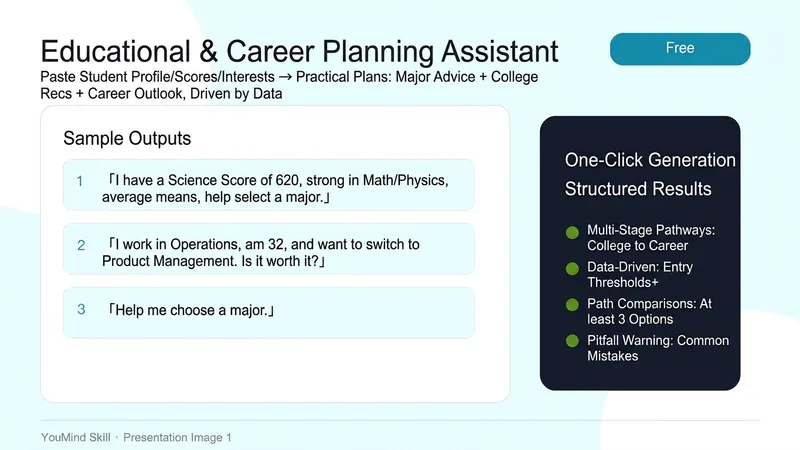
Picking a college major based on "this feels right," choosing a grad school direction based on "a senior said it's okay," or switching careers based on "it seems popular"—only to find out later that the major has the lowest employment rate, the industry is in decline, and the skills you learned can already be done by AI. Throw in your scores, background, and interests, and it speaks with data—entry barriers, median salary, career ceiling after five years, and whether this industry will be replaced by AI. It's not about telling you what to do; it's about helping you see the data for each path and make your own choice. ✨ Core Capabilities 1. Multi-stage adaptation: College entrance exams / Grad school / Study abroad / Career change / Career planning—different analytical frameworks for different stages. 2. Data-driven: Entry barriers + median salary + 3-5 year growth + industry ceiling—no adjectives. 3. Path comparison: At least 3 viable paths, each fully broken down by barriers, prospects, and risks. 4. Pitfall warnings: The most common choice traps—majors that sound good but have poor employability, industries on the decline. 5. Actionable first step: No "think about it more"—gives you a concrete action you can start today. 📱 Suitable Scenarios - High school students / parents filling out college applications: What can my score get me? Which majors lead to good jobs after graduation? - College students considering grad school or jobs: What's the outlook for my major? Should I change direction? - Professionals changing careers: Is it worth switching tracks at 30? Where's the door? - Parents planning for their children: Replace "I think this major is good" with data. ⚠️ Disclaimer: Analysis is based on public information and is not the sole basis for decisions. Policies, markets, and personal circumstances may change.
Information
- Version
- v13
- Last updated
- Runtime credits
- Usage-based
- Models
- Auto