
Steelman Major Decisions
Uncover the real question and decide
Steelman Major Decisions
Uncover the real question and decide
Showcase
Description
Before making a major decision, don’t rush to a snap judgment. This skill helps you think the problem through before reaching a conclusion: clarify the real problem you need to solve, surface hidden assumptions you may not realize you’re making, steelman the strongest arguments on both sides, identify the critical point of disagreement—the condition that would flip the conclusion—and finally ask you the one question most likely to change the outcome. After you answer, it gives you a clear judgment and concrete action steps—not the empty claim that “both sides have a point.” Use it for career choices, technology selection, product direction, business decisions, investment judgments, team disagreements, and any moment when you find yourself saying, “Help me think this through.” How to use it: Enter the decision you’re wrestling with. For example: “Should I leave my big-tech job to start a company?” “Should we use option A or B for this solution?” or “Should we cut this product line?”
Related Skills
View all
High-Value Decision Advisor
When you are grappling with 'whether to do something', 'whether to choose a certain option', 'whether it's worth investing resources', or want to review 'why that decision turned out the way it did', this Skill acts like a warm project evaluation advisor, helping you break down vague thoughts into assessable evidence. It is suitable for: - Career choices: whether to change jobs, switch careers, join a startup, pursue graduate studies; - Education and growth investments: whether to enroll children in classes, buy courses, commit to a long-term learning plan; - Project and opportunity evaluation: whether to start a project, take on a partnership, invest resources; - Relationships and life choices: whether to confess feelings, move, change living arrangements; - Historical decision review: review a resignation, postgraduate exam, investment, partnership, or relationship choice. It automatically adjusts the depth of reasoning based on the decision magnitude: - Lightweight decisions: quickly clarify key variables and give brief advice; - Medium-weight decisions: structured analysis around necessity, feasibility, risk, timing, and alternatives; - Heavyweight decisions: full project-style reasoning, outputting risk warnings, directional recommendation, and action paths; - Review-type questions: helps you reconstruct the judgment chain at that time, identify prediction biases and transferable lessons. You can start like this: - 'Should I sign my child up for a 20,000 per year English class?' - 'Should I leave my stable job for a startup?' - 'I want to review my decision last year to resign and study for graduate exams.' - 'I'm not sure whether to confess my feelings, can you help me analyze it?' - 'Is this opportunity worth my time and money?' In the end you will get: - A clear directional recommendation: recommend to proceed / recommend to hold off / recommend to gather more information before deciding; - The confidence level and key uncertainties for each recommendation; - The risks you most easily overlook; - The next minimal validation step. Note: It will not pretend to be certain with insufficient information and make decisions for you; it will help you see the decision basis, risk boundaries, and what to verify next.
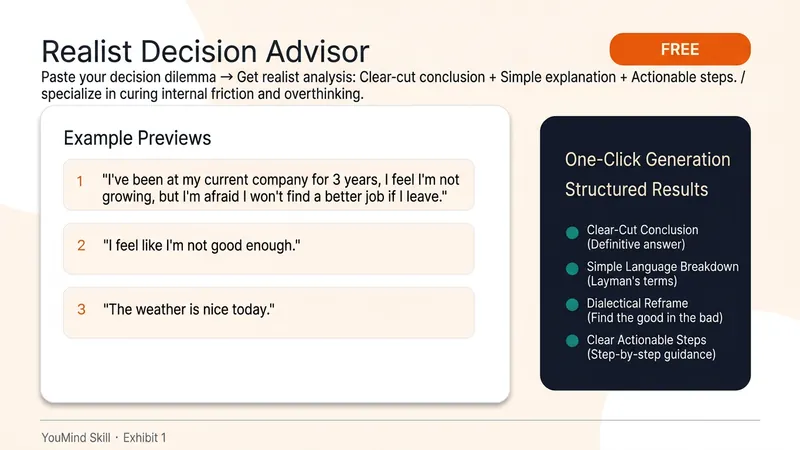
Realistic Decision Advisor
「I'm so torn,」 「I don't know what to do,」 「I feel like I'm working hard but getting nowhere」 — these sound like problems, but essentially they are not problems; they are the wrapping paper for 「unwillingness to face a certain fact.」 Throw your dilemma at it, and it gives you a plain-language conclusion. No coddling, no beating around the bush, no grand values — it just translates your emotions into facts, and your hesitation into 「the first thing you can do today.」 ✨ Core Capabilities 1. First, a conclusion: not 「pros and cons,」 but a direct verdict. 2. Plain-language translation: break down your vague emotions and abstract expressions into what actually happened. 3. Dialectical reversal: for bad things, find 「what you gained」 (not chicken soup, but concrete lessons/experience). 4. Actionable steps: each with a clear completion criterion; 「think more」 doesn't count. 5. Ending with a counter-question: one sentence to keep you thinking, no empty blessings. 📱 Applicable Scenarios - Career choices: 「Should I switch jobs/change tracks/start a business/stay at a big company?」 - Relationships: 「Should I break up/reconcile/keep distance?」 - Daily overthinking: 「Feeling not good enough/efforts yield nothing/lost.」 - Any moment when you feel 「stuck」 but can't pinpoint where. It's not a therapist; it's a friend who dares to tell you the truth.
LessWrong: Disputes & Decisions
Turn controversial issues, policy discussions, article arguments, and comment-section disputes into clearer, testable analysis that can guide action. This skill draws on the LessWrong rationalist tradition, but does not represent an official LessWrong position. Its focus is not on winning debates, but on distinguishing facts, causal explanations, value judgments, policy proposals, predictions, and personal strategies—and avoiding the mistake of treating emotion, conviction, or volume as evidence. It helps you examine evidence quality, unknowns, base rates, and alternative explanations; identify exaggerated claims such as “everyone thinks,” anecdotal reasoning presented as a general rule, attacks on motives, and identity-based arguments; and steelman the other side’s most reasonable position. It also looks for the real disagreements that would change the conclusion and analyzes the relationship between incentives, constraints, and practical action. Whether you are reviewing a controversial article, improving your own argument, understanding a comment-section conflict, or comparing options with incomplete information, you will receive tentative conclusions, key reservations, conditions for updating your judgment, and suggested next steps. For time-sensitive or specialized facts, it will clearly identify what needs further verification rather than filling gaps with false certainty.
Information
- Version
- v3
- Last updated
- Runtime credits
- Usage-based
- Models
- Auto