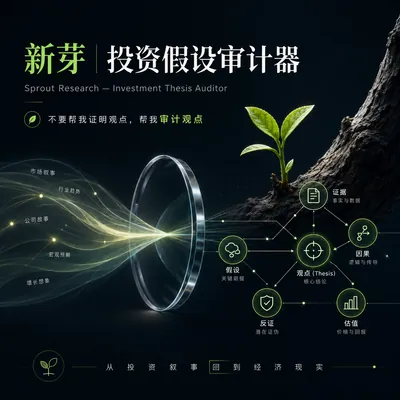
Sprout | Thesis Auditor
Don't prove my thesis—audit it
Sprout | Thesis Auditor
Don't prove my thesis—audit it
Showcase
Description
Don't help prove my thesis. Help audit it. Many investment judgments fail not because the data is entirely wrong, but because accurate data supports an overextended conclusion. For example: “AI orders are abundant, so profits will definitely grow rapidly over the next three years.” “The company's business is strong, so the stock is cheap right now.” “Customers keep increasing, so the company has already achieved network effects.” “Management says the technology is leading, and it is stated in the financial report, so the moat has been proven.” 「Sprout | Thesis Auditor」does not help you find more reasons to prove yourself right. It breaks your investment thesis into an auditable Critical Path and checks each layer: Facts → Evidence → Causal Relationships → Hidden Assumptions → Commercialization → Economic Outcomes → Valuation By prioritizing primary sources, it answers the questions that truly matter: Which parts have already been supported by evidence? Which are merely reasonable inferences? Which necessary link is most fragile? Is there counterevidence that genuinely attacks the Thesis? What evidence is most likely to change the conclusion? It ultimately assigns one of five ratings: SUPPORTED / PARTIALLY SUPPORTED / FRAGILE / BROKEN / INSUFFICIENT DATA The conclusion must be traceable to specific Necessary Claims and evidence, rather than a vague “on balance” assessment.
Recommended by
Shuting@YouMind
Why we love this skill
A decision-focused framework that breaks narratives into traceable claims, separates facts from inferences, and tests causality, valuation assumptions, evidence strength, and falsifiability.
Best for
For investors, researchers, and decision-makers who want to test investment narratives objectively and identify key assumptions and evidence gaps.
How to use this Skill
Provide your input
Enter a one-sentence idea, article, research conclusion, web-based claim, or complete investment thesis. You may also provide relevant materials.
Run the Skill
The system breaks down the investment thesis and checks the links between facts, evidence, causal relationships, key assumptions, commercialization, economic outcomes, and valuation. It identifies weak points and counterevidence.
Review your result
Receive a traceable investment thesis audit distinguishing supported claims, inferences, unknowns, and contradictions, with key gaps and follow-up evidence that could change the conclusion. No buy or sell advice is provided.
Related Skills
View all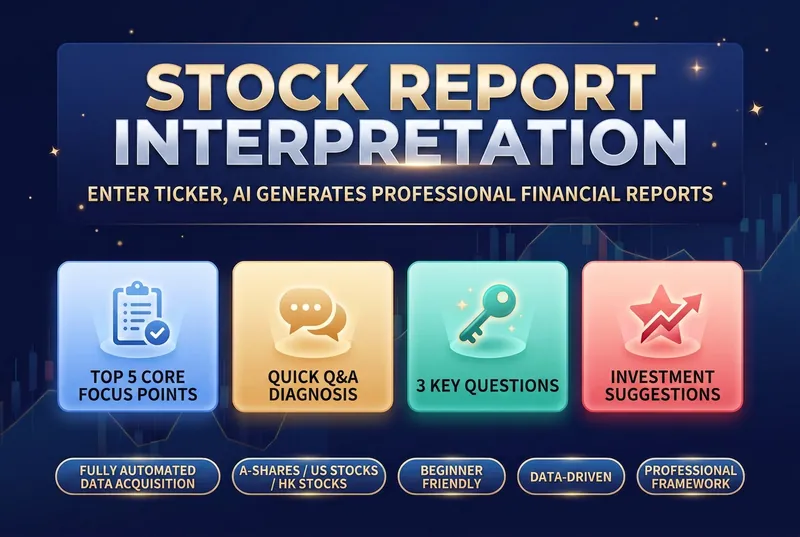
Stock Report Analyzer
Financial reports are a listed company's "physical exam report", but most investors feel lost when faced with pages of dense numbers: • 📝 Can't read the three financial statements — What do the balance sheet, income statement, and cash flow statement tell you? Which numbers matter most? • 🤔 Don't know what to look at — With dozens of pages, which key metrics should you focus on? • 📊 Lack an analysis framework — Even when you find the data, how do you judge good from bad and cross-check it? • 🏭 Industry standards differ — What counts as "good" varies completely by industry; manufacturing and internet companies can't be measured with the same yardstick. • ⏰ Time cost is too high — Manually looking up data, comparing peers, and calculating growth rates can take hours for one report. This skill was built to solve exactly these problems. It automates a professional financial analyst's framework, so you just need to enter a stock code to get a structured, logical, and beginner-friendly financial report interpretation. The tool's core value lies in its rigorous analysis framework, covering multiple dimensions from assessing growth quality to analyzing business models. It not only compares core metrics like revenue, gross margin, net margin, and cash flow, but also runs a quick Q&A on the seven key financial questions investors care about most. It clearly shows whether profits are turning into real cash, and whether receivables and inventory carry potential risks. By benchmarking against industry leaders, it helps you identify a company's true position in its industry chain. When generating the report, it also evaluates valuation levels, core strengths, and potential risks, and offers data-driven recommendations on what to watch. All analysis is presented in intuitive tables and plain, easy-to-understand language, turning complex accounting terms into concrete investment logic. Whether for daily review or deep research, it helps you quickly zero in on the core issue amid massive amounts of data, improving the efficiency and accuracy of your investment decisions.

Fact Check
Hand any opinion, conclusion, data point, or proposal to an AI fact-checker: online source tracing, five-level credibility ratings, and reasoning-chain analysis—followed by a fact-check report you can share directly. 【What it does】Paste any claim, and the skill completes three checks automatically: 🔍 Break it down—separates the claim into “verifiable facts / inferred conclusions / value judgments,” keeping positions distinct from facts 🌐 Trace sources online—verifies sources, samples, statistical definitions, dates, and full context point by point, with cross-checking across multiple channels 🧩 Check the reasoning chain—identifies hidden assumptions, correlation-versus-causation errors, omitted alternative explanations, and the conditions under which the conclusion holds or fails 【Why choose it】 ✅ Five-level credibility ratings: Confirmed / Generally sound but should be narrowed / Contested / Insufficient evidence / Clearly false, with source links for every item ✅ Four-part report: Reliable facts and corrections / The most critical flaws in the reasoning chain / The strongest revised version / How much you can trust it ✅ No made-up answers: When a claim cannot be verified, it is honestly marked “Insufficient evidence” instead of being passed off as “possibly true” ✅ Report-ready output: Share it directly with readers, clients, or your community 【Who it’s for】Independent media and content creators, investors and analysts, students and researchers, and anyone who needs to quickly decide whether a statement can be trusted. 【How to use it】Paste the claim you want checked—anything from one sentence to a paragraph. For example, enter “People with Hashimoto’s thyroiditis often have low energy” to get a source-backed, tiered fact-check report. ⚠️ For medical, legal, investment, and other professional questions, use this for information verification only and rely on qualified professionals for advice.
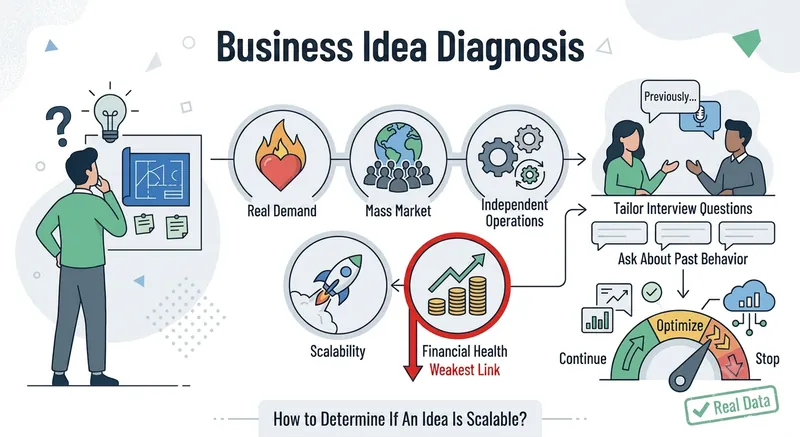
Can Your Business Idea Scale?
One-person company founders and side-hustle explorers: before you invest time and money, do a final calm check with customer data. Supports uploading business plans/BP (PDF/Word/PPT). Unlike the free version—which gives you a quick diagnosis and 3 interview questions to go talk to customers—the full version picks up after you've talked to customers: use customers' real answers (not your own feelings) to rescore the five switches, apply the one-vote veto system, automatically match validation experiments, GO gives a scaling roadmap, PIVOT gives a hypothesis adjustment path, and NO GO helps you extract reusable assets. If you haven't talked to customers yet, the full version can also give you interview questions directly—but it's recommended to first get the quick diagnosis and questions from the free version, talk to customers, and come back with their verbatim responses. The five switches: Is the need real? Can users represent the masses? Can it still run without you? What happens when you scale it 100x? Does selling more make more profit or more loss? If one switch breaks, the whole thing breaks—one-vote veto. Output includes: a customer-data-driven scoring report + 3 types of validation experiment plans (interview / landing page / Wizard of Oz, automatically matched) + GO → scaling roadmap + PIVOT → hypothesis adjustment path + NO GO → reusable asset extraction. Methodology: John List's The Voltage Effect + Rob Fitzpatrick's The Mom Test + Bland & Osterwalder's Testing Business Ideas.
Information
- Version
- v9
- Last updated
- Runtime credits
- Usage-based
- Models
- Auto
- Use cases
- Research & analysisBusiness & strategyInvestment & finance
- What you get
- ReportData