Fact Check
Verify claims, data, and opinions online
Fact Check
Verify claims, data, and opinions online
Showcase
Description
Hand any opinion, conclusion, data point, or proposal to an AI fact-checker: online source tracing, five-level credibility ratings, and reasoning-chain analysis—followed by a fact-check report you can share directly. 【What it does】Paste any claim, and the skill completes three checks automatically: 🔍 Break it down—separates the claim into “verifiable facts / inferred conclusions / value judgments,” keeping positions distinct from facts 🌐 Trace sources online—verifies sources, samples, statistical definitions, dates, and full context point by point, with cross-checking across multiple channels 🧩 Check the reasoning chain—identifies hidden assumptions, correlation-versus-causation errors, omitted alternative explanations, and the conditions under which the conclusion holds or fails 【Why choose it】 ✅ Five-level credibility ratings: Confirmed / Generally sound but should be narrowed / Contested / Insufficient evidence / Clearly false, with source links for every item ✅ Four-part report: Reliable facts and corrections / The most critical flaws in the reasoning chain / The strongest revised version / How much you can trust it ✅ No made-up answers: When a claim cannot be verified, it is honestly marked “Insufficient evidence” instead of being passed off as “possibly true” ✅ Report-ready output: Share it directly with readers, clients, or your community 【Who it’s for】Independent media and content creators, investors and analysts, students and researchers, and anyone who needs to quickly decide whether a statement can be trusted. 【How to use it】Paste the claim you want checked—anything from one sentence to a paragraph. For example, enter “People with Hashimoto’s thyroiditis often have low energy” to get a source-backed, tiered fact-check report. ⚠️ For medical, legal, investment, and other professional questions, use this for information verification only and rely on qualified professionals for advice.
Related Skills
View all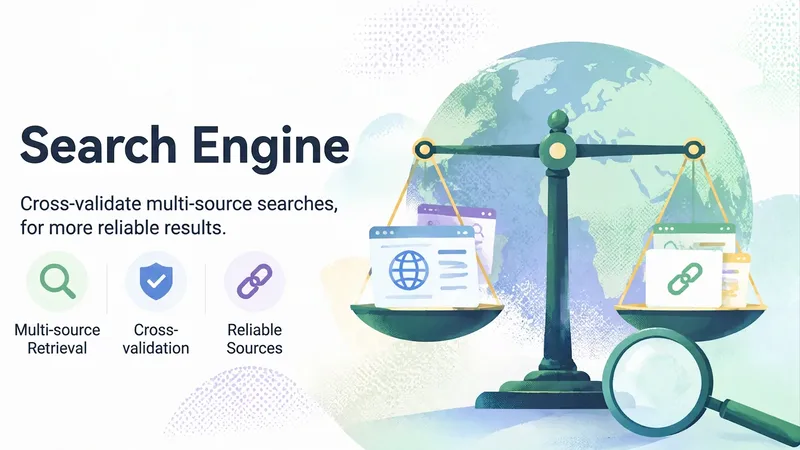
Search Engine
Turn natural-language questions into traceable public web search results for research, fact-checking, finding public-account articles, troubleshooting program errors, and searching for papers, technical documentation, and open-source projects. For topics requiring current information or evidence from multiple sources, it combines Chinese and international search results across different types of public sources, helping reduce omissions and bias from relying on a single search engine. In addition to summarizing relevant pages, it organizes titles, sources, links, and available publication dates, merges duplicate results, and distinguishes independent evidence from different organizations or websites. For key claims, the results present supporting and opposing information, disagreements between sources, and a credibility assessment based on the amount and quality of the evidence. This helps you see which points are supported by cross-checking and which remain isolated claims or cannot be confirmed. You can enter search terms or a claim to verify directly, and add a field, time range, region, language preference, or specific websites. The final output includes a structured search summary, source list, cross-checking results, and items requiring verification. Content that cannot be accessed, requires login, or has scraping restrictions is clearly marked; speculation is never used in place of real sources.
 Research
Company Background Checker
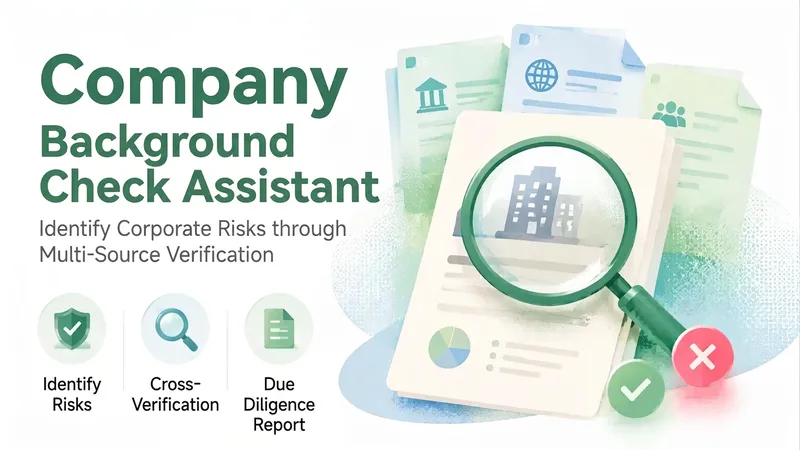
The Company Background Checker uses a tiered evidence verification method to check the authenticity of partners, suppliers, bidders, and internship providers. It identifies risks such as qualification grafting, data inflation, time anomalies, entity mismatches, metric mixing, performance misattribution, disguised dispatching, and omitted negative facts, producing due diligence conclusions that can be directly reported to leadership and written into contracts. Each conclusion is tagged across two dimensions: evidence nature (A-G: statutory registration, official lists, judicial supervision, annual reports, commercial databases, public web, inference) and source status (original official, official reference, commercially processed, self-reported), strictly distinguishing between disproven, unverified, and lacking evidence. It includes a built-in data source accessibility table and integration tiers. For listed or bond-issuing entities, it first reads disclosures from Cninfo and stock exchanges; for unlisted micro-enterprises, it provides alternative pathways for login walls and an industry metrics exception table. It enforces strict group-to-legal-entity attribution and includes 13 omission checks. Version 2.4 adds a bidding and supplier admission module: distinguishing bidding from winning, verifying performance entity attribution, grading licenses and certifications across four levels, checking three discredited lists according to regulatory standards with one-vote veto, and delivering a one-page conclusion card, evidence request letter, and contract risk clause package, complete with 18 regression self-checks. Version 2.5 adds an educational scenario module for reviewing school-enterprise partners, internship providers, and employment agencies, incorporating admission criteria and red lines based on vocational school internship regulations, using five criteria to identify disguised dispatching, prohibiting intermediary involvement and proxy fee collection, mandating tripartite agreements and internship liability insurance, and noting that these regulations serve as references for general undergraduate institutions. Version 2.5.1 introduces a final delivery gate with six-item skip-step consistency checks, an evidence chain self-verification table, a single-screen five-piece delivery set, anti-patterns, and a channel fact cold-start table. It disables commercial database inferred fields like enterprise scale or ratings. It supports four modes: basic risk overview from company name alone, targeted verification with company name and claims, page-level verification of uploaded materials, and integration consulting. It triggers when users mention background checks, due diligence, partner or supplier reviews, bidding qualifications, internship provider checks, school-enterprise reliability, cross-validation, or requests to verify specific companies. It is not suitable for legally binding due diligence requiring a law firm or classified military qualification reviews.
Proposal Readiness Checker
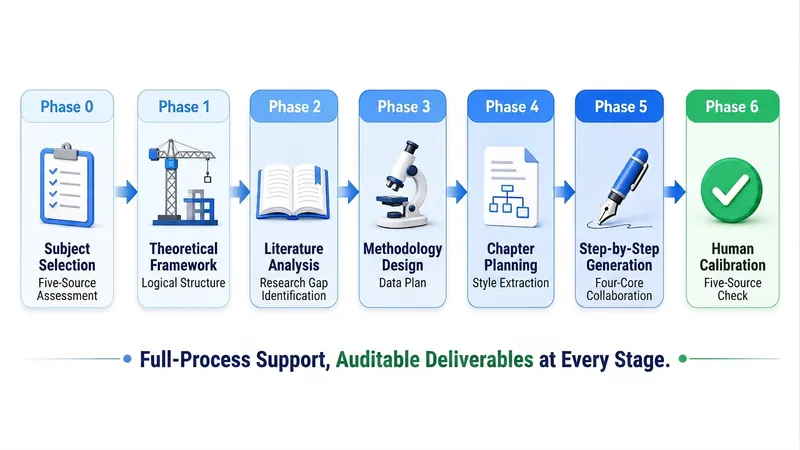
Before you spend dozens of hours writing your thesis, take ten minutes to run a structured checkup. This skill does only one thing: It diagnoses, not writes. It tells you whether your topic can hold up, whether your materials are sufficient, what's missing, where to fill the gaps, and in what order. Then it gives you an actionable missing-material checklist and search queries. It will not write your introduction, literature review, methods, or discussion. Four steps: 1. Discipline diagnosis: Classify your work into 1A Humanities/Arts, 1B Social Sciences, 2A Science/Engineering, or 2B Agriculture/Medicine/Life Sciences, and load the corresponding regulatory red lines; 2B triggers a mandatory ethics review block. 2. Topic checkup: Examine the topic from three dimensions—momentum, shape, and wording—to judge whether the research unit can be operationalized, whether the research question can be answered, and whether the topic has been done to death. 3. Material checkup: Register your existing literature into an M1/M2… material library, verify each entry against the four elements (author/year/title/verifiable locator), and compute the true coverage rate. 4. Gap list and search queries: Specify how many papers of what type are missing and which piece of evidence is lacking, and provide search queries ready to paste into databases (including Boolean keyword combinations, time ranges, and screening criteria). When to use it (trigger phrases): "Help me check my proposal" "Can this topic work?" "Do I have enough literature?" "My proposal was sent back" "I want to confirm before starting to write" — for graduate students who have just set a direction but haven't started writing; for those whose proposal was rejected but don't know why; for those with a pile of literature but unsure if it's enough to begin; for those wanting to confirm whether the topic is worth the investment before committing fully. Deliverables: A Proposal Checkup Report document + a Five-Source Readiness Scorecard (each level has behavioral criteria, not vague scoring) + a prioritized list of missing materials + search queries + an archive code. The archive code is compatible with the Academic Paper Full-Process Writing System v4.0; after the checkup, paste it there to continue writing without re-stating your discipline, topic, or journal. What this skill explicitly does not do: It does not write the main text, generate reference lists, or fabricate authors, years, volumes, issues, pages, or DOIs. Any literature found via online search is flagged with ⚠️ "needs verification" and must be verified by you before use. This skill does not promise any acceptance or passing outcome.
Information
- Version
- v3
- Last updated
- Runtime credits
- Usage-based
- Models
- Auto
