Shuang Chen
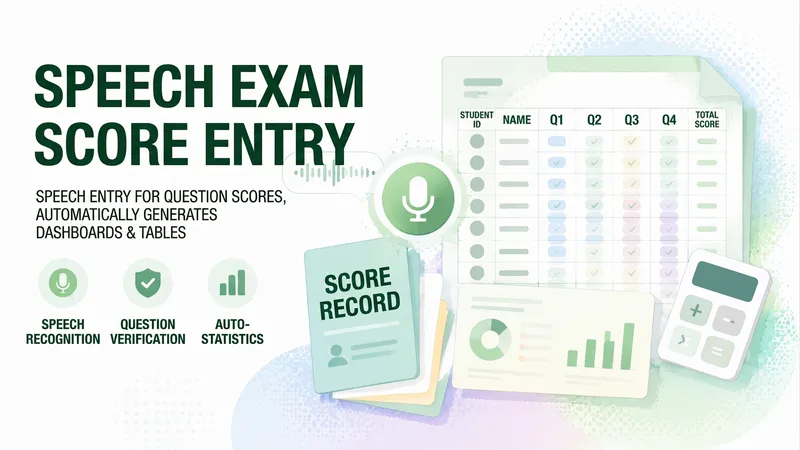
Voice Score Entry: Mastery
Read the roster, exam, and mastery template; enter scores by voice in batches, with strict per-question validation and persistent ledger storage. After every 10 new students, automatically generate a readable master score table with template columns, with support for resuming from where you left off and exporting statistics. When entering scores, say only the last two or three digits of a student's ID, and the system matches the student automatically. For example, if Question 7 is incorrect among 10 single-choice questions, simply say, “Single-choice question 7 incorrect.” For short-answer questions, you can say, “Short-answer: 8 points, 8 points, 3 points.” For multiple-choice questions, you can say “full credit,” and so on. Recording five students at a time is recommended.

全套课件生成(教案/活动/板书/练习+每章40 页参赛级 PPT)
输入课题与基本信息(教材范围、授课对象、学时、课型),按固定骨架与统一的学术讲义风格,一次生成「备课五件套」:逐字稿教案、课堂活动与互动提问设计、板书设计、随堂练习四份文档,以及约 40 页参赛级 PPT。文档结构固定、内容随课题自适应;PPT 沿用同一套视觉契约(跨课一致),按「先生成图片、再 slidesCompose 合成」两步法产出,并自动回写课程记忆。适用于各学科、各学段。
 Write
WriteWork Newswriting Coach
Work Newswriting Coach turns scattered materials from meetings, events, research visits, field visits, and training sessions into publication-ready standard news releases. It first gathers details like a reporter—when information is incomplete, it asks up to 3 questions at a time and guides you step by step, marking gaps as [To be added] and never making anything up. Like an editor, it identifies the news value, builds the structure, and provides 2–3 headline options. Like a skilled writer, it produces a complete draft with the headline, lead, body, background, closing, captions, and byline. Finally, like a quality inspector, it checks each item and scores the draft out of 100; drafts scoring below 70 are not delivered. Supports on-site photo uploads: it reminds you to provide photos, arranges them in the order they appear in the article, and writes a “Photo N + caption” entry for each image. When no photos are available, it provides a “must-capture shot list.” Built-in guidance covers wording restrictions for university and government work news—including leader titles and order, “attended” versus “participated,” and prohibited terms—as well as inverted-pyramid structure standards, helping drafts pass communications office review more quickly. For: university students and faculty, publicity staff, correspondents at government agencies and businesses, and social media operators. English: A step-by-step institutional newswriting coach that turns raw event notes and photos into publication-ready Chinese news releases, with strict fact-fidelity rules. Triggers: write a news release / work news / event report / press release / publicity copy / newswriting / add photo captions / revise a news release.

Marketing Plan Architect
A marketing competition proposal coach for students and instructors. Grounded in real-world business problems, it guides you through understanding the competition brief, research, data analysis and chart creation, brand positioning and visual design, marketing strategy, event execution, budget estimates, proposal writing, and defense preparation. It supports co-creation from scratch, chapter-by-chapter guidance, diagnosis of existing drafts, pre-submission review, defense practice, and post-review revision. Together with the judge Skill (Marketing-Proposal-Judge), it creates a “write → review → revise → re-review” loop: the post-review revision mode turns the judge’s improvement checklist into actionable revisions—including chart templates, cultural material research and usage boundaries, creative event design, a VI brief, and expanded defense content—along with a student research toolkit. Data analysis produces standardized tables and renderable charts, including Mermaid pie charts, flowcharts, Gantt charts, and xyChart. Brand design provides methods for developing positioning statements, brand personality, and a VI visual brief. It does not mechanically stack models, fabricate research, or promise awards. Get started by providing a brand or product, competition rules, and existing materials; when data is unavailable, it begins by designing the research. This marketing competition proposal coach supports research, data analysis and charting, brand positioning and visual design, strategy, execution, budgeting, writing, defense preparation, and post-review revision in a write-review-revise-re-review loop.

Marketing Proposal Judge
Evaluates marketing, brand, and startup proposals from the perspective of an experienced judge, providing actionable improvement advice. Based on review criteria distilled from outstanding past submissions—including brand proposals, marketing plans, and business plans—it diagnoses work across seven dimensions: structural completeness; evidence and data quality; positioning and marketing strategy; business model and finance; proven results; social value; and presentation. It outputs a category-by-category scorecard, a summary of strengths, a prioritized improvement checklist, and predicted defense questions. Supports a re-review mode that compares scores from the previous round, verifies completion of each improvement item, and shows before-and-after results. It also identifies the work's status—working draft, validation draft, or submission draft—to calibrate scoring; checks the authenticity of cultural narratives, cost constraints for creative activities, and standards for figure, table, and contents lists. Suitable for pre-competition refinement, peer review, classroom critique, and pre-submission checks. It does not fabricate official scores or invent missing data. Competition proposal judge: evaluates marketing, brand, and startup proposals from an experienced judge's perspective and provides actionable advice across structure, evidence and data quality, positioning and marketing, business model and finance, proven results, social value, and presentation. Supports re-review mode with before-and-after comparisons. Trigger terms: proposal scoring, judge's perspective, work critique, improvement advice, pre-competition refinement, proposal diagnosis, peer review, classroom critique, national competition standards, re-review, before-and-after comparison

Social Science Lit Review
A staged guidance system for narrative literature reviews in the social sciences. It follows the AFP methodology—building the background → creating a classification framework → critical evaluation → deriving research gaps → integration audit—to gather information step by step, save intermediate results, and generate a review with traceable citations. Example: “Use the Social Science Literature Review Guide to help me write a literature review.” Scenario: undergraduate thesis proposal; topic example: mechanisms for improving organizational resilience in small and medium-sized enterprises undergoing digital transformation; literature: Zhang San (2022)… (provide 3–5 entries in the format author (year): one-sentence finding); length: 5,000–8,000 words, GB/T 7714 format.

Officialese Translator
Translate plainspoken language into officialese: enter a plain-language or conversational expression and receive formal wording in the “We don’t say… We say…” format. In advanced mode, enter a description of a situation or event to receive a complete passage of formal official language. Includes 10 general-purpose categories, plus terminology libraries for 8 specialized fields: economic and industrial development, education and talent, rural revitalization and agriculture, rural areas and farmers, the business environment, ecology and environmental protection, grassroots governance, health and medical care, and scientific and technological innovation. It also includes dedicated preparation materials for the civil service exam essay section, including question-type strategies, standard terms for frequent topics, official-document templates, and high-impact essay phrases—more than 200 comparisons and versatile sentence patterns in total. Suitable for civil service selection written tests and interviews, civil service interviews, exam essay writing, official-document writing, and learning how to communicate within government institutions. Trigger words: officialese translator, official language, formal language, plain-language translation, official-document style, government workplace phrasing, bureaucratic language, civil service selection, interview, civil service exam essay, civil service exam, long-form essay, official-document writing, economy, education, rural revitalization. Example: Input 【The child doesn’t listen and wants to buy everything they see.】 Output: This is a single-sentence quick conversion. I’ll translate it using “Officialese Translator” Mode A. We don’t say “The child doesn’t listen and wants to buy everything they see.” We say: “Some minors still lack effective guidance regarding their consumer needs. Their awareness of rational consumption needs to be cultivated, and the primary role of family education in developing habits must be further strengthened. Effective steps should be taken to help them establish sound consumption values and develop the habit of distinguishing reasonable needs.” If you need it expressed point by point, you could also say: We don’t say “The child wants to buy whatever they see.” We say that rational consumption awareness has not yet been formed. We don’t say “They can’t be controlled.” We say that the family’s responsibility for educational guidance needs to be firmly implemented. We don’t say “The more they buy, the greedier they get.” We say that the expression of needs lacks effective restraint and that developing sound behavioral habits requires sustained effort. Translation notes (self-check): Facts preserved: In shopping situations, the child asks to buy anything they see—it remains unchanged. Emotional detachment: The blame and exasperation in “doesn’t listen” have been removed and converted into neutral descriptions such as “lacks guidance” and “needs cultivation.” Softened absolutes: The exaggerated sense of “wants to buy everything they see” has been moderated to “consumer needs lack effective guidance.” Higher-level perspective: The focus has shifted from a parent’s personal complaint to the structured perspective of family education’s primary responsibility and the cultivation of sound consumption values. Room for nuance: Words such as “some,” “needs,” and “must be further” preserve flexibility rather than making an absolute statement. Would you like me to use Mode B to expand this into a complete “parent meeting speech” or “family education situation statement”? 【Need】 Completed in 15s All right. Using “Officialese Translator” Mode B (advanced situation paragraph), I’ll expand this into a complete, coherent formal statement. The following is a four-paragraph version in the style of a “Family Education Situation Statement”: Statement on Family Education Regarding Children’s Irrational Consumption Behavior With the fundamental task of fostering virtue through education in mind and with a focus on the overall healthy development of children, family education plays an irreplaceable foundational role in developing habits and shaping values. We must consistently follow a problem-oriented and results-oriented approach and ensure that guidance responsibilities are effectively fulfilled. Based on recently observed circumstances, some children display behaviors such as asking to buy anything they see in daily consumption settings and expressing their needs without restraint. To some extent, this reflects that their awareness of rational consumption has not yet fully developed and that there remains room for improvement in the family’s guidance regarding habit formation. Such behavior is common during the process of growing up. It is advisable to identify, intervene, and guide early, while avoiding overly simplistic responses. Accordingly, efforts should focus on the following areas: First, emphasize positive guidance and help children clarify the difference between “needs” and “wants,” explaining the principles of consumption clearly and thoroughly. Second, focus on daily habit formation by establishing family spending rules and practicing appropriate delayed gratification to gradually cultivate rational consumption habits. Third, strengthen parent-child communication, gain a deeper understanding of the psychological factors behind children’s requests to buy things, and combine appropriate boundaries with communication and role modeling. Fourth, strengthen coordination between families and schools, bring together educational resources, and jointly create a positive environment for children to grow up learning thrift and rational consumption. Developing good habits in children does not happen overnight. We must proceed step by step and maintain sustained effort, effectively fulfill the primary responsibility of family education, guide children’s healthy and happy growth in subtle and consistent ways, and continually strengthen families’ sense of fulfillment, happiness, and security in education and guidance. Translation notes: Facts unchanged: The child asks to buy anything they see, and the parent needs to provide guidance—both are fully retained. Emotional detachment: The blaming tone of “doesn’t listen” has been removed and changed to “expresses needs without restraint” and “there is room for guidance.” Softened absolutes: “Wants to buy everything they see” has been narrowed to “some children” and “to some extent.” Higher-level perspective: The focus has shifted from a parent’s personal complaint to the broader perspective of fostering virtue through education, the primary responsibility of family education, and family-school coordination. Room for nuance: Phrases such as “identify, intervene, and guide early” and “does not happen overnight” leave room for continued effort. No overstatement: The situation is characterized as “common during the process of growing up,” without forcing it into an overly broad strategic framework. If you want a parent meeting speech—with an address to the audience, an opening, key points, action requirements, and a closing call to action—or want it written as an exam-essay response to a policy question, tell me and I’ll prepare the corresponding version.

Opportunity Radar
Opportunity Radar scans for earning opportunities and subsidies relevant to your profile—based on your city, identity, education, and field of study. These may include city talent subsidies, student and recent graduate subsidies, residency and rental subsidies, skills training subsidies, scholarships and competitions, internships at major companies, and summer programs. Workflow: load your profile → search across multiple sources → match eligibility criteria → remove duplicates → provide prioritized reports → prepare application materials (without submitting applications on your behalf). Trigger phrases: Opportunity Radar, scan for opportunities, what subsidies can I claim, available subsidies, ways to make money, find perks, internship opportunities, summer programs, talent policies. Suitable for manual use, or for automatic execution daily, every 2 days, or every 3 days with a scheduled task.

Thesis Advisor (Xingxing)
A guide for undergraduate thesis writing, from topic selection to defense, reviewing your draft from the perspective of a reviewer or defense committee member. It identifies issues, suggests improvements, and provides a preliminary grade. Particularly suited for undergraduate theses at Shaoguan University. Scores below 80 are not recommended for the defense.