
Officialese Translator
Officialese Translator
Showcase
Description
Translate plainspoken language into officialese: enter a plain-language or conversational expression and receive formal wording in the “We don’t say… We say…” format. In advanced mode, enter a description of a situation or event to receive a complete passage of formal official language. Includes 10 general-purpose categories, plus terminology libraries for 8 specialized fields: economic and industrial development, education and talent, rural revitalization and agriculture, rural areas and farmers, the business environment, ecology and environmental protection, grassroots governance, health and medical care, and scientific and technological innovation. It also includes dedicated preparation materials for the civil service exam essay section, including question-type strategies, standard terms for frequent topics, official-document templates, and high-impact essay phrases—more than 200 comparisons and versatile sentence patterns in total. Suitable for civil service selection written tests and interviews, civil service interviews, exam essay writing, official-document writing, and learning how to communicate within government institutions. Trigger words: officialese translator, official language, formal language, plain-language translation, official-document style, government workplace phrasing, bureaucratic language, civil service selection, interview, civil service exam essay, civil service exam, long-form essay, official-document writing, economy, education, rural revitalization. Example: Input 【The child doesn’t listen and wants to buy everything they see.】 Output: This is a single-sentence quick conversion. I’ll translate it using “Officialese Translator” Mode A. We don’t say “The child doesn’t listen and wants to buy everything they see.” We say: “Some minors still lack effective guidance regarding their consumer needs. Their awareness of rational consumption needs to be cultivated, and the primary role of family education in developing habits must be further strengthened. Effective steps should be taken to help them establish sound consumption values and develop the habit of distinguishing reasonable needs.” If you need it expressed point by point, you could also say: We don’t say “The child wants to buy whatever they see.” We say that rational consumption awareness has not yet been formed. We don’t say “They can’t be controlled.” We say that the family’s responsibility for educational guidance needs to be firmly implemented. We don’t say “The more they buy, the greedier they get.” We say that the expression of needs lacks effective restraint and that developing sound behavioral habits requires sustained effort. Translation notes (self-check): Facts preserved: In shopping situations, the child asks to buy anything they see—it remains unchanged. Emotional detachment: The blame and exasperation in “doesn’t listen” have been removed and converted into neutral descriptions such as “lacks guidance” and “needs cultivation.” Softened absolutes: The exaggerated sense of “wants to buy everything they see” has been moderated to “consumer needs lack effective guidance.” Higher-level perspective: The focus has shifted from a parent’s personal complaint to the structured perspective of family education’s primary responsibility and the cultivation of sound consumption values. Room for nuance: Words such as “some,” “needs,” and “must be further” preserve flexibility rather than making an absolute statement. Would you like me to use Mode B to expand this into a complete “parent meeting speech” or “family education situation statement”? 【Need】 Completed in 15s All right. Using “Officialese Translator” Mode B (advanced situation paragraph), I’ll expand this into a complete, coherent formal statement. The following is a four-paragraph version in the style of a “Family Education Situation Statement”: Statement on Family Education Regarding Children’s Irrational Consumption Behavior With the fundamental task of fostering virtue through education in mind and with a focus on the overall healthy development of children, family education plays an irreplaceable foundational role in developing habits and shaping values. We must consistently follow a problem-oriented and results-oriented approach and ensure that guidance responsibilities are effectively fulfilled. Based on recently observed circumstances, some children display behaviors such as asking to buy anything they see in daily consumption settings and expressing their needs without restraint. To some extent, this reflects that their awareness of rational consumption has not yet fully developed and that there remains room for improvement in the family’s guidance regarding habit formation. Such behavior is common during the process of growing up. It is advisable to identify, intervene, and guide early, while avoiding overly simplistic responses. Accordingly, efforts should focus on the following areas: First, emphasize positive guidance and help children clarify the difference between “needs” and “wants,” explaining the principles of consumption clearly and thoroughly. Second, focus on daily habit formation by establishing family spending rules and practicing appropriate delayed gratification to gradually cultivate rational consumption habits. Third, strengthen parent-child communication, gain a deeper understanding of the psychological factors behind children’s requests to buy things, and combine appropriate boundaries with communication and role modeling. Fourth, strengthen coordination between families and schools, bring together educational resources, and jointly create a positive environment for children to grow up learning thrift and rational consumption. Developing good habits in children does not happen overnight. We must proceed step by step and maintain sustained effort, effectively fulfill the primary responsibility of family education, guide children’s healthy and happy growth in subtle and consistent ways, and continually strengthen families’ sense of fulfillment, happiness, and security in education and guidance. Translation notes: Facts unchanged: The child asks to buy anything they see, and the parent needs to provide guidance—both are fully retained. Emotional detachment: The blaming tone of “doesn’t listen” has been removed and changed to “expresses needs without restraint” and “there is room for guidance.” Softened absolutes: “Wants to buy everything they see” has been narrowed to “some children” and “to some extent.” Higher-level perspective: The focus has shifted from a parent’s personal complaint to the broader perspective of fostering virtue through education, the primary responsibility of family education, and family-school coordination. Room for nuance: Phrases such as “identify, intervene, and guide early” and “does not happen overnight” leave room for continued effort. No overstatement: The situation is characterized as “common during the process of growing up,” without forcing it into an overly broad strategic framework. If you want a parent meeting speech—with an address to the audience, an opening, key points, action requirements, and a closing call to action—or want it written as an exam-essay response to a policy question, tell me and I’ll prepare the corresponding version.
Related Skills
View all
Tailored Parenting Dialogues
Waking up, sulking, seeing a news article... everyday little things are opportunities for seamless guidance. It helps you see the opportunity and know how to start a conversation. ⚡ Review Past Events 「My child came home today and said a classmate took his eraser and hasn't returned it. He's angry but afraid to tell the teacher.」 → We'll walk through: spot the opportunity, create the dialogue, listen attentively, respond effectively. A virtual practice so you'll feel confident next time in a similar situation; practice more and you'll be able to handle new scenarios on your own. 🔮 Anticipate What Hasn't Happened Yet 「Next week is parent-teacher conference; your child's grades have dropped — that conversation on the way home is a perfect opportunity for seamless guidance.」 → Prepare in advance how to say it, turning everyday moments (including possibly negative situations) into conversations your child can actually hear. Each Output ⚡ 30-Second Overview — A quick glance when you're busy shows you how to start. 📋 Complete Dialogue Plan — Spot, Create, Listen, Respond: four steps. Includes: three opening phrases (each with the exact words and rationale), branched contingency plans for listening and responding (possible child reactions + how you respond), and extrapolation. About the Author She has a natural sensitivity to the countless parenting situations in daily life. Where others see a child sulking, she sees a complete path: spot the opportunity, create the dialogue, listen attentively, respond effectively. For over two decades, this path has been refined through three identities: a mother's dedicated practice, a researcher's continuous observation, and a family education teacher's repeated reflection. The fusion of these three has given her mature and practical judgment on 'when and how to talk.' The logic behind this Skill comes from her over 20 years of dedicated observation and personal validation. Her own child left home early for studies, with little togetherness over the past decade, yet they have an excellent parent-child relationship that friends envy. It turns out that conversations nurtured with heart, emotion, and love withstand any separation. A good parent-child relationship doesn't rely on being together every day, but on speaking and listening the right way at the right moment. We're glad you've opened this Skill. Let's practice together step by step. :) 💡 Complementary Usage Suggestions: - Want to know how to say it? → Use this Skill. - Child doesn't want to do anything, no interest? → Use with 'Motivation Engine: What to do when your child is not proactive'. - Child's emotions out of control, explosive? → Use with 'Emotion Engine: What to do when your child is emotionally out of control'.

Motivation: Unmotivated Child?
Your child won't do homework, is addicted to their phone, says "I can't learn it," seems self-motivated but stops whenever you stop pushing… The problem isn't laziness—it's that their motivation system is stuck. Describe the situation in one sentence and get: ⚡ A 30-second overview — which gear is missing (autonomy/mastery/purpose/high-compliance) + one action to take today 📋 A complete solution — not just conversation, but also environmental adjustments, habit design, and non-verbal strategies Includes: scripts you can use today, how to change the physical environment, how to leave gaps in the schedule, a 7-day action checklist (printable to put on the fridge) 🔮 Learn from one instance to others — this time it's homework, next time it's piano practice or chores, you'll know what to do --- Suitable for ages 3–18, with different approaches for different ages | Address what's missing, not just academics—also applies to life habits and interest cultivation --- 💡 Recommended pairing: - To know "what to say": use 「一事一策·育儿情境对话定制」 - To solve "motivation problems": use 「内驱力引擎」 - Use both together for double the effect
 Research
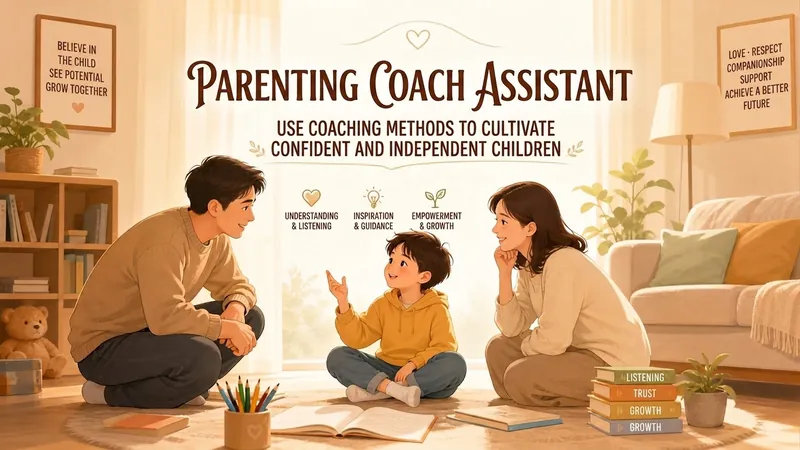
Coaching Parenting Assistant
[闭嘴] Between you and your child, all it takes is the right way to speak. [汗] You've tried: Reasoning with him — he shuts the door. Losing your temper — you feel guiltier. Biting your tongue — nothing changes. Your family doesn't lack love, it lacks a set of coaching communication methods. Not coaxing, not preaching, not 'I'm doing this for your own good.' It's about letting the child say 'I want to do it,' not 'You want me to do it.' [玫瑰] This isn't empty inspiration. It's the core methodology of a 3980-yuan coaching parenting course — the **See → Be Curious → Inspire → Co-create** four-step dialogue framework. - Kid addicted to phone? Not confiscation, it's setting boundaries together. - Anxious and slacking off before exams? Not saying 'You can do it,' but asking 'What do you need?' - You say ten words and he talks back? Change how you ask so he speaks up himself. [咖啡] This skill solves the everyday communication chaos in your home. And along the way, it lights up your child's inner drive.
Information
- Version
- v9
- Last updated
- Runtime credits
- Usage-based
- Models
- Auto