
Search Engine
Search, fact-check, and debug across sources
Search Engine
Search, fact-check, and debug across sources
Showcase
Description
Turn natural-language questions into traceable public web search results for research, fact-checking, finding public-account articles, troubleshooting program errors, and searching for papers, technical documentation, and open-source projects. For topics requiring current information or evidence from multiple sources, it combines Chinese and international search results across different types of public sources, helping reduce omissions and bias from relying on a single search engine. In addition to summarizing relevant pages, it organizes titles, sources, links, and available publication dates, merges duplicate results, and distinguishes independent evidence from different organizations or websites. For key claims, the results present supporting and opposing information, disagreements between sources, and a credibility assessment based on the amount and quality of the evidence. This helps you see which points are supported by cross-checking and which remain isolated claims or cannot be confirmed. You can enter search terms or a claim to verify directly, and add a field, time range, region, language preference, or specific websites. The final output includes a structured search summary, source list, cross-checking results, and items requiring verification. Content that cannot be accessed, requires login, or has scraping restrictions is clearly marked; speculation is never used in place of real sources.
Best for
Users who need public research, fact-checking, technical troubleshooting, or papers and open-source projects.
How to use this Skill
Provide your input
Enter a natural-language query or claim to verify. You can add a field, time range, region, language preference, and websites to include or exclude.
Run the Skill
Search across multiple public sources, organize and deduplicate results, compare independent evidence, and note sources, disagreements, accessibility, and verification confidence.
Review your result
Receive a structured search summary, source list, cross-checking results, and items requiring verification. Inaccessible or unsupported content is clearly marked.
Related Skills
View all
Fact Check
Hand any opinion, conclusion, data point, or proposal to an AI fact-checker: online source tracing, five-level credibility ratings, and reasoning-chain analysis—followed by a fact-check report you can share directly. 【What it does】Paste any claim, and the skill completes three checks automatically: 🔍 Break it down—separates the claim into “verifiable facts / inferred conclusions / value judgments,” keeping positions distinct from facts 🌐 Trace sources online—verifies sources, samples, statistical definitions, dates, and full context point by point, with cross-checking across multiple channels 🧩 Check the reasoning chain—identifies hidden assumptions, correlation-versus-causation errors, omitted alternative explanations, and the conditions under which the conclusion holds or fails 【Why choose it】 ✅ Five-level credibility ratings: Confirmed / Generally sound but should be narrowed / Contested / Insufficient evidence / Clearly false, with source links for every item ✅ Four-part report: Reliable facts and corrections / The most critical flaws in the reasoning chain / The strongest revised version / How much you can trust it ✅ No made-up answers: When a claim cannot be verified, it is honestly marked “Insufficient evidence” instead of being passed off as “possibly true” ✅ Report-ready output: Share it directly with readers, clients, or your community 【Who it’s for】Independent media and content creators, investors and analysts, students and researchers, and anyone who needs to quickly decide whether a statement can be trusted. 【How to use it】Paste the claim you want checked—anything from one sentence to a paragraph. For example, enter “People with Hashimoto’s thyroiditis often have low energy” to get a source-backed, tiered fact-check report. ⚠️ For medical, legal, investment, and other professional questions, use this for information verification only and rely on qualified professionals for advice.
 Webpage
网站SEO体检|问题证据与修复复查
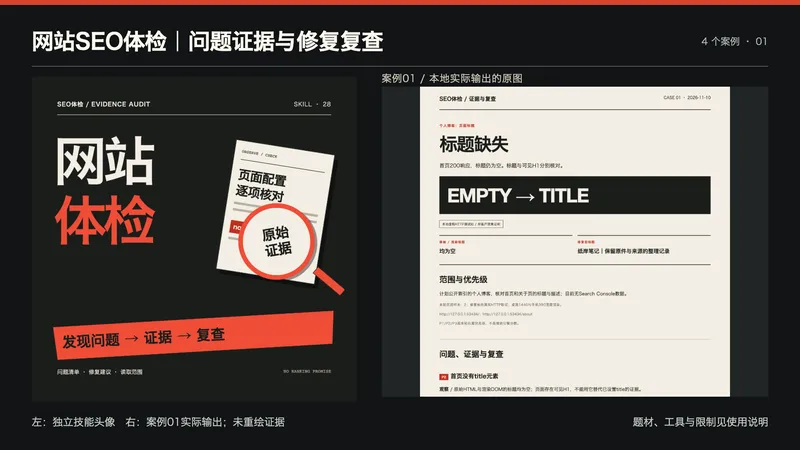
适合需要检查博客、课程、软件介绍或内容网站的创作者与站点维护者。 提供:网站URL或页面材料、需要核对的页面范围、是否希望公开索引、已知改动;Search Console和分析数据仅在你提供并有权限时使用。没有数据不编流量、排名或收录结果。 处理:限定URL范围,读取状态/响应头与原始HTML,实际渲染页面,区分抓取约束、索引规则和规范地址;核对标题、描述、链接、手机布局和必要结构化数据,再写每条问题的证据、优先级、修复建议与复查方法。抽样不冒称全站检查,建议不冒充已修改线上。 交付:可读体检报告、问题CSV、URL覆盖与证据文件、复查清单。使用时发送范围和目标,先看主要问题与证据,再按建议改动;修复后重新读取核对。 依赖:可用文字模型(推荐GPT)、真实HTTP/浏览器/文件能力。包内可选Python3标准库脚本保存限定同源URL原始证据,不运行JavaScript、不做SEO打分;浏览器渲染和最终判断仍需要实际工具。robots辅助采用保守Disallow检查,可能挡下Allow例外,不能当Google完整规则验证。目标平台缺少读取或渲染工具时必须列未核项,不保证YouMind直接执行本地脚本或绑定固定模型。 本地四个真实执行案例是原创虚构HTTP测试站:缺标题/描述、公开目标与noindex冲突、canonical指向404及指南断链、重复标题与动态JSON-LD。共8个页面样本,修复前后各实际HTTP取证,并用桌面/手机查看;动态标记实际在渲染后出现,没有凭静态抓取误报不存在。测试站复查不代表公网收录、排名、流量或客户收益。 四张展示是实际报告的代表节选,完整报告/原页截图/原始与渲染证据本地保留;头像为独立原创文字与图形排版,未冒称生图API。未追加YouMind耗积分运行测试。199积分不包含平台模型、第三方SEO工具或数据服务;不保证排名、收录、流量、收入或任意网站零遗漏。 展示说明:首张为独立技能头像与案例01实际输出的并排排版,用于横向缩略展示;不是新增案例,也未让生图模型重绘证据。其余三张对应案例02—04。
SEO+GEO Visibility Engine
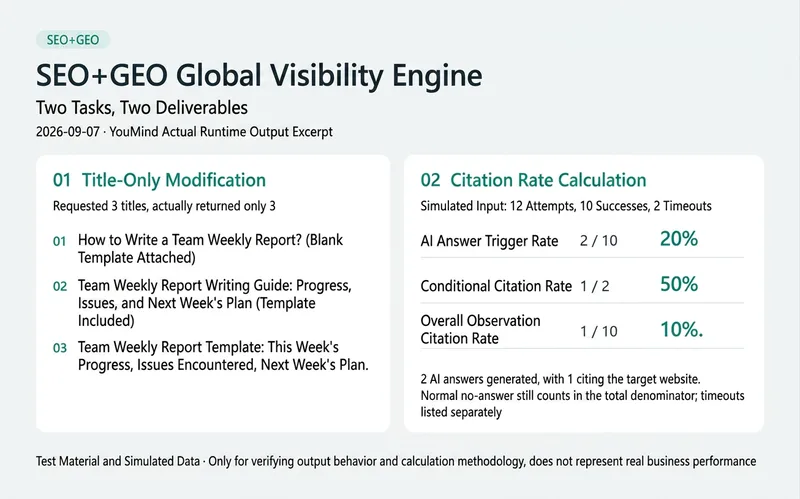
Optimize the search performance and AI citation readiness of your articles, product pages, and landing pages. Quickly identify the issues most worth fixing, or get ready-to-use titles, rewrites, content briefs, technical fix lists, or performance retest plans. Four modes route tasks appropriately: send only a link or body copy for a quick diagnosis by default; request writing to get usable text first; use a full audit to break findings down by target engine and page; or use a performance retest with clearly defined data sources, numerators, denominators, and comparison conditions. Simple tasks do not require a full-length report. Supports platform-specific checks for Google AI Overviews / AI Mode, Bing / Copilot, ChatGPT Search, Perplexity, and Claude. Search, training, and user-triggered visits are assessed separately. For Chinese platforms, checks are adapted to actually available sources and direct observations rather than applying rules from other engines. v8 standardizes scoring and evidence criteria, limits the scope of local blocks, distinguishes answer trigger rate, conditional citation rate, and overall citation rate, and updates Google site-level AI control checks. Use it for your own websites, articles on third-party platforms, and unpublished drafts. Recommendations distinguish what you can change from items that require platform-side validation. Each key finding includes evidence or clearly stated limitations. Scores are provided when needed; data, authors, or citations are never fabricated, and rankings, indexing, or AI citations are not guaranteed. Actual run example (2026-09-07; test material, not business results) Title mode: Given test copy for “How to write a team weekly report” with a request to return only 3 titles, the actual output was: 1. How to Write a Team Weekly Report: Blank Template Included 2. Team Weekly Report Writing Guide: Progress, Issues, and Next Week’s Plan (Template Included) 3. Team Weekly Report Template: This Week’s Progress, Issues, and Next Week’s Plan Calculation mode: Simulated 12 attempts, with 10 successes and 2 timeouts; 2 successful runs generated AI answers, and 1 cited the target website. Actual output: AI answer trigger rate 2/10 = 20%, conditional citation rate 1/2 = 50%, and overall observed citation rate 1/10 = 10%. Normal no-answer cases remain in the overall denominator, while timeouts are listed separately. These figures validate the calculation criteria only and do not represent actual citation performance.
Information
- Version
- v3
- Last updated
- Runtime credits
- Usage-based
- Models
- Auto
- Use cases
- Research & analysisLearning & educationSoftware development
- What you get
- ReportData
