
Skill Evaluator
A reference for evaluating AI Skills
Skill Evaluator
A reference for evaluating AI Skills
Showcase
Description
Enter the name, link, or instructions for the AI Skill to evaluate, then conduct an evidence-based initial quality review in real-world usage scenarios. Keep the six-question quick test (4 positive, 1 negative, and 1 ambiguous), and separately verify automatic selection and execution after explicit invocation; successful manual invocation does not count as successful automatic triggering. Use direct scoring across five dimensions: triggering 30%, execution 25%, cost 15%, robustness and boundaries 15%, and safety 15%. Distinguish between evidence from this test, historical run evidence, static checks, and unverified items. Do not provide an overall score or star rating when key evidence is incomplete. Assess safety based on data access, external transmission, and operational authorization—not on the author's identity or endorsement. Block recommendations in cases of serious unauthorized access. Produce a one-page, conclusion-first report showing the tested scope, unverified items, and prioritized improvement suggestions, and automatically create a record. Say “deep review” to add independent repeat tests and source checks; the budget will be confirmed before execution. This Skill only evaluates and provides recommendations; it does not automatically modify the Skill being evaluated. Suitable for quality checks of self-created Skills, rechecks of installed Skills, and pre-installation screening of marketplace Skills; the six-question results do not represent full certification.
Recommended by
Shuting@YouMind
Why we love this skill
An evidence-based framework that separates automatic selection from explicit execution, scores only traceable results, and includes safety risks and process efficiency in its conclusions.
Related Skills
View all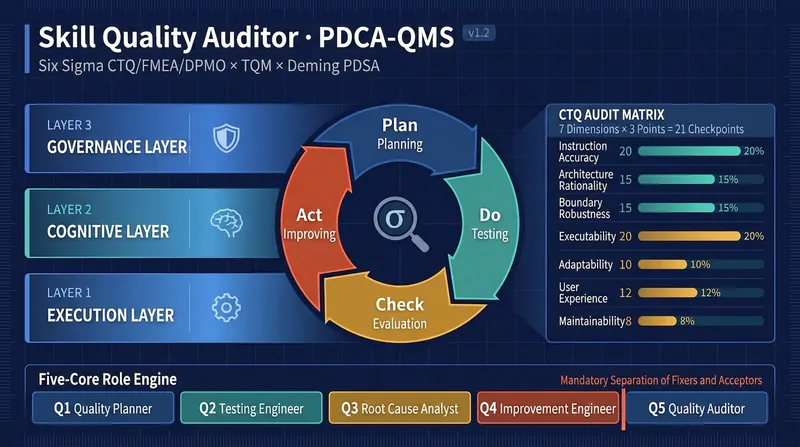
Skill Quality Audit (PDCA-QMS)
Evaluate Skills using a quality management system based on management science, not an off-the-cuff checklist. Based on Six Sigma CTQ/FMEA/DPMO × TQM × Deming PDSA cycle, through the Plan-Do-Check-Act four phases, it provides: a quality scorecard with Sigma level, a defect priority table ranked by RPN, root cause analysis down to the instruction design layer, and the full Skill text after Poka-Yoke correction. The fixer and reviewer are forcibly separated, and scores only increase, never decrease. v2.0 additions: ① Quantitative contract – closed enumeration of structural unit counting (only phase level), K-value gradient anti-scoring lock, Sigma table lookup with log axis interpolation, and full zero-padding to prevent division by zero, ensuring scores are reproducible and undistorted; ② Quality level × disposal path dual-axis gate, eliminating the contradiction of 'unqualified but recommended for release' labels; ③ Diagnostic mode – say 'only a report' or 'don't modify yet', then run through P-D-C and stop at Check, without modifying your script; ④ Output contract – pass/fail points fold, evidence limited to 50 characters, phase word count limits, values must include calculation process. When to use: evaluate whether a Skill is good, diagnose why its output is unstable, systematically optimize an existing Skill, benchmark multiple Skills, pre-release quality inspection of Skill drafts, or only want a diagnostic report without modifying the draft. Trigger words: detect skill quality, skill quality check, quality audit, rate a skill, PDCA optimize skill, skill health check, evaluate this skill, skill defect analysis, diagnose only without repair, pre-release skill quality check, skill benchmarking.
Image Generation Grandmaster
If you want to extract production-ready image-generation Skills from reference images on YouMind in one streamlined process, this is the grandmaster-level option. Creating a new Skill costs around 300 credits, turning you into an image-generation Skill-making machine and helping you avoid Skills that cost thousands. With reference images, you can build what you need yourself. Personally tested and effective; see the task examples for details. It distills the visual mechanisms in reference images into reusable, testable image-generation Skills. The subject can change while the composition, spatial logic, material appearance, and visual hierarchy are preserved, rather than simply copying the original image. It is suited to creators and teams that need to establish a consistent visual style, reuse design principles, or evaluate existing generation Skills. Use it to compile visual rules, test existing Skills, calibrate based on feedback, run historical regressions, and publish versions. It clearly identifies the scope of application, fixed invariants, adjustable variables, adaptation rules, and common failure modes. It also distinguishes between an image that is high quality and one that truly preserves the visual mechanism, helping you identify why a generated result has deviated from the underlying rules. The final results may include a structured visual specification, an independent Skill, a test plan or audit report, along with calibration patches, regression results, and release records. When image generation or visual inspection is unavailable, complete test prompts are retained and the pending-verification status is clearly indicated. Once confirmed, rules, failure diagnoses, and version information can continue to be recorded in YouMind for future maintenance and reuse.

Career Experience Analyzer
After years of work, the real challenge is often not a lack of experience, but knowing which parts are facts, which are your interpretations, and which experiences are still worth validating outside your original company. This Skill works with one anonymized, real-life experience: it organizes evidence cards, explains what the current material can and cannot prove, identifies the earliest evidence gap, and provides one low-cost validation path, one thing to hold off on, and a 7-day action plan. It is not a psychological test and does not assign an overall experience-asset score. It does not use your job title, years of experience, salary, certifications, praise from colleagues, or a single internal success as substitutes for external demand and payment evidence. When the material is insufficient, it will say directly: “Insufficient material; no judgment for now.” Please do not submit names, companies, clients, phone numbers, WeChat IDs, email addresses, government ID numbers, contracts, or unpublished business data. If identifiable information is detected, the Skill will stop the analysis and ask you to anonymize the material locally before resubmitting it. This is a preliminary self-guided assessment. It does not replace a professional evaluation, does not include manual review by Kevin, and does not promise income, traffic, career transitions, or business results.
Information
- Version
- v4
- Last updated
- Runtime credits
- Usage-based
- Models
- Auto