
Review Insights
Analyze reviews to extract pain points, selling points, and hidden needs with quotes and visual charts.
Review Insights
Analyze reviews to extract pain points, selling points, and hidden needs with quotes and visual charts.
Showcase
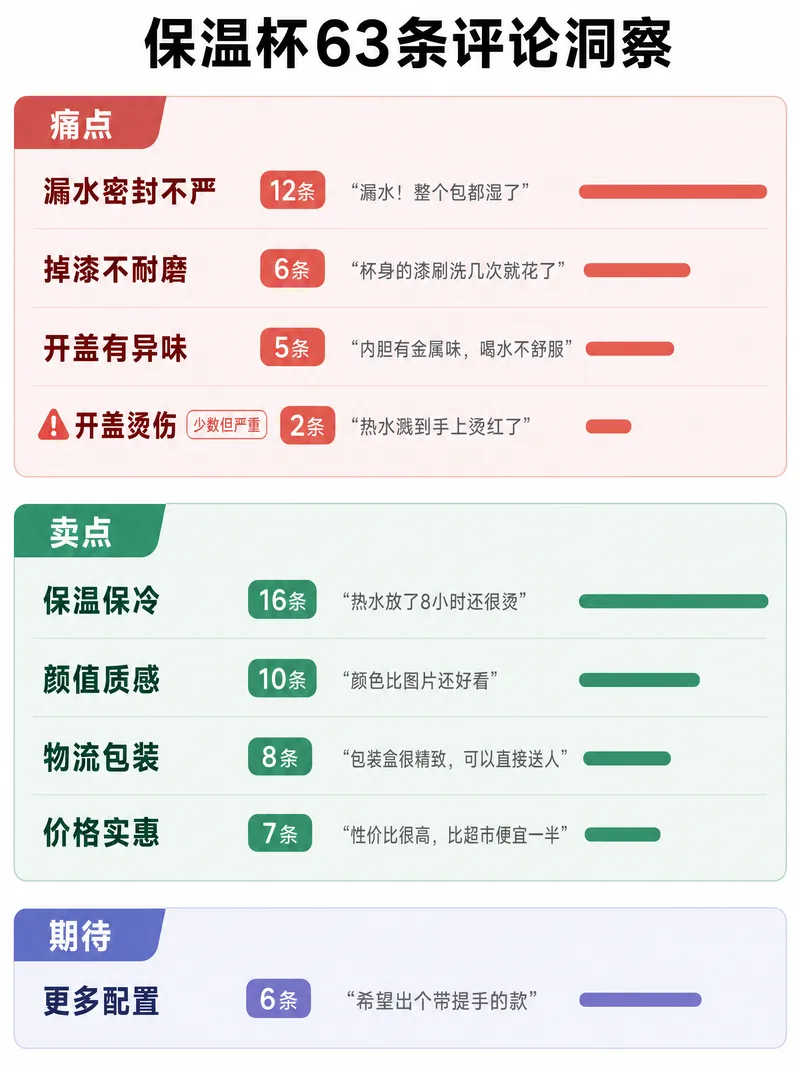
保温杯63条评论洞察分析
保温杯63条评论洞察图
保温杯63条评论洞察分析
保温杯63条评论洞察图
Description
# Review Insights **Don't let valuable user feedback get lost in hundreds of reviews.** What hidden pain points lie within product reviews? What do customers love most about your product? Are there ideas for your next best-selling product or content piece hidden in the comment section? Upload comments or paste feedback, and the AI helps you extract **pain points, selling points, and potential needs** from messy user feedback, citing source evidence for every conclusion and generating an intuitive insight chart. **Go beyond summarizing comments to turn user words into actionable insights.** ## What You Get **① Comprehensive User Needs Analysis** Organizes comments into three main categories: - 🔴 **Pain Points**: What are users complaining about? Which issues need improvement? - 🟢 **Selling Points**: What do users truly appreciate? Which advantages are worth highlighting? - 🟡 **Expectations**: What features do users want added? What unmet needs still exist? **② Evidence-Backed Conclusions** Every topic indicates the related comment count, review ID, and authentic quote for easy verification. No making up user thoughts or exaggerating a single comment into a majority opinion. **③ Rare but Severe Issue Detection** Potential safety or serious quality issues like burns, breakage, or allergies are flagged individually even if mentioned in few reviews, preventing them from being buried by positive feedback. **④ Actionable Next Steps** Provides product improvement, selling point refinement, and content topic suggestions based on review evidence, along with the reasoning for each recommendation. **⑤ User Insight Chart** Automatically organizes key findings into a visual diagram showing pain points, selling points, expectations, and comment counts for easy review and sharing. ## Who Is This For? **🛍️ E-Commerce Sellers** Analyze your own or competitor reviews to find quality issues, recognized selling points, and new product development opportunities. **📱 Content Creators** Organize video comment sections to understand viewer interests and find direction for future content. **📊 Product Managers & Operations** Prioritize issues and product improvements from app reviews, survey feedback, and user messages. **💡 Entrepreneurs & Product Selectors** Discover unmet consumer needs through authentic reviews to inform product positioning and selection. ## How to Use 1. Paste comments or upload Excel, CSV, or text format review data. 2. Optionally specify a goal, such as "find product flaws," "extract selling points," "analyze competitors," or "find video topics." 3. The AI organizes comments, categorizes themes, cites evidence, and offers suggestions. 4. Generate an insight chart to help you quickly understand key findings. ## Tips - More complete comments and sufficient samples generally provide more valuable analysis. - Opinions in comments do not necessarily represent all consumers. - Duplicate comments, unhelpful messages, and sample limitations will be noted during analysis. - Direct quotes are for evidence verification; ensure compliance with platform rules and privacy requirements before public commercial use. - AI statistics and chart text may contain minor errors; important conclusions should be cross-checked with raw data. --- **Turn every authentic review into a clue for product improvement, creative inspiration, and a more persuasive selling point.**
Recommended by
Dancang
Why we love this skill
Turn scattered reviews into verifiable user insights by categorizing pain points, selling points, and hidden needs with matched original quotes and generated charts.
Best for
E-commerce sellers, creators, product managers, and marketers looking to uncover product improvements and selling points from feedback.
How to use this Skill
Provide your input
Paste product reviews, video comments, app reviews, or survey responses, or upload Excel, CSV, or text files, and specify your analysis goal.
Run the Skill
The AI categorizes comments by theme, extracts pain points, selling points, and expectations, verifies evidence with quotes, and flags critical issues.
Review your result
Receive an evidence-based user insight report, action recommendations, quote candidates, and a visual insight chart showing pain points and selling points.
Related Skills
View all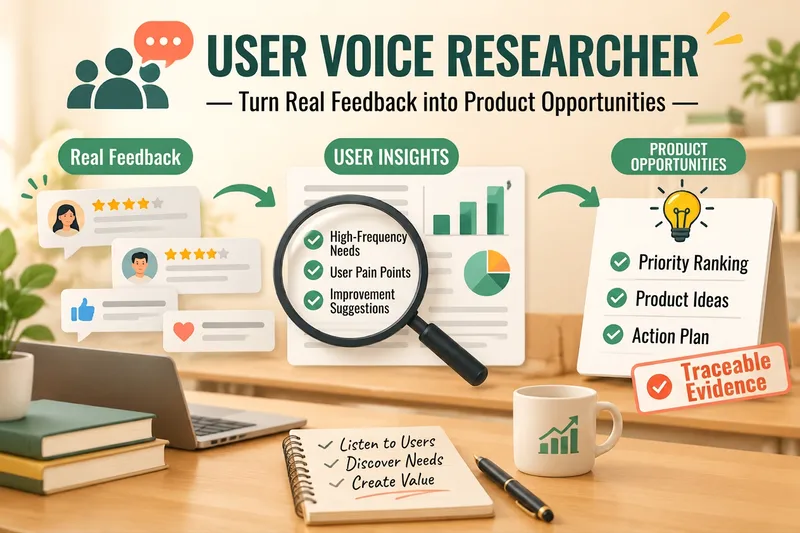
Voice of Customer Researcher
Turn reviews, ratings, user interviews, and customer feedback into traceable user demand insights, product opportunities, and validation plans. Analyze feedback materials such as reviews, ratings, interviews, open-ended survey questions, customer service logs, and community discussions to identify real user problems, behavioral motivations, purchase barriers, and improvement opportunities, ensuring every key conclusion links back to the original evidence. ### Applicable Scenarios - Product Managers: Analyze product reviews, feature requests, churn reasons, and experience issues. - E-commerce Sellers: Analyze product reviews, return reasons, purchase concerns, and selling points. - Content Creators and Knowledge Services: Analyze learner feedback, community questions, course evaluations, and unmet needs. - Local Merchants: Analyze customer reviews, service feedback, and repurchase barriers. - Entrepreneurs: Discover product opportunities from user interviews and early feedback.
AI Problem Decomposer
# AI Problem Decomposer **One complex question, one clear analysis diagram.** Why is store traffic unchanged while profits keep falling? Why did video views suddenly drop? Why are projects always delayed? Enter the question you want to understand, and AI will break down possible causes, map out cause-and-effect relationships, determine what to investigate first, and generate a clear, easy-to-understand Chinese-language analysis diagram. It does more than tell you **what the possible causes might be**. More importantly, it tells you: **why they might be happening and what to check next.** ## What you'll get **① Intelligent problem breakdown** Identify the key parts of a problem. For situations that can be analyzed with formulas, the tool prioritizes establishing metric relationships to help identify what needs to be investigated. **② 4–6 possible causes** Each cause includes: - Possible symptoms - The cause-and-effect mechanism behind the outcome - A practical way to verify it Unverified speculation is not presented as fact. **③ Intelligent investigation order** Based on impact, verification difficulty, and the information available, the tool recommends what to check first and what to check later, helping you avoid investigating blindly. **④ One professional Chinese-language analysis diagram** The tool automatically selects a suitable structure based on the question, such as a radial map, causal chain, fishbone diagram, or timeline. Different colors distinguish information types, and specific action prompts are placed next to causes, such as: - Check: impression click-through rate - Check: product gross margin - Review: customer comments and feedback **⑤ Image text check** After generation, the tool checks the Chinese text, number of causes, and consistency between the diagram and its content. If obvious text errors are found, it attempts one automatic correction based on the run settings; additional generation may use more credits. ## What kinds of questions is it suited for? **Business operations** - Why are profits falling even though store traffic is unchanged? - Why are returning customers decreasing despite good reviews? **Content creation** - Why did YouTube views suddenly drop? - Why are impressions high but click-through rates low? **Work and learning** - Why are projects always delayed? - Why hasn't performance improved significantly despite investing more time in learning? ## How to use it 1. Enter a specific question you want to analyze. 2. Include any data, screenshots, or reference materials you have. 3. AI breaks down the causes, analyzes the mechanisms, and provides verification methods. 4. Generate a Chinese-language multifactor analysis diagram to help you investigate each item step by step. ## Usage tips - The more specific the question and the more complete the data, the more targeted the analysis will be. - Do not fabricate statistics, survey results, or external sources. - The causes shown in the diagram are analytical hypotheses and do not mean the actual causes have been confirmed. - Generated images may contain layout or text errors. - A single test run uses approximately 100–200 credits. Actual credit usage depends on the model, task complexity, and whether additional generation is needed. **Make complex questions easier to understand, investigate, and act on.**
 Research
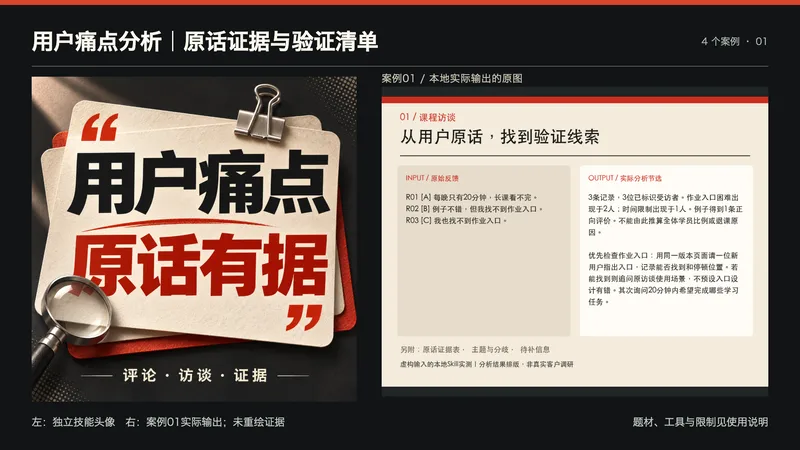
User Pain Point Analysis
Target Audience: Creators and product operators who need to organize user comments, interviews, surveys, or customer service logs. What You Need to Provide: Authorized, anonymized raw feedback, product background, and the decision you want to make, along with available channels, dates, and anonymous user IDs. How It Works: Keeps original quotes and sources item by item, distinguishes record counts from user counts, consolidates duplicates from the same person, extracts scenarios and friction points, organizes themes and counterexamples, and then proposes minimal validation actions. Final Delivery: Scope and findings, original quote evidence table, theme and divergence table, validation priorities, and missing information. Defaults to fully copyable Markdown. Does not present individual feedback as applying to all users, nor does it infer paid conversion rates from comment counts. Usage: Paste feedback and state the problem to be solved; review the theme table and check original quotes, then follow the validation checklist to check the actual process or follow up. Suggestions are not yet implemented, and problem causes must be reproduced to be confirmed. Requires a text model only; GPT is recommended, with the model chosen by the platform. Does not require image models or external APIs. The four display images are fictional inputs and outputs analyzed by the local GPT main agent according to the actual final skill for layout presentation, not real customer research. No additional runtime tests were run on YouMind, so actual results still need to be verified. Not Suitable For: Impersonating real interviews, inferring total market share or purchase intent, unauthorized public disclosure of original quotes, or automatically contacting users. Does not promise commercial opportunities, growth, or conversion lifts. Display Notes: The first image is a side-by-side layout of the independent skill avatar and the actual output of Case 01 for horizontal thumbnail display; it is not a new case, nor did an image generation model redraw the evidence. The remaining three images correspond to Cases 02 through 04. The independent avatar is an original conceptual visual created by local ImageGen, not a research or polishing result; the specific image model ID was not returned by the tool.
Information
- Version
- v5
- Last updated
- Runtime credits
- Usage-based
- Models
- Auto
- Use cases
- Research & analysisMarketing & growthE-commerce & sales
- What you get
- ReportImage
