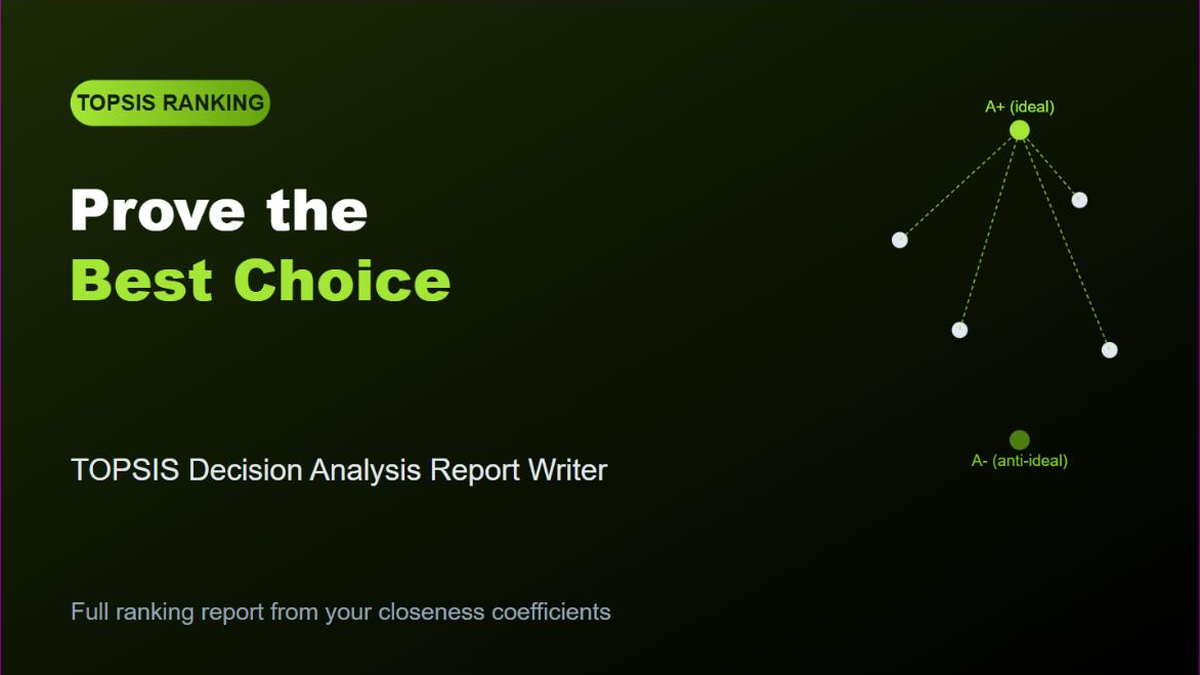
TOPSIS Decision Analysis Writer
Produces a full ranking report from TOPSIS output
TOPSIS Decision Analysis Writer
Produces a full ranking report from TOPSIS output
Showcase
Description
Produces a complete manuscript-ready Methods + Results text from your TOPSIS analysis outputs (normalized decision matrix, distances to positive/negative ideal solutions, closeness coefficients). Provides a ranking table and interprets which criteria the best and worst alternatives excelled or lagged in. Suitable for: researchers working on multi-criteria ranking problems such as supplier selection, product/service comparison, or clinical decision support.
Recommended by
Shuting@YouMind
Why we love this skill
An editor’s pick for turning raw TOPSIS statistics into publication-ready Methods and Results text. It stands out by explicitly handling benefit and cost criteria, validating coefficient and ranking consistency, explaining best and worst alternatives, and adding a focused sensitivity-analysis prompt.
Best for
Researchers who need clear, publication-ready writing for TOPSIS-based multi-criteria ranking studies.
How to use this Skill
Provide your input
Provide your alternatives, criteria and weights, benefit/cost types, TOPSIS distances, closeness coefficients, and ranking.
Run the Skill
The skill turns your TOPSIS analysis outputs into manuscript-ready Methods and Results prose with a clear ranking table and interpretation.
Review your result
Receive a polished report describing the ranking, comparing the strongest and weakest alternatives, and noting how weight changes may affect results.
Related Skills
View all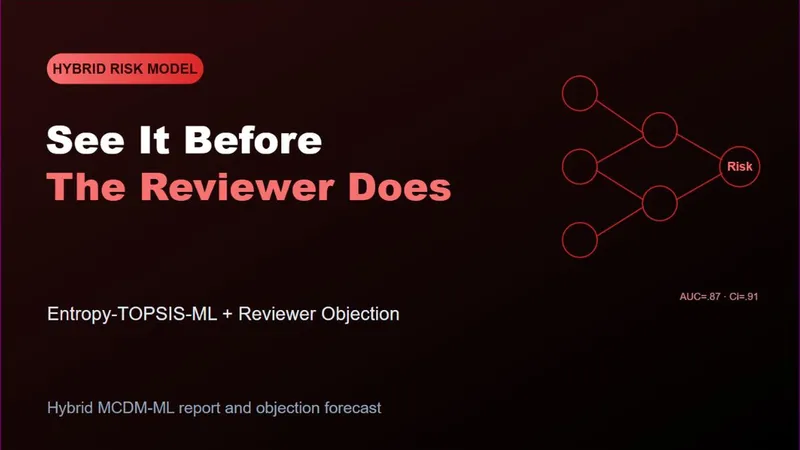 Research
Entropy-TOPSIS-ML + Reviewer Objection
Produces a complete Methods + Results report from your entropy weighting + TOPSIS ranking + ML classifier (XGBoost, Random Forest, Logistic Regression, etc.) outputs. Correctly classifies AUC interpretation (Hosmer & Lemeshow criteria) and, if the train/test performance gap is large, states the overfitting risk explicitly. It also pre-identifies at least 4 objections journal reviewers frequently raise (e.g., "how was class imbalance handled," "no external validation set was used") and suggests a defense sentence for each. Suitable for: researchers working in health informatics, clinical risk prediction, or hybrid MCDM-ML methodology who want methodological robustness before journal submission.
 Research
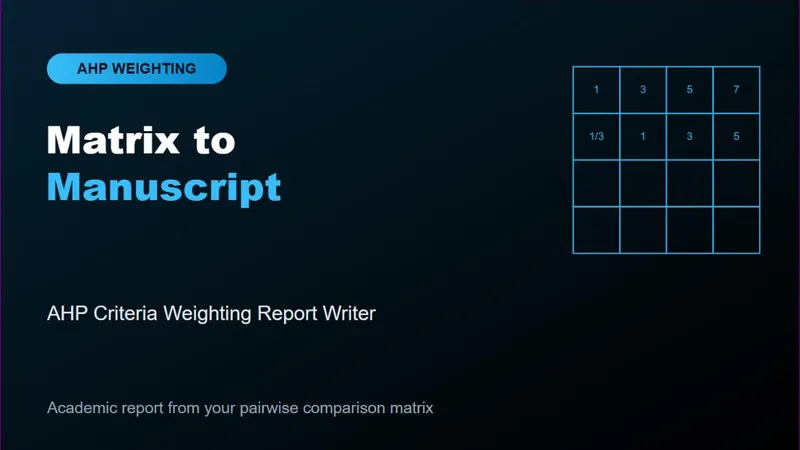
AHP Criteria Weighting Writer
Converts the user's AHP (Analytic Hierarchy Process) pairwise comparison matrix outputs (criteria weights, consistency ratio) into an academic "Criteria Weighting" section ready to drop straight into a manuscript. If the consistency ratio (CR) exceeds 0.10, it states this openly rather than hiding it. Suitable for: researchers who use MCDM methods such as TOPSIS/VIKOR and determine criteria weights with AHP, and graduate students.
 Research
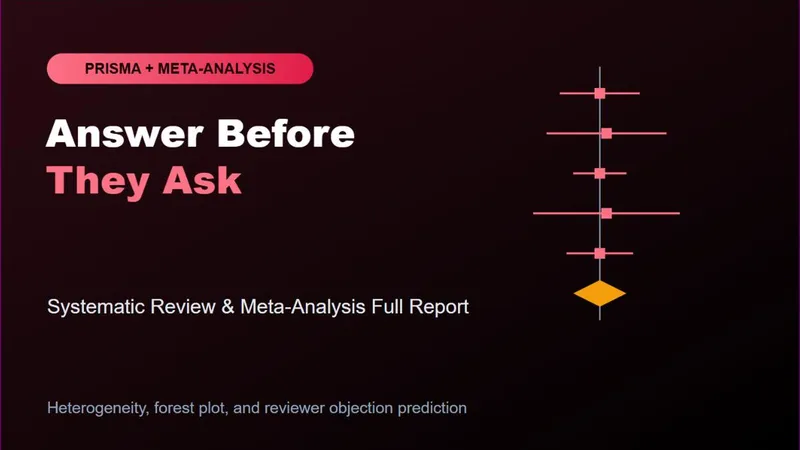
Meta-Analysis Full Report Writer
Produces a complete Methods + Results + Limitations text compliant with PRISMA 2020 and the Cochrane Handbook from your meta-analysis statistics (pooled effect size, I², Q, tau², publication bias indicators). Never misinterprets the I² value (including the "percentage of variance" framing); avoids overstated causal language (uses cautious phrasing like "findings are consistent with..." instead of "evidence demonstrates that"). At the end, it also offers at least 3 questions a reviewer might ask along with defense sentences. Suitable for: researchers writing a meta-analysis paper who want to strengthen the methods section before journal submission. What it does not do: it does not perform statistical calculations from raw data (you must already have your R/RevMan/CMA output) — it only converts and interprets your results into academic text.
Information
- Version
- v2
- Last updated
- Runtime credits
- Usage-based
- Models
- Auto
- Use cases
- Writing & contentResearch & analysis
- What you get
- ReportDocument
