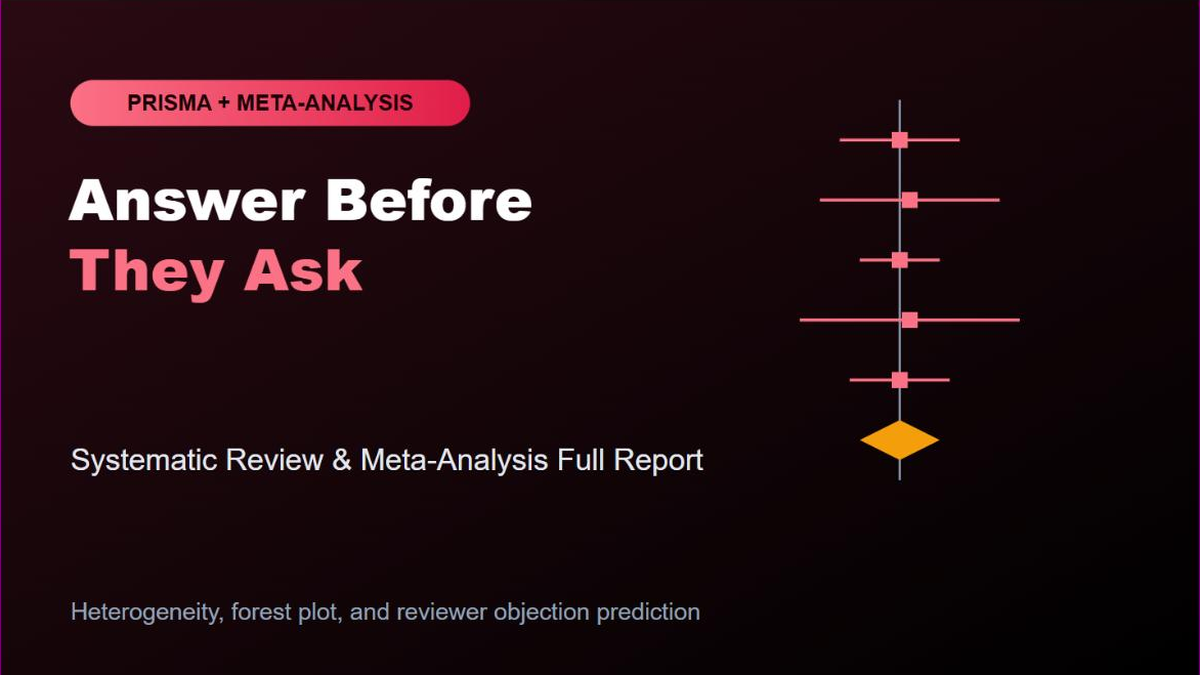
Meta-Analysis Full Report Writer
Produces a PRISMA report from your meta-analysis statistics
Meta-Analysis Full Report Writer
Produces a PRISMA report from your meta-analysis statistics
Showcase
Description
Produces a complete Methods + Results + Limitations text compliant with PRISMA 2020 and the Cochrane Handbook from your meta-analysis statistics (pooled effect size, I², Q, tau², publication bias indicators). Never misinterprets the I² value (including the "percentage of variance" framing); avoids overstated causal language (uses cautious phrasing like "findings are consistent with..." instead of "evidence demonstrates that"). At the end, it also offers at least 3 questions a reviewer might ask along with defense sentences. Suitable for: researchers writing a meta-analysis paper who want to strengthen the methods section before journal submission. What it does not do: it does not perform statistical calculations from raw data (you must already have your R/RevMan/CMA output) — it only converts and interprets your results into academic text.
Recommended by
Shuting@YouMind
Why we love this skill
An editor’s pick for turning raw meta-analysis outputs into publication-ready PRISMA Methods, Results, limitations, and reviewer defenses. It stands out for statistically precise heterogeneity interpretation, cautious causal language, model-selection rationale, and clinically meaningful effect-size reporting.
Best for
Researchers preparing or strengthening a meta-analysis manuscript before journal submission.
How to use this Skill
Provide your input
Provide your research question, included-study details, effect-size results, heterogeneity statistics, publication-bias indicators, and risk-of-bias assessment from an existing meta-analysis.
Run the Skill
Submit the results for academic reporting and interpretation.
Review your result
Receive PRISMA-aligned Methods, Results, and Limitations text, plus reviewer questions with suggested defense sentences.
Related Skills
View all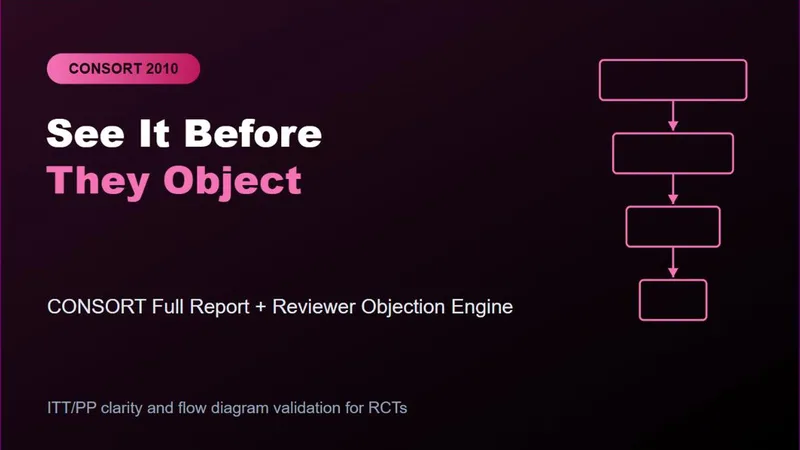 Research
CONSORT 2010 Report Writer
From your randomized controlled trial (RCT) data — randomization method, blinding status, power analysis, CONSORT flow numbers (screened/randomized/allocated/analyzed), ITT/PP analysis approach — it produces a complete Abstract + Methods + Results draft compliant with all 25 items of CONSORT 2010. It never confuses ITT/PP; it checks the consistency of flow diagram numbers (randomized ≥ allocated ≥ followed-up ≥ analyzed). It also pre-identifies at least 4 objections journal reviewers frequently raise (e.g., "why wasn't an ITT analysis reported," "was blinding success tested," "was there outcome switching") and suggests a defense sentence for each. Designed for clinical researchers in medicine/nursing/pharmacy conducting RCTs who want methodological robustness before journal submission. What it does not do: it does not perform statistical analysis or generate data — it only converts results you already have into a CONSORT-standard report.
 Research
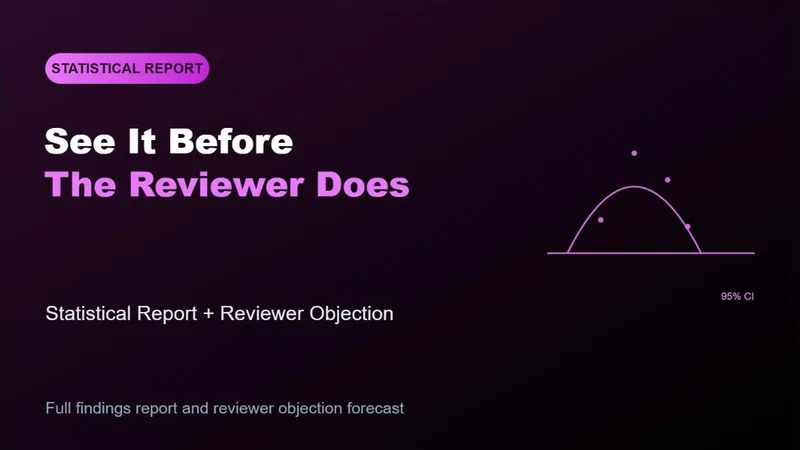
Statistical Report + Reviewer Objection
Produces a complete Results section from your descriptive + inferential statistics outputs (including assumption tests). If it detects a normality or variance homogeneity violation, it recommends the non-parametric alternative test rather than concealing it. It also pre-identifies at least 4 objections journal reviewers commonly raise (e.g., "assumption tests not reported", "effect size not stated", "no multiple comparison correction applied") and provides a defense sentence for each. Who it's for: researchers working with quantitative methods who want statistical reporting rigor before journal submission.
 Research
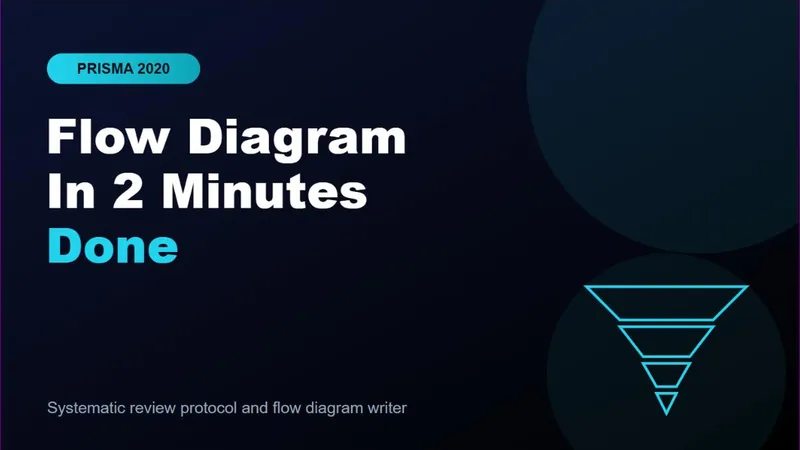
PRISMA 2020 Flow Diagram Writer
Generates a PRISMA 2020-compliant flow diagram text and protocol paragraph for researchers conducting systematic reviews. When you enter your database screening counts (identification → screening → eligibility → included), it checks the consistency of the numbers and produces text defensible against the reviewer question "why does your flow diagram lose so many records?" It also converts your inclusion/exclusion criteria into a PICO/PECO-format table. Suitable for: graduate students, academics, and journal editors' pre-checks for systematic review/meta-analysis papers. If it detects a numeric inconsistency (e.g., included > eligibility) it states this explicitly rather than silently correcting it.
Information
- Version
- v2
- Last updated
- Runtime credits
- Usage-based
- Models
- Auto
- Use cases
- Writing & contentResearch & analysis
- What you get
- ReportDocument