
Textbook Writing Master
Evidence-first, natural-language writing workflow
Textbook Writing Master
Evidence-first, natural-language writing workflow
Showcase
Description
Transform your experience into a ready-to-submit textbook: verify the source of every statement first, then write in natural language that students can easily understand and teachers can readily teach. It pauses to ask you for missing information rather than fabricating volume and page numbers. The generated text is checked line by line against an anti-AI vocabulary list and rewritten into engaging textbook prose. From project alignment (audience, measurable skills, hours, chapters, style sheets) to building an evidence foundation, reverse-engineering chapter frameworks, two-pass writing, removing AI tone, five-stage review, and breakpoint continuation, it handles the entire book. For vocational project-based learning (EPIP/work-study integration), it provides nine primary sections per project chapter and five sections per task. The delivery phase includes publishing-grade self-checks (figure and table numbering, twelve convention rules, print-ready layout, copyright and standard validity), compliance red lines (political and territorial integrity, citation version discipline, annotation styles, GB/T 7714-2025 new national standard, final consistency checks), and a final tone check (24 AI-sounding Chinese vocabulary lists + match density judgment + textbook human tone definition). Suitable for: writing textbooks, converting school handouts into textbooks, revising older textbooks, and unifying multi-author manuscripts. Not suitable for: academic monographs, individual research papers, curriculum standard development itself, or digital textbooks (see Digital Textbook Writing Master). Trigger words: write textbook, textbook outline, chapter and period allocation, textbook style, EPIP project-based, work-study integration, task-driven textbook, this sounds too much like AI, remove AI tone, polish into textbook language, AI tone, remove AI tone vocabulary, how to cite references, how to write standard numbers, figure and table numbering, print layout, continue writing next chapter, political review red line, citation versions, annotation style, final check, new national standard for references.
Recommended by
Dancang
Why we love this skill
Transforms textbook writing into an executable process: locking in objectives, building frameworks with evidence, drafting, de-AI-ing, and review. Excels at vocational and multi-author textbooks.
Best for
Ideal for textbook authors, teachers, researchers, and collaborative teams writing, revising, and reviewing publications.
How to use this Skill
Provide your input
Provide the textbook topic, target audience, competency goals, hours, existing materials, and publisher style guidelines, or submit chapters and paragraphs for review.
Run the Skill
Builds the structure based on goals, verifies traceable evidence, writes or rewrites chapters, and checks terminology, citations, figure numbers, and publishing standards.
Review your result
Receive textbook writing contracts, outlines, chapter designs, text, exercises, review reports, or pre-submission checklists.
Related Skills
View all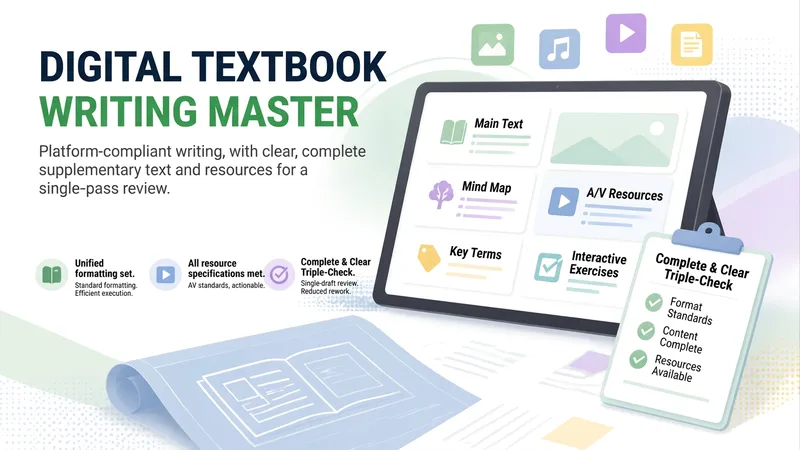 Write
Digital Textbook Pro
Create a digital textbook ready for online publishing: establish the formatting standards according to platform guidelines in one go, then write the main text, configure resources, and complete final pre-submission checks. It generates six supplementary elements (book description, preface or study guide, table of contents, mind map, key terms, and references) all at once. It provides actionable specifications for image resolution, audio and video bitrate and file size limits, and four types of interactive exercises, while verifying whether audio duration, bitrate, and file size meet platform requirements. Beyond the standard three-step pre-submission check, it also performs a final writing style review featuring a built-in vocabulary list of 24 AI-sounding Chinese phrases, plus checks for five AI-sounding patterns specific to digital textbooks. Evidence, outlines, two-pass writing, AI-style removal, and review guidelines are all built-in and can be used independently without requiring other textbook writing skills. Suitable for: writing digital textbooks for publishing platforms, adapting print textbooks into digital editions, and converting school-based handouts into digital textbooks. Not suitable for: print-ready books, academic monographs, single research papers, or platform button operation training. Trigger words: digital textbook, cloud creation platform, digital textbook author guide, digital textbook writing specification, mind map, key terms, interactive exercises, rich media resources, video bitrate, audio size, pre-submission check, submission pre-review, online self-test entry, caption position, formula numbering, remove AI style.
AI Textbook Quality Inspector
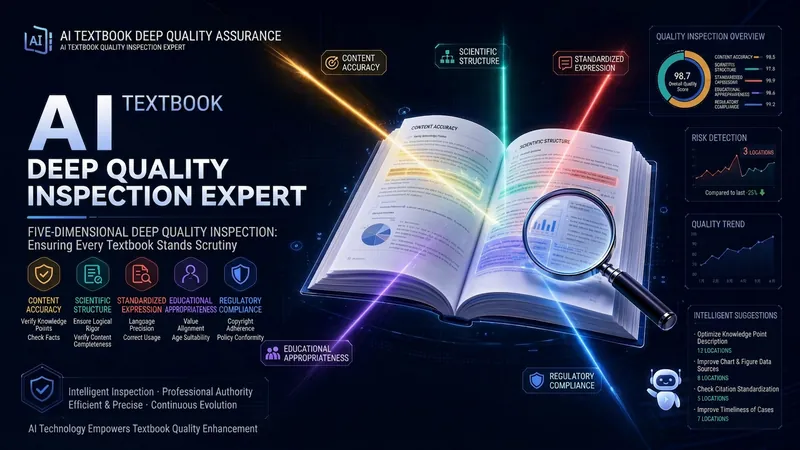
📚 AI Textbook Quality Inspector — Five-dimensional scan to make AI-written textbooks withstand review Textbooks written with AI assistance suffer from five common problems: hard-to-detect knowledge errors, instructional design lacking classroom feel, excessive 'correct but empty' statements, templated writing that feels robotic, and obscure language that makes students give up reading. This system performs a five-dimensional in-depth quality check chapter by chapter, examining each chapter from the perspectives of four roles: subject matter expert, instructional designer, fact-checker, and style reviewer. It outputs quantitative scores and directly replaceable modification suggestions. Five Dimensions: 📐 Knowledge Accuracy — Trace and correct concepts, models, and data one by one, with each error annotated with a source 🎯 Instructional Design — Review difficulty curve, prerequisite preparation, and chapter connections like a seasoned teacher 💎 Content Substantiveness — Expose 'correct but empty' statements, calculate real information gain per section 🤖 AI-Flavor Detection — Textbook-specific standards to distinguish normal writing from AI template patterns 📖 Readability — Paragraph rhythm, term density, assess whether students can read smoothly Highlight Features: 🔗 Cross-Chapter Consistency — Automatically generate knowledge profile, detect conceptual contradictions, inconsistent terminology, and duplicate definitions 🔄 Closed-Loop Iteration — After revision, resubmit and automatically track improvements, remaining issues, and new problems 📊 Layered Report — First see overview score + top 3 issues, then expand section-by-section analysis as needed 🎤 Sharp Commentary — No sugarcoating; if a definition is wrong, it says so bluntly, with each criticism accompanied by a revision reference Applicable to: AI-assisted undergraduate and graduate textbooks, academic monographs, and course handouts. Current version is optimized for undergraduate textbooks, but also works for graduate textbooks. Paste chapter → Get score → Make targeted revisions → Re-test until quality passes.
Academic Writing Engineering
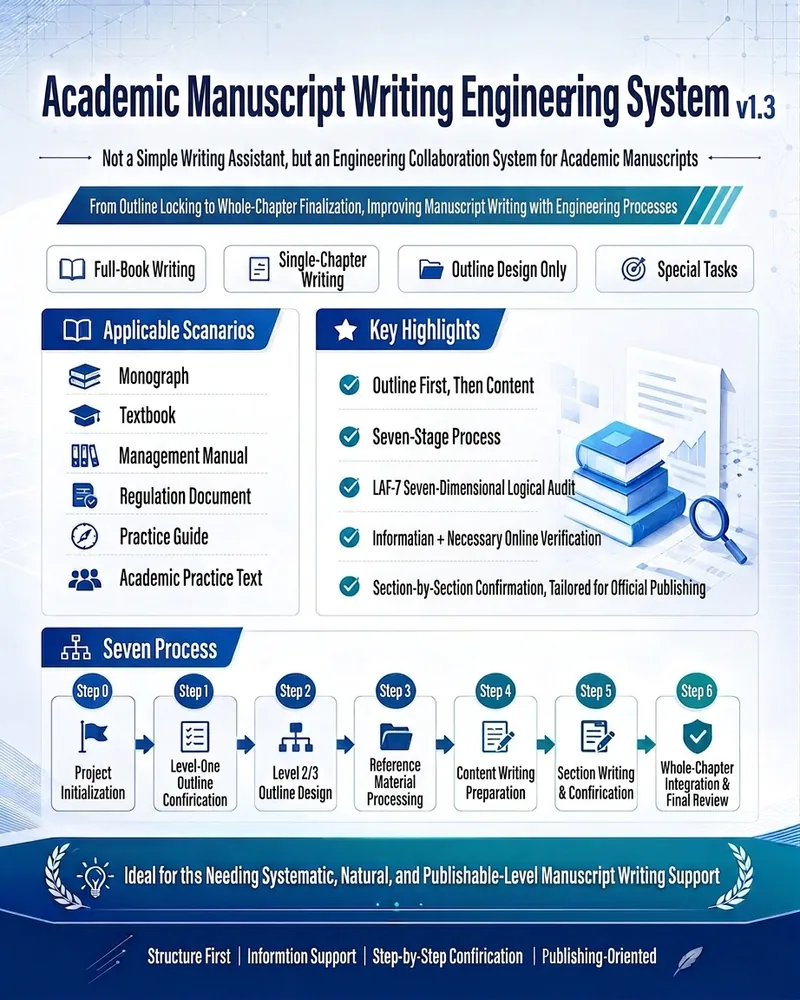
An engineering collaborative agent for scholarly manuscript writing across disciplines, covering monographs, textbooks, chapters, institutional texts, management manuals, practical guides, and academic practice texts in natural sciences, engineering, humanities and social sciences, business, law, education, medicine, and more. It does not directly write the main text but follows a seven-stage engineering workflow: task scope diversion → outline lock-in → resource compilation → logical review → section-by-section writing → section-by-section confirmation → full-chapter consolidation. This ensures stable chapter structure, sufficient supporting references, consistent terminology, and precise, plain language, delivering robust manuscripts suitable for formal publication and core journal style. Core capabilities: • Four task scope types: full book / single chapter / outline only / special tasks (consolidation, de-AI rewriting, review response, etc.) • Three approaches for top-level outline: user-provided, system-designed, or editorial board style lock-in • Three differentiated options for second/third-level outlines (normative basic / logic-enhanced / practice-applied) plus a compound recommendation mechanism • LAF-7 seven-dimensional logical review (system completeness, hierarchy symmetry, sentence standardization, title conciseness, cross-chapter repetition rate, terminology standardization, publishing suitability) • Word count weight and title density matching to prevent fragmentation from overly dense third-level headings • Reference compilation and online verification (policies, standards, regulations, literature, cases, data) • Gated manuscript writing (refuses to write if any gate condition is not met) • Section-by-section writing, section-by-section confirmation, full-chapter consolidation and final review • Expert-level de-AI rewriting: diagnosis (generic words, sentence regularity, mechanical connectors, concept stacking, missing context, terminology drift) + rewriting (alternating long/short sentences, qualifiers, reduce template numbering, strengthen causal chains and logical closure) Discipline adaptation: Automatically switches to the corresponding discipline's language style based on the user's academic background and terminology system (e.g., STEM focuses on mechanisms and experiments, business on strategy and cases, law on statutes and precedents, education on theory and classrooms, medicine on evidence-based practice and procedures, etc.) without imposing a fixed disciplinary framework. Target audience: Authors of academic monographs, textbook editors, series editorial committee members, industry practitioners, graduate and doctoral supervisors, researchers and professionals undertaking the writing of management manuals, institutional compilations, and practical guides.
Information
- Version
- v18
- Last updated
- Runtime credits
- Usage-based
- Models
- Auto
- Use cases
- Writing & contentResearch & analysisLearning & education
- What you get
- ReportDocumentPlan
