Teacher Man · Science Q Check
Evaluate your scientific question from a reviewer's perspective
Teacher Man · Science Q Check
Evaluate your scientific question from a reviewer's perspective
Showcase
Description
Conduct a reviewer-perspective deep health check on the scientific questions (or title abstracts and preliminary ideas) refined in your proposal. It supports automatically tracing back from scattered ideas or title abstracts through a four-step chain: Domain (Level 7) to Direction (Level 8 sub-discipline) to Bottleneck (Level 9) to Scientific Question (Levels 10-11), scoring each link. It first verifies legitimacy (non-research inputs trigger a 10-point cutoff, G0 three-question preliminary veto, science vs. engineering differentiation, and free exploration vs. target-driven alignment), then performs diagnoses across three lenses: looking at origin (Level 11 contraction ruler and pre-experiment two-way causal bridge), looking at depth (online verification of peer depth lines, 8-tier journal quality x quantity dual-track popularity, and sub-discipline uniqueness horizontal comparison), and looking at alignment (same-scale measure borrowing and red-team three paths). It outputs a three-lens scorecard, a four-step reverse-engineering check table, a five-dimensional score, an overall judgment, and a rewritten "one core + two keys" expression, and saves it as a document.
Recommended by
Dancang
Why we love this skill
Transforms the assessment of scientific questions from subjective feeling into a verifiable peer-review check, using origin, depth, and alignment lines to pinpoint weaknesses and rewrite them into a core statement with two key factors.
Related Skills
View all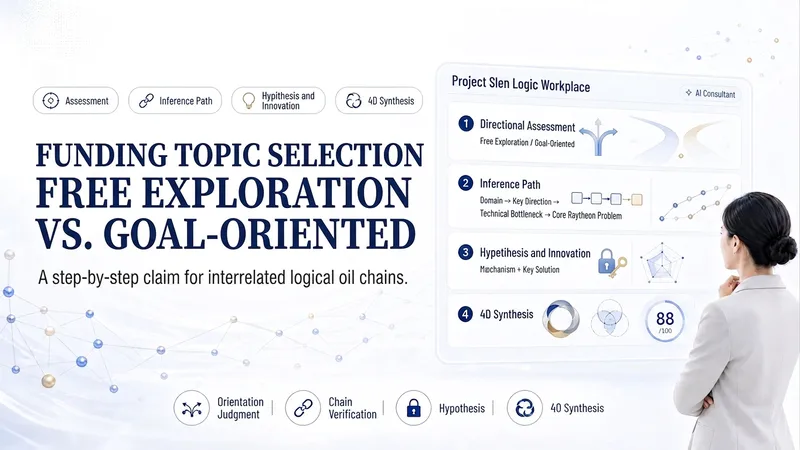
Teacher Man NSFC Topic Selection
The "Teacher Man NSFC Topic Selection" advisor skill helps you set your track using the first 6 layers of official codes plus the 7th layer of proposal fields (free exploration vs. target-oriented, including non-research circuit breaking and code misalignment checks). It then guides you step by step along an 11-layer contraction chain (7th layer field [dual-track popularity] -> 8th layer distinctive direction -> 9th layer quantified technical bottleneck -> preliminary experiment two-way causal questioning bridge -> 10th layer 1 core scientific question -> 11th layer 2 key scientific questions), performing "link checks" at every step. It derives scientific hypotheses (lock core diagram) and same-scale innovation (golden key), and concludes with a four-step onion-peeling scoring and four-dimensional mesh pressure test, producing a closed-loop core statement that can be directly written into your proposal. Each step automatically comes with a 16:9 white-background hand-drawn marker doodle-style illustration.
NSFC Question Refiner
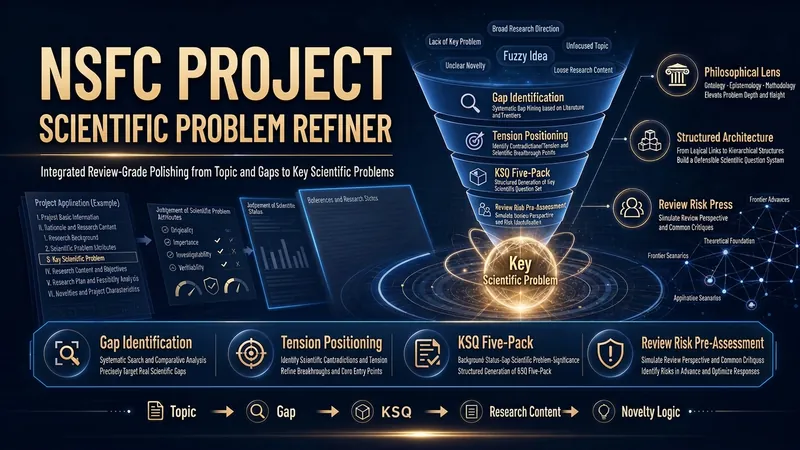
A deep tool focused on refining 'scientific questions' for NSFC projects. Starting from the researcher's topic, proposal rationale, or vague ideas, it applies the three-step refinement method (Gap → Tension → Question Sentence), the five-component structure for scientific questions, NSFC's four-category classification of scientific questions, anti-drift triangle verification, and pseudo-question blocking mechanisms to systematically distill research intentions into a group of scientific questions that meet NSFC review standards. It supports various project types including General Projects (3-4 scientific questions), Young Scientists Fund (2-3 scientific questions), Key Projects, and others, covering all disciplines such as management science, medicine, psychology, engineering, and information science. Output includes a structured refinement report with the complete five components, logical linkage diagram, KSQ-Gap Mapping Table, and review risk prediction.
 Research
Thesis Topic & Intro v3.2
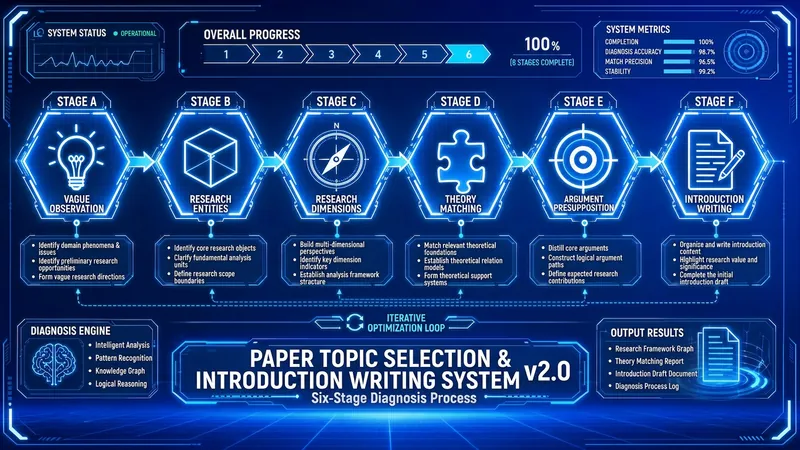
Read in 10 seconds: turn a vague observation into a defensible topic, then into an introduction that can pass review. Throughout, it uses only the real materials you provide — no fabricated references. Trigger words: thesis topic, topic selection, introduction, research gap, academic writing, thesis proposal, topic selection before literature review. Applies to: journal papers / dissertations / conference papers / course papers, across all disciplines — humanities and social sciences, STEM, agriculture, medicine, and life sciences. Up and running in 3 minutes: lock in your discipline and starting point → shape the topic layer by layer → strict evidence-chain gate → module-by-module introduction → ratchet finalization. [Division of labor with other skills] The health check comes first, writing comes after, and polishing comes last. This skill handles the middle stretch: topic shaping + introduction draft. It does not write the full paper (that's the Academic Paper Full-Process Writing System v4.x), and it does not polish language sentence by sentence (that's the Academic Paper Three-Track Polishing System v8.x). [Six gates] 1. Discipline placement: classify into one of four categories — 1A humanities/arts, 1B social sciences, 2A STEM, 2B agriculture/medicine/life sciences — and load the corresponding red-line norms; for category 2B, ethics review status is always checked. 2. Stage positioning: are you at a vague observation, have a unit but no angle, have an object but no theory, lack a method, lack a viewpoint, or only lack an introduction? Start from the corresponding gate instead of starting over from scratch. 3. Topic shaping: research unit → dimension compass → theoretical perspective → research method → research viewpoint, locked layer by layer; before locking each layer, first judge whether the previous layer holds. 4. Strict evidence-chain gate: before the introduction, your references are registered into an M1/M2… material library, each entry verified on four elements — author/year/title/locator; if fewer than 3 references are registered in the conversation, the system refuses to generate the research-gap statement — not a downgrade, a refusal. 5. Module-by-module generation: the introduction is produced in five inverted-pyramid modules, and each module must be annotated with citation numbers [Mn]; no source, no sentence. 6. Ratchet finalization: only versions that have passed receive credit; qualifying modules are locked and no longer changed; scores only go up, never down. [Deliverables] A '[Topic Keyword] · Topic & Introduction' document + a sentence-level traceable citation mapping table + a ⚠️ to-verify checklist + an AFP archive code. The archive code works across four systems — the proposal health-checker, the v4.x full-process system, and the three-track polishing system — so switching skills doesn't require re-stating your discipline, topic, journal, or material library. [Explicitly not done] It does not fabricate authors, years, volumes, issues, page numbers, or DOIs; any bibliographic records retrieved online are marked ⚠️ to-verify and can only be written into the reference list after you verify them; it makes no promises of acceptance or passing review. Authorship and responsibility are yours — please verify every citation and data point.
Information
- Version
- v7
- Last updated
- Runtime credits
- Usage-based
- Models
- Auto
