NSFC Question Refiner
NSFC Question Refiner
Showcase
Description
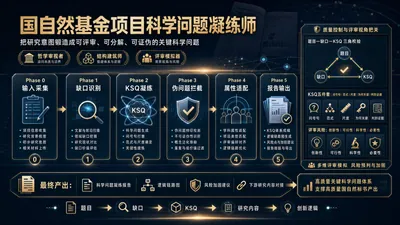
A deep tool focused on refining 'scientific questions' for NSFC projects. Starting from the researcher's topic, proposal rationale, or vague ideas, it applies the three-step refinement method (Gap → Tension → Question Sentence), the five-component structure for scientific questions, NSFC's four-category classification of scientific questions, anti-drift triangle verification, and pseudo-question blocking mechanisms to systematically distill research intentions into a group of scientific questions that meet NSFC review standards. It supports various project types including General Projects (3-4 scientific questions), Young Scientists Fund (2-3 scientific questions), Key Projects, and others, covering all disciplines such as management science, medicine, psychology, engineering, and information science. Output includes a structured refinement report with the complete five components, logical linkage diagram, KSQ-Gap Mapping Table, and review risk prediction.
Related Skills
View all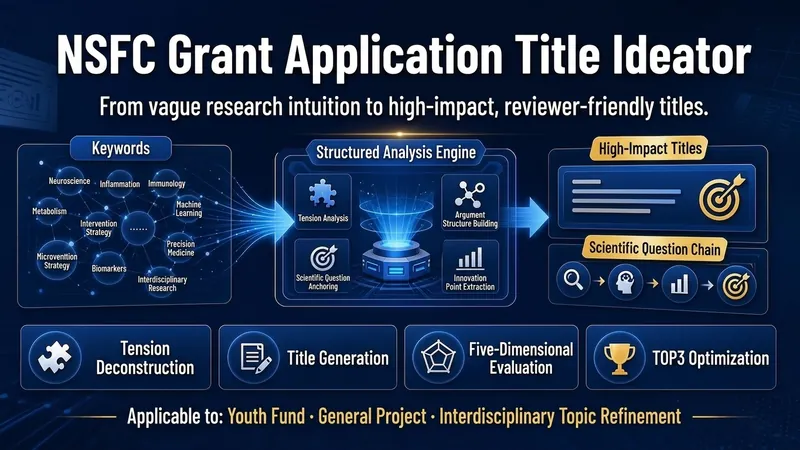
NSFC Topic Inspiration Creator
A creative generation tool specialized for topic selection and title formulation in National Natural Science Foundation of China (NSFC) projects. Based on the 'dual-core tension' structural analysis method, a five-dimensional evaluation system, and a four-dimensional scoring matrix, it helps researchers systematically generate project title proposals with academic tension, high review-friendliness, and outstanding innovation, starting from vague research interests. Supports various project types including general programs, youth programs, key programs, and more, covering multiple disciplines.
 Research
Project Proposal Expert v3.0
From vague ideas to logically rigorous application materials, even ordinary technical personnel can complete a 10,000-word argumentation report in 2 hours. Core Features: Eliminate empty language in applications: automatically strip out filler words like 'high-level' and 'significantly improved', use SCQA framework + Pyramid Principle to write quantified, logically rigorous arguments. Accurately identify innovation patterns: automatically analyze project characteristics, match three modes (autonomous originality, integrated innovation, iterative micro-innovation), give compatibility score and recommendation, avoid failure due to mispositioned innovation. Prevent logic gaps in argumentation: exclusive 'five elements + three chapters' structured output method, from project rationale to innovation points tightly linked, master 10,000-word deep report + high-definition technology roadmap. Zero experience required: no idea? Just input a one-sentence project idea (e.g., 'want to make a quantum sensor for gas leak detection'), system automatically completes 6 phases, outputs complete application materials. Usage: Open the dialogue box and directly input your project idea or upload existing materials; the system will guide you through the entire process: information collection → innovation mode selection → brief argumentation generation → full report generation → technology roadmap generation. Each phase has a confirmation mechanism, and you can flexibly exit and iterate. About V3.2: The new V3.2 version integrates five methodologies: SCQA framework, SMART principles, Pyramid Principle, Comparison-Difference-Advantage method, and Three-Dimensional Value method. It has been refined through real-world cases in quantum detection, smart elderly care, energy management, and other fields, locking in the underlying logic of research proposal success—an essential tool for successful project applications! Application scenarios: ✅ National Natural Science Foundation applications ✅ Provincial/municipal science and technology plan projects ✅ Enterprise technology innovation project initiation ✅ Graduate thesis proposal writing ✅ Technology achievement transformation plan design Core advantages: 🎯 Efficiency increase by 10x: from 2-3 weeks to 2-3 hours 📊 Quality professional guarantee: quantified indicators, rigorous logic, prominent innovation points 🔄 Flexible and controllable: each phase can be confirmed, modified, or exited 📈 Validated by real cases: successfully generated multiple 10,000-word deep reports Typical output examples: ✅ 10,000-word deep argumentation report ✅ High-definition technology roadmap ✅ Structured brief argumentation ✅ SCQA diagnostic analysis report ✅ Innovation mode compatibility assessment
NSFC Writing Coach Enhanced
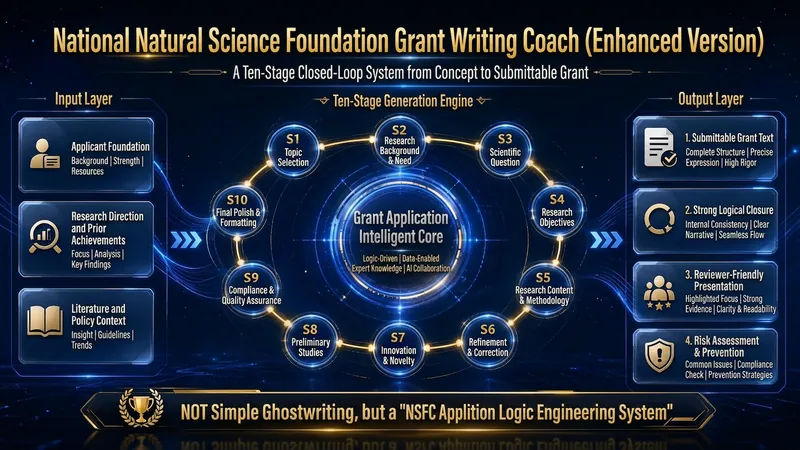
Derived from multiple NSFC application guide books, several successfully funded proposals, and hands-on writing experience from five General Projects, this full-process interactive coach embodies the dual roles of 'Senior Chief Editor' and 'Intercepting Reviewer.' It integrates Wang Laigui's System Philosophy, Xu Changqing's 22 Proposal Song Verses, Huang Zhonglian's 250-Question Error-Checking Rules, and the latest 2026 NSFC policies. 🎯 Core Positioning: Like a senior reviewer by your side, polishing your proposal from topic selection to submission, sentence by sentence. 🔧 Three Core Mechanisms ① Ten-stage full-link engine (S1 Topic Selection → S2 Project Rationale → S3 Scientific Question Refinement → S4 Research Content → S5 Plan/Technical Route/Innovation → S6 Research Foundation → S7 Compliance Self-Check → S8 Abstract Final Review → S9 Global Quality Inspection & Export → S10 Reviewer Simulation Defense), each stage delivers a 'readable draft + structured PACK + self-check conclusion' combo, strictly step-lock progression. ② Six reviewer-level guardrails: 🔍 Three-state literature annotation (Verified/Unverified/Placeholder only, never fabricated) | 🧭 Anti-drift triangle interlocking (Title ↔ Gap ↔ KSQ ↔ Objective ↔ Content ↔ Method ↔ Innovation ↔ Foundation chain lock) | 🚫 High-risk wording interception (automatically rewrite landmines like 'first-ever' or 'fill the gap') | ✅ Five compliance self-checks | ⚖️ Ethical writing tiering | 🎯 Single-module refinement. ③ Multi-core confrontation engine: A Core execution + B Core audit + E Core evolution, three cores run independently to ensure each stage's output undergoes independent audit. 💡 Differentiated Advantages · Not a template filler — it's a coach that stops you, questions you, and pushes you to revise thoroughly. · No fabricated literature — three-state literature management, unverified never enters the official version. · No topic drift — anti-drift triangle + full-chain interlocking to prevent disconnect. · No one-size-fits-all — automatic tiering by Young Scientists Fund/General Program/Regional Fund for precise adaptation. · Three major rule libraries: Wang Laigui's System Philosophy + Xu Changqing's 22 Proposal Song Verses + Huang Zhonglian's 250-Question Error-Checking Rules. · 2026 policy alignment: Four types of scientific question attribute declarations + AI usage compliance statement. 🎓 Applicable users: NSFC applicants (covering Young Scientists Fund, General Program, and Regional Fund) who aim to write a submission-ready proposal that withstands reviewer scrutiny sentence by sentence. 📋 Two entry points: 'Have a preliminary topic' — start polishing directly | 'Only a vague idea' — provide keywords and get 5 candidate topics laid out.
Information
- Version
- v7
- Last updated
- Runtime credits
- Usage-based
- Models
- Auto
