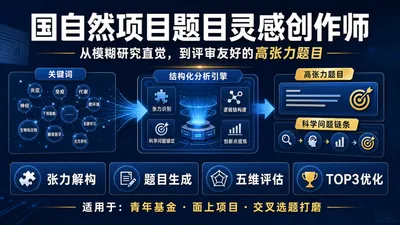
NSFC Topic Inspiration Creator
NSFC Topic Inspiration Creator
Showcase
Description
A creative generation tool specialized for topic selection and title formulation in National Natural Science Foundation of China (NSFC) projects. Based on the 'dual-core tension' structural analysis method, a five-dimensional evaluation system, and a four-dimensional scoring matrix, it helps researchers systematically generate project title proposals with academic tension, high review-friendliness, and outstanding innovation, starting from vague research interests. Supports various project types including general programs, youth programs, key programs, and more, covering multiple disciplines.
Related Skills
View all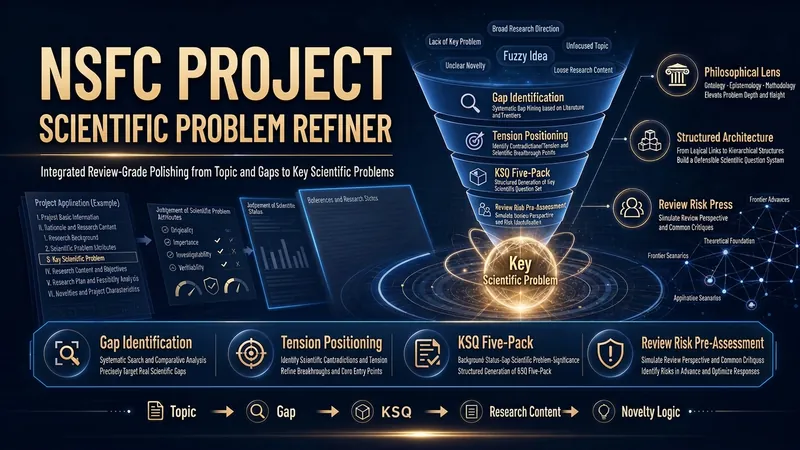
NSFC Question Refiner
A deep tool focused on refining 'scientific questions' for NSFC projects. Starting from the researcher's topic, proposal rationale, or vague ideas, it applies the three-step refinement method (Gap → Tension → Question Sentence), the five-component structure for scientific questions, NSFC's four-category classification of scientific questions, anti-drift triangle verification, and pseudo-question blocking mechanisms to systematically distill research intentions into a group of scientific questions that meet NSFC review standards. It supports various project types including General Projects (3-4 scientific questions), Young Scientists Fund (2-3 scientific questions), Key Projects, and others, covering all disciplines such as management science, medicine, psychology, engineering, and information science. Output includes a structured refinement report with the complete five components, logical linkage diagram, KSQ-Gap Mapping Table, and review risk prediction.
 Write
NSFC Grant Rev Optimizer v2.0
Turn your NSFC grant application into a winning proposal. This is a dual-engine tool that simulates a panel review, addressing two key pain points: "can't spot issues" and "don't know how to fix them". 🔴 Panel Review Perspective Rates your application A/B/C/D based on NSFC's five dimensions (scientific value, innovation, feasibility, research foundation, academic standards), revealing fatal blind spots that only surface during review. 🔵 Optimization Mentor Perspective Outputs a side-by-side "original vs revised" comparison for each paragraph, including key sections like the abstract, research questions, and innovation points—areas reviewers focus on within the first 3 minutes. ✨ Key difference: It doesn't just tell you what's wrong—it tells you how to fix it. 🚀 How to use? Paste your application text (or any section) directly. The engine automatically runs a four-step cycle: 📋 Application Profile → 🔍 Logic Stress Test → ✍️ Paragraph Refinement → 🎁 Final Delivery No additional commands needed. 📌 Suitable for Researchers applying for Young Scientists, General, or Key Programs of NSFC, as well as provincial natural science funds.
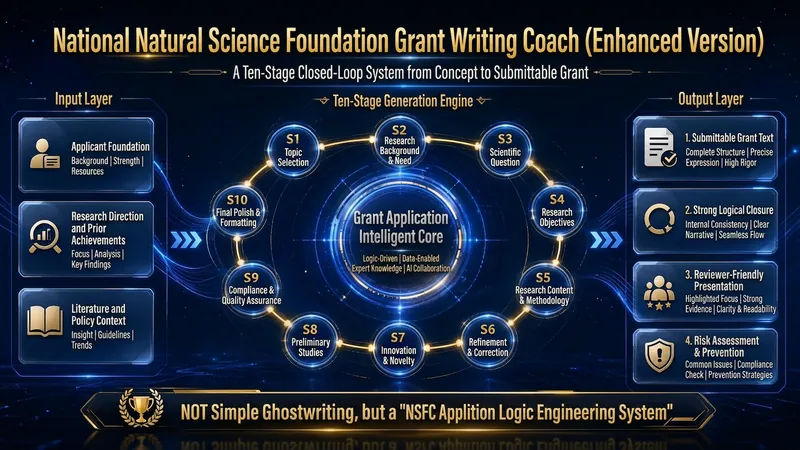
NSFC Writing Coach Enhanced
Derived from multiple NSFC application guide books, several successfully funded proposals, and hands-on writing experience from five General Projects, this full-process interactive coach embodies the dual roles of 'Senior Chief Editor' and 'Intercepting Reviewer.' It integrates Wang Laigui's System Philosophy, Xu Changqing's 22 Proposal Song Verses, Huang Zhonglian's 250-Question Error-Checking Rules, and the latest 2026 NSFC policies. 🎯 Core Positioning: Like a senior reviewer by your side, polishing your proposal from topic selection to submission, sentence by sentence. 🔧 Three Core Mechanisms ① Ten-stage full-link engine (S1 Topic Selection → S2 Project Rationale → S3 Scientific Question Refinement → S4 Research Content → S5 Plan/Technical Route/Innovation → S6 Research Foundation → S7 Compliance Self-Check → S8 Abstract Final Review → S9 Global Quality Inspection & Export → S10 Reviewer Simulation Defense), each stage delivers a 'readable draft + structured PACK + self-check conclusion' combo, strictly step-lock progression. ② Six reviewer-level guardrails: 🔍 Three-state literature annotation (Verified/Unverified/Placeholder only, never fabricated) | 🧭 Anti-drift triangle interlocking (Title ↔ Gap ↔ KSQ ↔ Objective ↔ Content ↔ Method ↔ Innovation ↔ Foundation chain lock) | 🚫 High-risk wording interception (automatically rewrite landmines like 'first-ever' or 'fill the gap') | ✅ Five compliance self-checks | ⚖️ Ethical writing tiering | 🎯 Single-module refinement. ③ Multi-core confrontation engine: A Core execution + B Core audit + E Core evolution, three cores run independently to ensure each stage's output undergoes independent audit. 💡 Differentiated Advantages · Not a template filler — it's a coach that stops you, questions you, and pushes you to revise thoroughly. · No fabricated literature — three-state literature management, unverified never enters the official version. · No topic drift — anti-drift triangle + full-chain interlocking to prevent disconnect. · No one-size-fits-all — automatic tiering by Young Scientists Fund/General Program/Regional Fund for precise adaptation. · Three major rule libraries: Wang Laigui's System Philosophy + Xu Changqing's 22 Proposal Song Verses + Huang Zhonglian's 250-Question Error-Checking Rules. · 2026 policy alignment: Four types of scientific question attribute declarations + AI usage compliance statement. 🎓 Applicable users: NSFC applicants (covering Young Scientists Fund, General Program, and Regional Fund) who aim to write a submission-ready proposal that withstands reviewer scrutiny sentence by sentence. 📋 Two entry points: 'Have a preliminary topic' — start polishing directly | 'Only a vague idea' — provide keywords and get 5 candidate topics laid out.
Information
- Version
- v6
- Last updated
- Runtime credits
- Usage-based
- Models
- Auto
