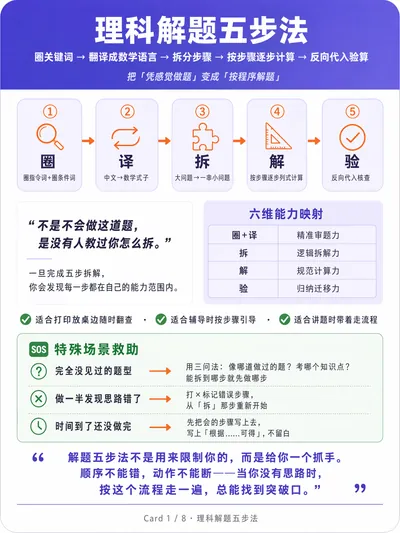
Science Problem-Solving Coach
Transform intuition into a structured five-step workflow.
Science Problem-Solving Coach
Transform intuition into a structured five-step workflow.
Showcase
Description
A science problem-solving tutoring agent that supports three modes: Analysis (five-step breakdown), Guidance (heuristic questioning), and Diagnosis (error analysis + six-dimensional capability assessment), automatically switching based on keywords. The core framework is the 'Circle—Translate—Break Down—Solve—Verify' five-step method, with LaTeX mathematical formula rendering, helping students transform from 'solving by intuition' to 'solving by procedure,' securing full marks on what they know.
Best for
Students looking to improve science problem reading, breakdown, structured calculation, and verification habits.
How to use this Skill
Provide your input
Enter a science or math problem, or include your working out; you can also specify "analysis", "guide", or "diagnose".
Run the Skill
After selecting the mode, the agent explains, guides with questions, or checks errors using the circle-translate-breakdown-solve-verify framework.
Review your result
Receive step-by-step problem-solving explanations, guided prompts, or diagnostic results complete with error analysis and capability feedback.
Related Skills
View all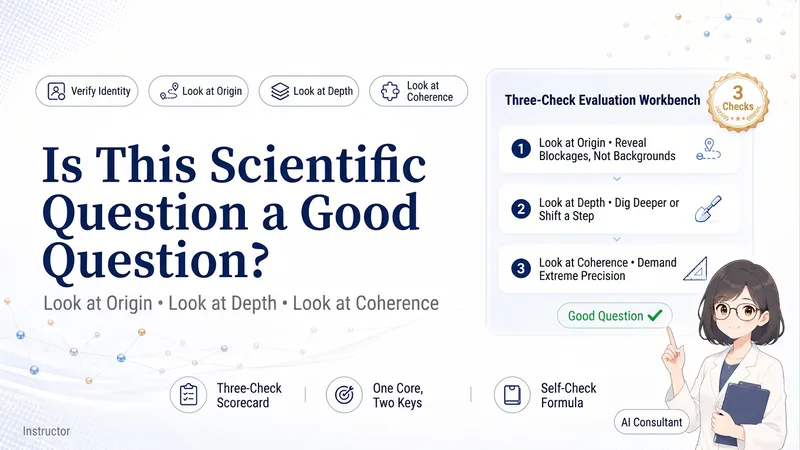 Research
Teacher Man · Science Q Check
Conduct a reviewer-perspective deep health check on the scientific questions (or title abstracts and preliminary ideas) refined in your proposal. It supports automatically tracing back from scattered ideas or title abstracts through a four-step chain: Domain (Level 7) to Direction (Level 8 sub-discipline) to Bottleneck (Level 9) to Scientific Question (Levels 10-11), scoring each link. It first verifies legitimacy (non-research inputs trigger a 10-point cutoff, G0 three-question preliminary veto, science vs. engineering differentiation, and free exploration vs. target-driven alignment), then performs diagnoses across three lenses: looking at origin (Level 11 contraction ruler and pre-experiment two-way causal bridge), looking at depth (online verification of peer depth lines, 8-tier journal quality x quantity dual-track popularity, and sub-discipline uniqueness horizontal comparison), and looking at alignment (same-scale measure borrowing and red-team three paths). It outputs a three-lens scorecard, a four-step reverse-engineering check table, a five-dimensional score, an overall judgment, and a rewritten "one core + two keys" expression, and saves it as a document.
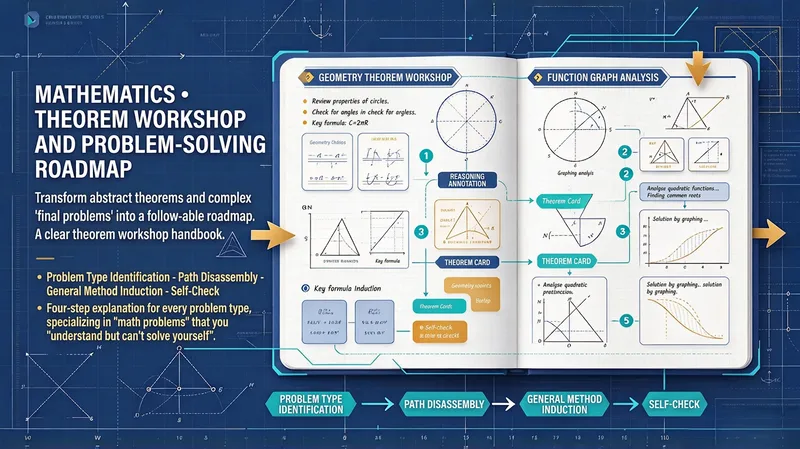
Math Theorem Lab & Roadmaps
SKILL Features Problem-Type Identification Cards: First determine which model the problem belongs to—such as function zeros, extrema, loci, existence, or case analysis—then choose the right tools to solve the problem of not knowing where to start. Solution-Path Breakdown: Known conditions → intermediate bridges (auxiliary lines / substitutions / constructed functions / coordinate systems) → target conclusion. Each step explains “why this idea came to mind” through its trigger signal. Theorem Workshop: For each theorem, provide its content, applicable conditions, counterexamples showing when it fails, common variants, and connections to other theorems to avoid applying formulas mechanically. Multiple Solutions and General Methods: Compare at least two approaches—algebraic / geometric / vector / derivative-based—and extract a general method that can be transferred to similar problems. Dual Algebra–Geometry Track: Translate between function graphs, geometric figures, and parametric equations, including the approach of “read the answer from the diagram first, then prove it.” Self-Check Checklist: Prioritize the domain; check endpoints and equality cases; identify extraneous and discarded roots; verify that case analysis is complete; test special values; and check whether dimensions and orders of magnitude are reasonable. Common-Mistakes Archive: Collect classic traps that seem reasonable but are actually wrong, such as ignoring the domain, omitting cases, or assuming equality can be attained in an inequality when it cannot. Multiple Difficulty Levels: Middle school foundations / high school and entrance-exam prep / advanced competition prep, including construction methods, bounding techniques, and invariant-based thinking. Recommended Prompts Turn “number of zeros of a function” into a problem-type identification card and solution-path breakdown, with an algebra–geometry diagram. Organize “extrema and ranges of conic sections,” with multiple solutions and a general-method summary. Create a workshop page on “constructing auxiliary lines in solid geometry” and clearly explain the trigger signals. Turn “choosing methods for summing sequences” into an identification card, with one example each for telescoping by shifted subtraction, partial fractions, and grouping. Create a theorem workshop on “derivatives, monotonicity, and extrema,” with counterexamples showing when theorems fail. Generate a common-mistakes archive and self-checklist for “probability and distribution tables” at the high school and entrance-exam level.
 Research
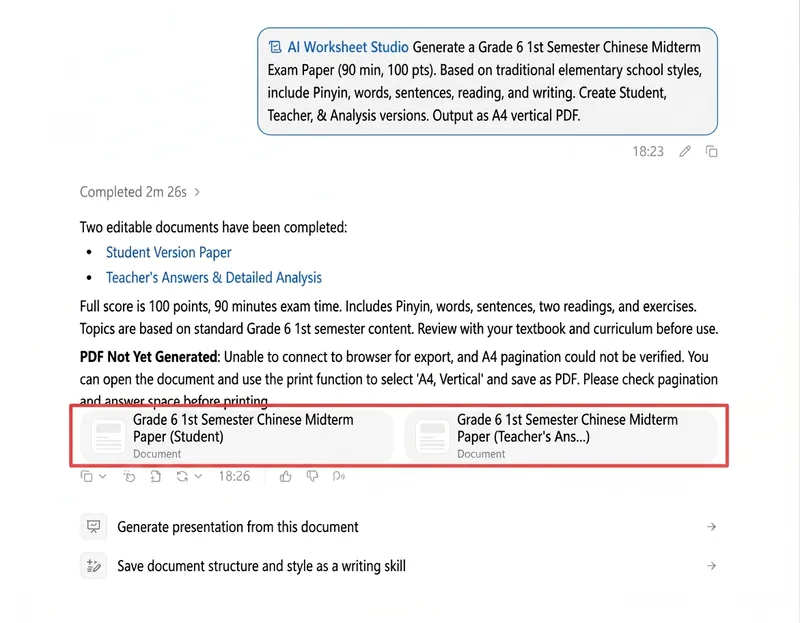
Exam Paper Generator
AI Exam Paper Factory | All-Subject Smart Study Material Generator for Primary Schools Still spending hours creating questions, formatting, and making practice tests? AI Exam Paper Factory is a smart study material creation tool designed specifically for primary school education. It supports grades 1 through 6, covering subjects such as Chinese, mathematics, English, and science. Simply enter the grade, subject, textbook version, and knowledge points to automatically generate professional unit tests, midterm exams, final review mocks, daily practice, specialized training, and pre-exam sprint materials. Core Features: Smart Question Generation: Automatically designs original questions based on grade level and knowledge points. Comprehensive Coverage: One-stop generation for Chinese, mathematics, English, and science. Difficulty Control: Freely switch between basic, intermediate, and advanced levels. Similar Paper Generation: Reference uploaded exam images to generate brand-new practice tests of the same type. Answers and Explanations: Automatically generates standard answers, step-by-step solutions, and grading criteria. Wrong Answer Reinforcement: Generates targeted variant practice based on student mistakes. Professional Formatting: A4 portrait layout, black-and-white printing, standard numbering, and answer areas. File Output: Supports generating editable documents and PDFs (depending on available export tools). Target Audience: Primary school teachers, parents, educational training institutions, and study material creators. From a single knowledge point to a complete set of mock exams, make test creation more efficient, practice more targeted, and lesson planning simpler.
Information
- Version
- v8
- Last updated
- Runtime credits
- Usage-based
- Models
- Auto
- Use cases
- Learning & education
- What you get
- ReportDocument
