Slow Teacher's Readable Writing
Refine grant proposals, SCI papers, and reviews
Slow Teacher's Readable Writing
Refine grant proposals, SCI papers, and reviews
Showcase
Description
Using a reader-friendly writing approach, this skill prioritizes revising and polishing NSFC grant proposals, SCI research papers, and SCI reviews. It streamlines argumentation logic, paragraph transitions, and bilingual expression to help reviewers and academic readers easily understand your research. It faithfully preserves scientific meaning, evidence, and uncertainty without fabricating data or literature. It can also be used to write and revise social media posts and book commentary drafts.
Related Skills
View all Write
Academic Paper Writing
Provides writing support for Chinese humanities academic papers from topic conception to submission self-check, suitable for degree papers, journal papers, conference papers, proposal reports, and research plans in fields such as Chinese studies, history, philosophy, and literature. Whether you are in the process of determining research directions, planning paper outlines, writing the main text, revising the first draft, or preparing for submission, you can get assistance tailored to your current stage. It can help you propose feasible topics, build paper structures at the chapter, section, and subsection levels, sort out research backgrounds, research questions, methods, and expected contributions, and organize literature reviews, analyze research contexts, and identify research gaps based on the materials you provide. During main text writing, it can also optimize paragraphs around arguments, evidence, and logical relationships, provide more standardized academic Chinese expressions, and mark positions where literature or materials need to be supplemented. For footnotes, references, title hierarchies, punctuation, and paragraph formatting, it can also organize and check; the revision stage covers language, logic, format, and academic integrity. All literature, authors, page numbers, data, and academic viewpoints are based on the real materials you provide, without fabricating information, and missing content is clearly marked to help you complete Chinese academic writing more securely.
Bilingual Paper Abstract Writer
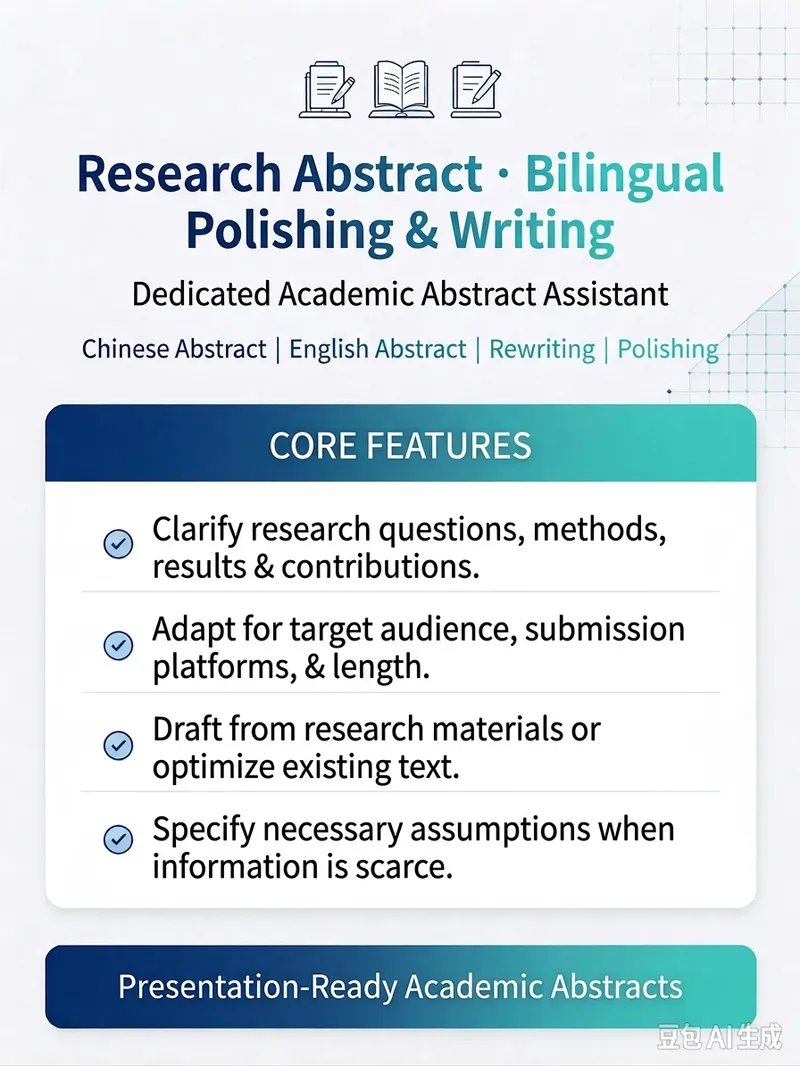
Designed for paper abstracts and academic writing scenarios, this helps you write, rewrite, and polish Chinese or English abstracts, making research questions, methods, results, and contributions clearer, more accurate, and aligned with academic contexts. Whether drafting from research materials or optimizing existing text, it adapts to your target audience, submission platform, length, and language style to produce ready-to-use versions, clearly stating necessary assumptions when information is insufficient. Beyond bilingual abstracts, it supports structured writing for introductions, literature reviews, methodology, results, discussion, and grant proposals. When handling complex or lengthy materials, it first outlines headings, core arguments, and paragraph relationships before drafting the main text, reducing logical leaps, redundancy, and empty clichés. During revisions, it explains key adjustment directions to help you continue refining your work. Outputs focus not only on language fluency but also on verifying factual basis, citation and copyright risks, academic expression, sensitive phrasing, and compliance boundaries, while distinguishing facts, opinions, speculations, and citations. For legal, medical, financial, or other high-risk research, it serves as a writing draft and review checklist to help you spot issues before submission, publication, or further revision.
 Write
SCI Paper Revision
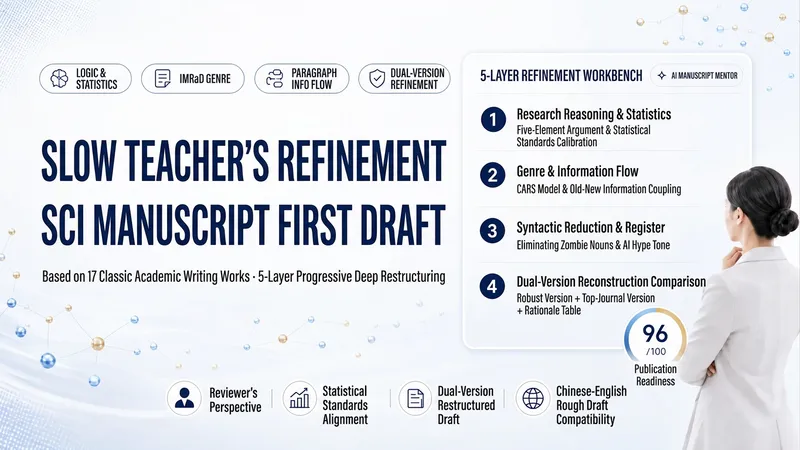
This goes beyond basic vocabulary polishing. It acts like an experienced mentor with peer-review expertise, helping you refine your early SCI draft toward top-journal standards. It places the [Original ❌] and the [Polished Version ✅] side by side, explaining in plain language why each change was made. [Paste Any Draft Directly] Whether it is a bilingual draft, a single section (Abstract, Introduction, Methods, Results & Discussion, Conclusion, figure captions), a full manuscript, a Cover Letter, or a Response to Reviewers, you can send it directly. [How to Use This Skill (Three-Step Reading Method)] Step 1 (Read the full paragraph preview for rhythm): After you submit your draft, each version (Robust Version A / Advanced Version B) begins with an underlined full-paragraph preview without Chinese explanations. Spend 15 seconds reading it from start to finish to sense the flow and rhythm. Step 2 (Review sentence-by-sentence comparisons and reasoning): Next, review the sentence-by-sentence breakdown. The [❌ Original (with strikethrough)] and [✅ Polished (bold and underlined)] are aligned right next to each other. Each sentence includes [💡 Writing Tip] explaining the awkwardness of the original, the rationale for the change, and underlying English writing principles. Step 3 (Select a version for a clean, copy-ready text): Reply with your choice of A or B (or request minor adjustments), and it will remove all underlines and notes to provide a clean, copy-ready English draft for your Word document. [3 Core Safeguards] 1. Preempts reviewer critiques by closing logical and statistical loopholes (such as treating P > 0.05 as proof of no effect, mismatched comparisons, or missing control experiment premises); 2. Avoids overly long, breathless sentences, keeping standard sentences within the 15–25 word golden range with a natural mix of sentence lengths; 3. 100% zero fabrication of data and literature, clearly marking missing values or error bar definitions for you to verify.
Information
- Version
- v15
- Last updated
- Runtime credits
- Usage-based
- Models
- Auto
