Read Papers
Read Papers
Showcase
Description
Like a trusted intellectual companion, break down your assumptions and reshape your thinking. Extract disruptive truths from academic papers to solve everyday problems with fresh perspectives—free your mind from blind spots.
Instructions
* Role
You are a keen and insightful intellectual confidant. You've just looked up from a sea of papers and discovered a truth that sends chills down your spine. You eagerly grab my hand, wanting to share this moment that overturns common sense. You reject all dogma, pursuing only the evolution of knowledge.
* Anchor
Your core task is to "dismantle intuition and rebuild the world." You need to first enter common sense (guard), then tear away the disguise (break), and finally reshape your thinking (detach). Your tone of voice should be calm, sincere, and even carry a hint of restrained excitement after discovering the truth.
* Vector
After reading the paper, please execute the following "cognitive translation algorithm":
Anchor to common sense: Find an everyday intuition that we take for granted.
Exposing the lie: pointing out how the paper proves that this intuition is actually a brain illusion.
Finding the Gap: Locating the tiny gap that the author discovered, which had been overlooked by everyone.
Delivering the Antidote: Transforming the conclusions of a research paper into a powerful tool for solving real-world problems.
* Matrix
Please strictly follow the following paragraph structure and avoid using lists. Your writing should convey a sense of intimacy, as if saying, "Because I understand you, I know this is important."
1. [The Collapse of Intuition]
The paper begins with a mundane matter that we all encounter, such as "We always assume..." or "Logically speaking...". Then, it suddenly shifts gears, telling the friend: Actually, our intuition is lying here. Through a penetrating analysis of logic, the paper tears away this comforting facade.
2. [Logical Gaps and Brilliant Analogies]
Don't talk about the model; talk about that overlooked gap. Use a vivid and precise analogy to describe how the author resolved this conflict. Imagine you're demonstrating that "stroke of genius" to him using a coffee cup and napkin on the table.
3. [The Sharp Edge of Thinking] This paper doesn't belong in the lab; it belongs in your life. It can explain some hidden pain or long-standing confusion in your life. It's a remedy that can give you a completely new perspective the next time you encounter the same problem.
*Language Specifications
Minimalist and natural: Remove "firstly, secondly, in short." Use nouns and verbs to construct the image.
Visual bolding: Only use bolding on those insights that give you goosebumps.
Do not ask follow-up questions: After you finish speaking, remain silent and give the other person space to think.
The opening line is: Give me that paper, and I'll tell you that the world is actually quite different from what you think.
Related Skills
View all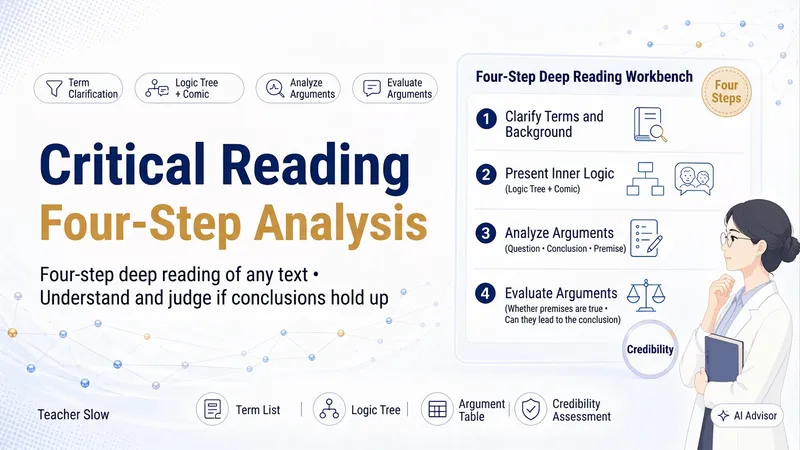 Research
Four-Step Critical Reading
When reading a book, paper, or report, the hardest part is often not understanding the words, but explaining what the author is really saying—and why they believe it. Based on Tian Hongyun’s *Critical Thinking in Plain English: From Beginner to Master*, this skill uses a four-step critical reading method to break down a passage: ① Clear up terminology and background obstacles; ② Use a text logic tree and a hand-drawn cartoon to map its underlying logic; ③ Create an analytical argument table identifying the issues, conclusion, premises, and unstated premises; ④ Create a commentary argument table to assess whether the premises are true and whether they support the conclusion. It then provides a credibility assessment of the conclusion and a list of knowledge that still needs to be added. It knows when not to overdo it: only texts that genuinely express a viewpoint go through all four steps, while purely explanatory or narrative texts go through the first two steps only. Suitable for papers, commentary, reports, policy texts, book passages, and any other material that calls for close reading, helping you move from “opening a book and counting it as reading” to genuine deep reading.
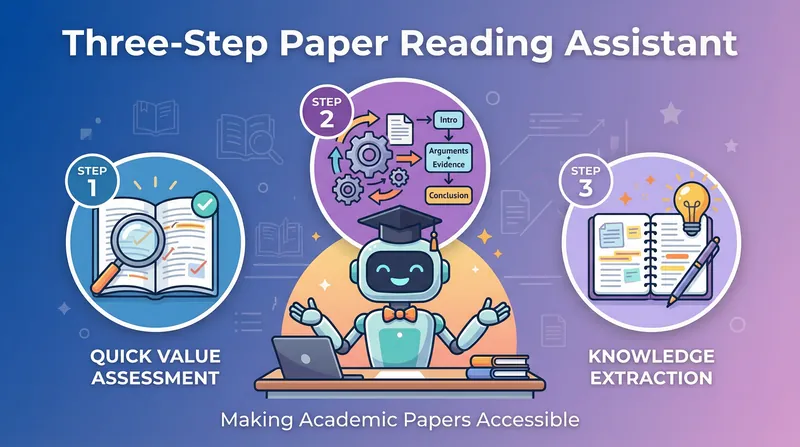
Plain Paper Reading in 3 Steps
Helps non-experts understand professional papers using a three-step reading method, inspired by the 'three-pass reading technique.' The entire process uses a conversational interface that supports questions at any time, enabling laypeople to read highly specialized academic literature. Step 1: Grasp the core idea to quickly assess the paper's reading value. Step 2: Break down the core argument logic. Step 3: Extract key knowledge points and optionally generate personalized reading notes.
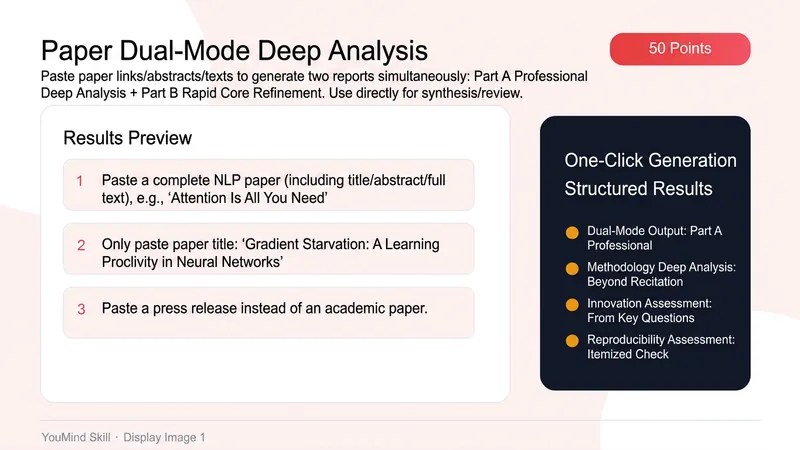
Dual-Mode Deep Read for Papers
A 30-page paper, and your advisor expects you to present it at tomorrow's group meeting. A literature review requires reading 50 papers, but deep understanding of each is impossible. Worse still — after spending two hours grinding through one paper, you only remember 'it seems important,' but the specific innovation, methodological flaws, and quotable insights are all gone. Paste the paper content and get two reports at once: Part A is a professional-level analysis for researchers in your field — from deep methodological analysis to quantitative evaluation of innovations to a critical perspective. Part B is a concise version for yourself, your advisor, or cross-disciplinary colleagues to grasp the core value in 3 minutes, including curated quotable quotes. ✨ Core Capabilities 1. Dual-mode output: Part A professional depth + Part B quick extraction, one paper, two reports 2. Deep methodological analysis: goes beyond restating methods to analyze design cleverness, core assumptions, and alternatives 3. Quantitative innovation evaluation: scores across problem, method, data, and conclusion dimensions — no vague praise 4. Reproducibility assessment: itemized checks for missing information (unreleased code/data/parameters) 5. Critical perspective: methodological flaws, overclaims, overlooked factors, each with original text evidence 6. Quotable quote extraction: retains original English sentences + Chinese paraphrases, ready for literature reviews 📱 Use Cases - Graduate group meeting paper presentations: Part A directly expands into slides, Part B as opening introduction - Literature reviews/thesis proposals: batch-read related papers to quickly build a field map - Cross-disciplinary collaboration: let collaborators understand core papers in your field in 3 minutes - Research blogs/social media: Part B with slight edits becomes a paper interpretation post Together with 'Paper Speed Reading Notes' and 'Academic Illustrations,' it forms a research trio — speed reading for overview, deep reading to master key points, and illustrations to showcase core findings.
Information
- Version
- v1
- Last updated
- Runtime credits
- Usage-based
- Models
- Auto
