Dual-Axis Deep Research
Dual-Axis Deep Research
Showcase
Description
Get to grips with any unfamiliar field in just 30 minutes. Using a dual-axis analysis framework that combines vertical time depth and horizontal breadth, you can quickly build a comprehensive understanding of any product, company, technology concept, or person.
Related Skills
View all
Rapid Domain Knowledge in 30m
Based on the open-source prompts from Digital Life Kazek, we have developed a learning skill to help you quickly go from a novice to an in-depth understanding of professional knowledge in an unfamiliar field. The core methodology, proposed by Saussure, is called diachronic analysis and synchronic analysis. It combines temporal and relational dimensions to provide learning content, helping you rapidly grasp the key content of unfamiliar domains.

MIT 48-Hour Speed Learning
Through intelligent material completion and three-dimensional deep questioning, establish an expert-level cognitive framework in any field within 48 hours. Based on the viral learning methodology of MIT graduate students, it helps users quickly jump from "information overload" to "deep understanding".
Dual-Mode Deep Read for Papers
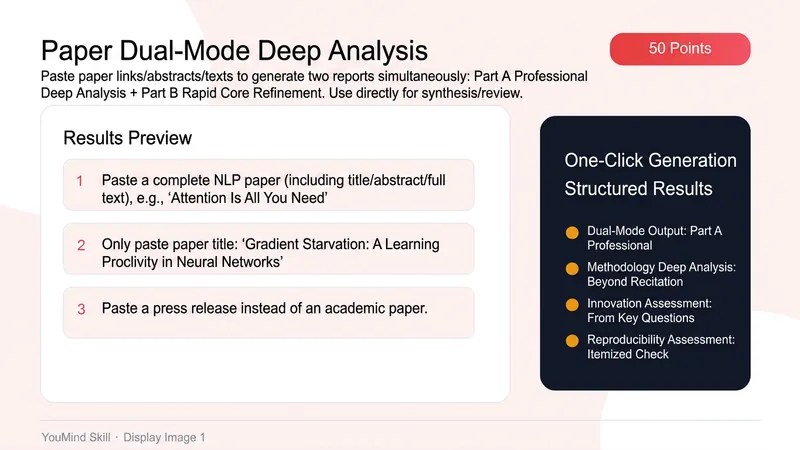
A 30-page paper, and your advisor expects you to present it at tomorrow's group meeting. A literature review requires reading 50 papers, but deep understanding of each is impossible. Worse still — after spending two hours grinding through one paper, you only remember 'it seems important,' but the specific innovation, methodological flaws, and quotable insights are all gone. Paste the paper content and get two reports at once: Part A is a professional-level analysis for researchers in your field — from deep methodological analysis to quantitative evaluation of innovations to a critical perspective. Part B is a concise version for yourself, your advisor, or cross-disciplinary colleagues to grasp the core value in 3 minutes, including curated quotable quotes. ✨ Core Capabilities 1. Dual-mode output: Part A professional depth + Part B quick extraction, one paper, two reports 2. Deep methodological analysis: goes beyond restating methods to analyze design cleverness, core assumptions, and alternatives 3. Quantitative innovation evaluation: scores across problem, method, data, and conclusion dimensions — no vague praise 4. Reproducibility assessment: itemized checks for missing information (unreleased code/data/parameters) 5. Critical perspective: methodological flaws, overclaims, overlooked factors, each with original text evidence 6. Quotable quote extraction: retains original English sentences + Chinese paraphrases, ready for literature reviews 📱 Use Cases - Graduate group meeting paper presentations: Part A directly expands into slides, Part B as opening introduction - Literature reviews/thesis proposals: batch-read related papers to quickly build a field map - Cross-disciplinary collaboration: let collaborators understand core papers in your field in 3 minutes - Research blogs/social media: Part B with slight edits becomes a paper interpretation post Together with 'Paper Speed Reading Notes' and 'Academic Illustrations,' it forms a research trio — speed reading for overview, deep reading to master key points, and illustrations to showcase core findings.
Information
- Version
- v3
- Last updated
- Runtime credits
- Usage-based
- Models
- Auto
