
Critical Writing IBAC
Build the framework first, then write
Critical Writing IBAC
Build the framework first, then write
Showcase
Description
Many articles lack depth not because of writing skills, but because the authors themselves haven't figured out what question they are answering and why they reached that conclusion. This skill uses Tian Hongjun's critical writing framework IBAC—I (Issue), B (Big premise / hidden assumptions and values), A (Actual premise / facts and evidence), C (Conclusion)—to first narrow your topic down to an arguable question, and then build an IBAC structure table to confirm with you before writing. Once confirmed, it turns the framework into an argumentative essay with complete elements, accompanied by a hand-drawn marker-style structure diagram and an IBAC self-check list that points out where premises are weak or evidence is missing line by line. It neither embellishes nor fabricates: where evidence is insufficient, it writes 'need to supplement evidence' and never glosses it over with rhetoric. Suitable for academic, science popularization, workplace, and self-media writing across all scenarios.
Recommended by
Shuting@YouMind
Why we love this skill
It explicitly breaks down issues, unexpressed premises, evidence, and conclusions using IBAC before writing and visualization. Its uniqueness lies in reviewing the structure first to prevent logical leaps and unsupported assertions.
Best for
Ideal for students, researchers, and content creators who need to organize complex viewpoints, improve argumentative rigor, and write argumentative essays.
How to use this Skill
Provide your input
Provide a writing topic, argument to prove, or background materials, and you can also add style requirements and existing evidence.
Run the Skill
The skill first organizes the question, premises, evidence, and conclusion to build an argument framework for your approval; after confirmation, it completes the article and checks for evidence gaps.
Review your result
Receive a well-structured argumentative essay, a hand-drawn style argument structure diagram, and a self-evaluation checklist highlighting weak points.
Related Skills
View all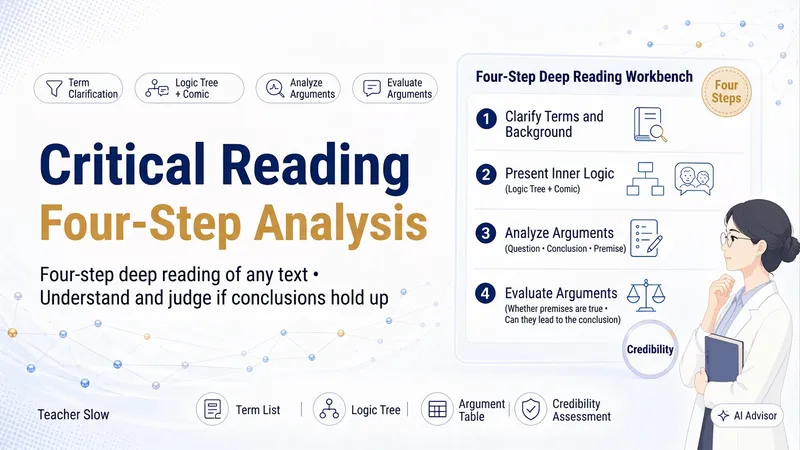 Research
Four-Step Critical Reading
When reading a book, paper, or report, the hardest part is often not understanding the words, but explaining what the author is really saying—and why they believe it. Based on Tian Hongyun’s *Critical Thinking in Plain English: From Beginner to Master*, this skill uses a four-step critical reading method to break down a passage: ① Clear up terminology and background obstacles; ② Use a text logic tree and a hand-drawn cartoon to map its underlying logic; ③ Create an analytical argument table identifying the issues, conclusion, premises, and unstated premises; ④ Create a commentary argument table to assess whether the premises are true and whether they support the conclusion. It then provides a credibility assessment of the conclusion and a list of knowledge that still needs to be added. It knows when not to overdo it: only texts that genuinely express a viewpoint go through all four steps, while purely explanatory or narrative texts go through the first two steps only. Suitable for papers, commentary, reports, policy texts, book passages, and any other material that calls for close reading, helping you move from “opening a book and counting it as reading” to genuine deep reading.
 Write
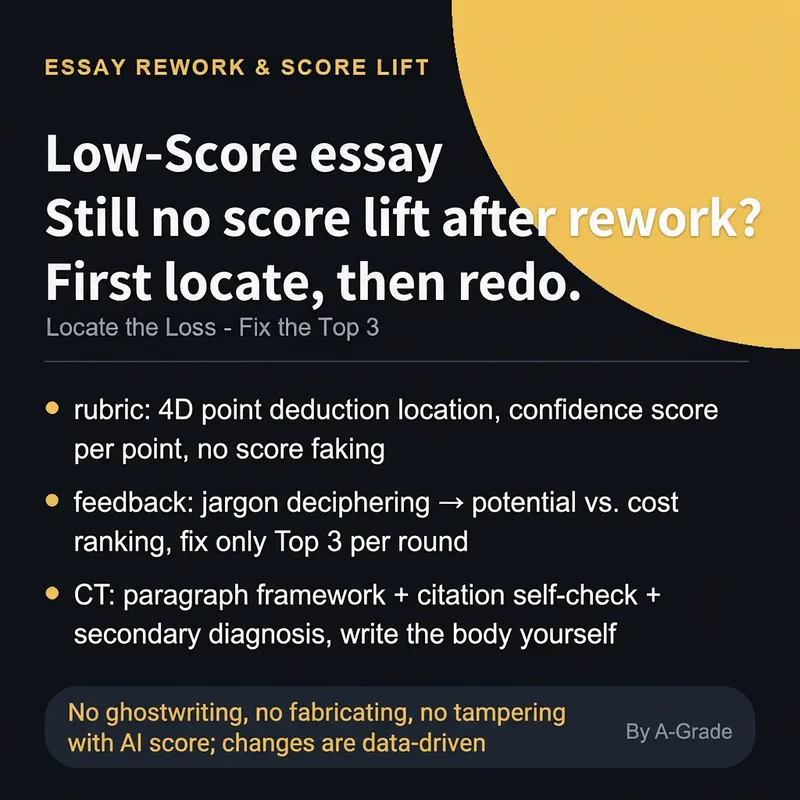
Essay Revision and Score Booster
Your essay gets a 58, and the feedback simply says "needs more critical analysis." You revise it seven or eight times, drifting further off track, and the next score is still a 62—3,000 words and 30 references later, still falling short of a 70. ### Why does it stay at 62 after eight revisions? It is not because you are not working hard, but because you are **spreading your effort evenly**: rewriting the whole piece, adding random citations everywhere, and editing low-impact areas. This Skill first helps you answer two questions: **Where are the points actually leaking? And what changes are most likely to boost your score?** Only then does it get to work. ### How it works 1. **Point-Loss Localization**: Scans across four rubric dimensions (argument structure, critical analysis, evidence citation, language format), providing evidence anchors and confidence levels for every point lost. If unclear, it marks it as "to be verified" and never fabricates claims. 2. **Feedback Decoding**: Translates comments like "too descriptive / lacks critical analysis / unclear" into specific actions and locations. 3. **Revision Priority**: Categorizes tasks into First, Next, Batch, and Skip based on "score-boosting potential × revision cost," focusing on **only the top 3 per round**—the core defense against drifting off track. 4. **Critical Thinking Frameworks**: Provides fillable paragraph frameworks (claim, evidence, analysis, counter-argument, conclusion). You fill in and verify the evidence yourself; the Skill does not write the final text for you. 5. **Citation Self-Check & Secondary Diagnosis**: More citations do not mean correct citations. After revising, run another diagnosis to see if weak points have shifted. ### What it does not do (red lines) - **No ghostwriting**: Provides only diagnosis, frameworks, and checklists; you write your own essay. - **No fabrication**: Scores, literature, citations, evidence, and sources—anything missing is marked as "to be added / to be verified." - **No AI-detection bypassing / Turnitin evasion**: This is academic misconduct and is not supported. It only helps improve the genuine quality of your argument and analysis. - **No guaranteed results**: Does not guarantee score increases, specific scores, or passing outcomes.
 Write
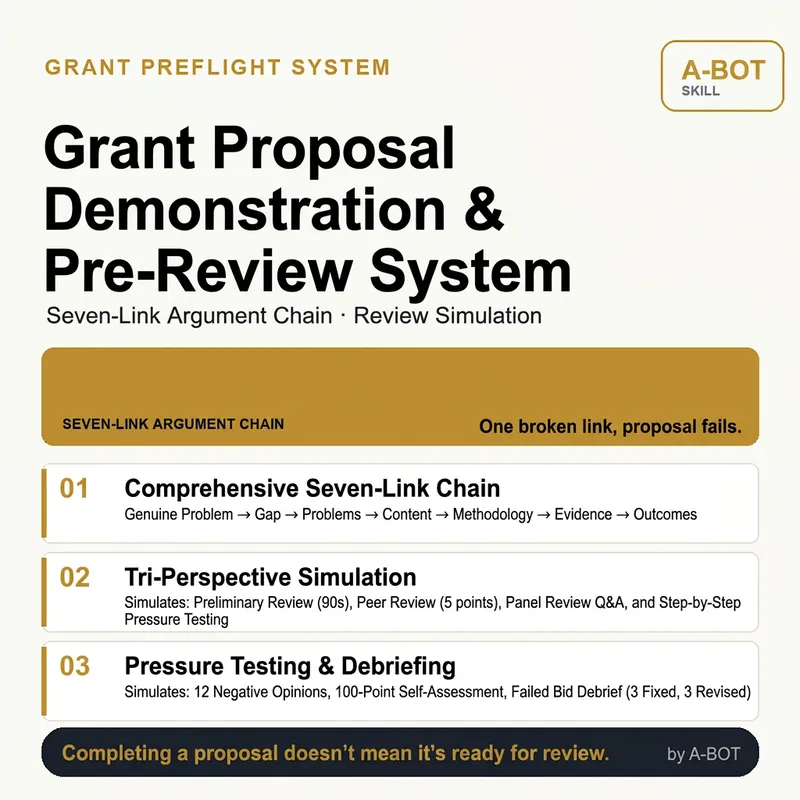
NSSF Proposal Review & Audit
Does your proposal hold up under scrutiny? This skill compresses your National Social Science Fund or Ministry of Education humanities proposal into a one-page 7-ring logic chain, previews it from three review perspectives, and stress-tests it against 12 negative review opinions. With execution upgrades, it organizes your materials into a 7-ring argument table, a negative opinion comparison table, and a self-assessment form after authorization. It never ghostwrites text, fabricates facts, or guarantees approval. Key selling point: It doesn't just point out flaws—after authorization, it directly generates the 7-ring argument table, negative opinion comparison table, dual-track framework, and self-assessment form for you. Announcements for the current year apply; no preliminary results are fabricated. Best for: Applicants for National Social Science Fund or Ministry of Education humanities projects, early-career researchers looking to review rejected submissions, or anyone whose content resembles a textbook table of contents, whose innovations sound like slogans, whose main thread is broken, or who worries about identity disclosure in blind reviews. What to input: Discipline + category + batch (subject to the current year's announcement) + research direction + your actual completed work + draft (optional). What is delivered: 8 content items (identity card / rejection review / restriction checklist / three-perspective card / 7-ring one-pager / dual-track framework / 12 negative opinions / 100-point self-assessment / authoritative anchor check) + 5 finished items (authorization record / 7-ring argument table / negative opinion comparison + dual-track framework / self-assessment form / rejection review & acceptance sheet). If tools are unavailable, a copy-pasteable finished content package is provided with notes. ## Exclusive Methodology: The 7-Ring Logic Chain Most rejections aren't due to formatting, but fragile arguments. Before writing a single word of text, this method compresses your logic onto a single page: 1. 7-ring thread: True problem → literature gap → research question → content → methods → evidence → outcomes. Any broken ring is highlighted in red with a fix, and rings 3→4→5→7 must connect. 2. Three-perspective preview: 90-second initial review, five-item desk review, and panel review skepticism—each step highlights "who is being defended against," helping you understand why the check matters. 3. Stress testing and review: Check off 12 negative opinions one by one, take a 100-point self-assessment (submissions under 70 points are not recommended), and conduct a rejection review for secondary submissions adhering to "three unchanged, three must-change" principles to block skin-deep rejections. Remember this: Break one ring, and the proposal fails. ## Evidence-Based: Parameter Rules Follow Current Announcements Anchored strictly to authentic public guidelines: current year's NSSF application announcement / Ministry of Education humanities notification / institutional research office template (highest priority), historical approval libraries, and CNKI/Wanfang novelty checks (self-checked), plus standard publishing ethics (background only). Age limits, word counts, restrictions, columns, and deadlines that cannot be confirmed are marked as "pending verification"; numbers are never filled in from memory. Unrelated guidelines (PRISMA, ICMJE, etc.) are explicitly marked as not applicable. ## v1 Update: From Tables to Finished Files Older versions provided modifiable intermediates, but this version turns content into usable files: it first tests your current session's tool capabilities, tells you what will be generated and resource consumption, and only proceeds upon your confirmation. - One-page 7-ring argument table: 7 rows of arguments with broken rings highlighted in red and connectivity conclusions, ready for Excel. - Negative opinion preview comparison table: 12 rows checked one by one, hit location + one-sentence fix. - Dual-track framework + self-assessment form + rejection review table: Frameworks based on Type A blind review 8 sections / Type B form 5 columns, complete with self-assessment scores and secondary submission revision lists. No generation tool in the session? Delivered as a "ready-to-paste finished content package"—all five tables written in Markdown, ready to copy into Word or Excel. Never pretends to generate or fabricates file paths. ## Detail Page Text ### Proposal AIGC is a hard red line. How does this skill safeguard it? Its scope is narrow: it only organizes the authentic materials you provide into tables and frameworks. If you lack data, interviews, samples, preliminary results, literature, or approved entries, they remain "pending supplement / pending verification." The skill will not fabricate them just to make a table look good; the 7,000-word text is written by you. ### Five Steps 1. Identity card + rejection review (secondary submissions prioritize three unchanged, three must-change rules); 2. Track gate + restrictions + three perspectives (mutually exclusive blocking, age verification, current year parameters); 3. 7-ring one-pager (broken rings highlighted in red, connectivity must pass); 4. Dual-track framework (no ghostwriting of text); 5. Negative opinions + removing AI tone + formal review + 100-point self-assessment. + Authoritative anchoring layer + execution delivery layer (detect → authorize → generate finished file → accept/downgrade).
Information
- Version
- v4
- Last updated
- Runtime credits
- Usage-based
- Models
- Auto
- Use cases
- Writing & contentResearch & analysisLearning & education
- What you get
- ArticleReportImage
- Visual styles
- Hand-drawn
