
Help Me Understand
Understand mechanisms, evidence, and limits
Help Me Understand
Understand mechanisms, evidence, and limits
Showcase
Description
Helps readers understand papers, reports, complex proposals, or difficult AI answers. It identifies barriers caused by terminology, relationships, steps, and changing conditions, then automatically chooses clear text, diagrams, or interactive HTML while preserving sources, evidence, and applicable limits. It is useful for requests like “help me understand this,” “draw this process,” “what happens if this condition changes,” or “I still don’t get it.” Ordinary polishing, simple factual questions, and writing ready-to-publish copy do not require the full process.
Recommended by
Dancang
Why we love this skill
It goes beyond simplifying complex content by tracking mechanisms, evidence strength, and applicability limits while preserving conditions and uncertainty—and avoiding claims that correlation proves causation.
Best for
For readers, learners, and researchers or analysts who need to understand papers, reports, complex proposals, or difficult answers.
How to use this Skill
Provide your input
Provide a paper, report, complex proposal, AI response, file, or accessible material, and say what you want to understand or which condition changes you want to explore.
Run the Skill
The system identifies terms, relationships, steps, evidence, and applicable limits, then chooses text, diagrams, or interactive pages based on the learning challenge. It separates source facts from teaching assumptions.
Review your result
Get traceable explanations of mechanisms, relationship diagrams, or interactive HTML while preserving key numbers, assumptions, uncertainty, evidence scope, and situations where the material does not apply.
Related Skills
View allAI Problem Decomposer
# AI Problem Decomposer **One complex question, one clear analysis diagram.** Why is store traffic unchanged while profits keep falling? Why did video views suddenly drop? Why are projects always delayed? Enter the question you want to understand, and AI will break down possible causes, map out cause-and-effect relationships, determine what to investigate first, and generate a clear, easy-to-understand Chinese-language analysis diagram. It does more than tell you **what the possible causes might be**. More importantly, it tells you: **why they might be happening and what to check next.** ## What you'll get **① Intelligent problem breakdown** Identify the key parts of a problem. For situations that can be analyzed with formulas, the tool prioritizes establishing metric relationships to help identify what needs to be investigated. **② 4–6 possible causes** Each cause includes: - Possible symptoms - The cause-and-effect mechanism behind the outcome - A practical way to verify it Unverified speculation is not presented as fact. **③ Intelligent investigation order** Based on impact, verification difficulty, and the information available, the tool recommends what to check first and what to check later, helping you avoid investigating blindly. **④ One professional Chinese-language analysis diagram** The tool automatically selects a suitable structure based on the question, such as a radial map, causal chain, fishbone diagram, or timeline. Different colors distinguish information types, and specific action prompts are placed next to causes, such as: - Check: impression click-through rate - Check: product gross margin - Review: customer comments and feedback **⑤ Image text check** After generation, the tool checks the Chinese text, number of causes, and consistency between the diagram and its content. If obvious text errors are found, it attempts one automatic correction based on the run settings; additional generation may use more credits. ## What kinds of questions is it suited for? **Business operations** - Why are profits falling even though store traffic is unchanged? - Why are returning customers decreasing despite good reviews? **Content creation** - Why did YouTube views suddenly drop? - Why are impressions high but click-through rates low? **Work and learning** - Why are projects always delayed? - Why hasn't performance improved significantly despite investing more time in learning? ## How to use it 1. Enter a specific question you want to analyze. 2. Include any data, screenshots, or reference materials you have. 3. AI breaks down the causes, analyzes the mechanisms, and provides verification methods. 4. Generate a Chinese-language multifactor analysis diagram to help you investigate each item step by step. ## Usage tips - The more specific the question and the more complete the data, the more targeted the analysis will be. - Do not fabricate statistics, survey results, or external sources. - The causes shown in the diagram are analytical hypotheses and do not mean the actual causes have been confirmed. - Generated images may contain layout or text errors. - A single test run uses approximately 100–200 credits. Actual credit usage depends on the model, task complexity, and whether additional generation is needed. **Make complex questions easier to understand, investigate, and act on.**
Academic Methodology Writer
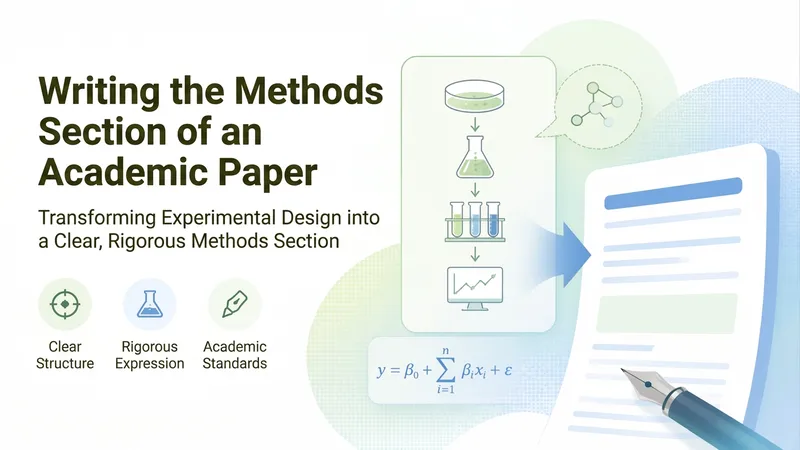
Helps you clearly and rigorously write and refine the methodology section of your academic papers, suitable for experimental research, empirical analysis, algorithm implementation, questionnaire surveys, case studies, and more. Whether drafting from scratch, rewriting based on research materials, or polishing existing text for academic tone, it covers research design, data sources, experimental procedures, variable definitions, model formulas, parameter settings, and implementation details to enhance the reproducibility and logical coherence of your methods. You will receive a structural plan tailored to your research objectives and target audience, along with ready-to-use text that can be generated in more concise, formal, or conservative versions as needed. For existing manuscripts, it helps identify missing steps, confused concepts, logical gaps, vague expressions, redundancy, and insufficient factual backing, while distinguishing between facts, speculations, and citations to avoid fabricating data or literature. Suitable for drafting first drafts, pre-submission revisions, peer-review responses, and organizing research proposals. When information is incomplete, it clarifies necessary assumptions and provides suggestions for supplemental materials, revision priorities, and quality checks. It also highlights matters requiring further confirmation by professionals when dealing with academic compliance or other high-risk content.
 Research
Read Legal Papers & Cases
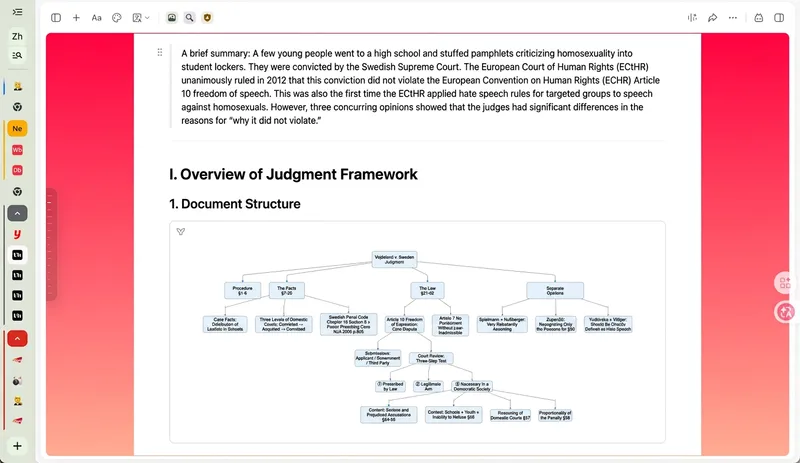
Turn difficult legal papers or cases into clear, accessible Chinese explanations that are easy to review and useful for research. After you provide a paper or case, the analysis focuses on the original text’s research framework, line of reasoning, and key viewpoints. It helps you quickly understand what question the author raises, how it is analyzed, and how different viewpoints relate logically—rather than stopping at simple excerpts or a linear summary. The result is saved as a new document named after the paper title or case name for easy reference, archiving, and continued research. For academic papers, the interpretation first presents the overall structure, then explains the connections among the research question, central claims, evidence, and conclusions. When legal concepts or technical terms appear, they are explained in context with the corresponding English terms to make the material easier to read. For legal cases, the analysis covers the disputed issues, applicable rules, application of the facts, and conclusion. It may also reconstruct the legal reasoning as “major premise—minor premise—conclusion,” while explaining the relevant statutory provisions, causes of action, and analytical assumptions. Suitable for students, researchers, and legal professionals who need to read legal papers, prepare literature reviews, study case analysis, organize legal arguments, or clearly explain legal materials to others.
Information
- Version
- v2
- Last updated
- Runtime credits
- Usage-based
- Models
- Auto
- Use cases
- Research & analysisLearning & education
- What you get
- DocumentWebpageDiagram
