
Comment Demand Miner
Turn viral comments into ranked content ideas
Comment Demand Miner
Turn viral comments into ranked content ideas
Showcase
Description
You come across a viral post, scroll through its comments for ages, and still have no idea what to make next. 【Comment Demand Miner】sorts scattered comments into six categories (help-seeking, opposing, personal-experience, follow-up-question, complaint, and unrelated), first cleaning them up and telling you how many were removed and why. It then ranks a list of content ideas by demand strength. Each idea includes the idea itself, why there is demand for it (which comment type points to it and roughly how many comments do so), three opening lines plus a structure outline, and potential pitfalls. It also provides a reverse list of topics that commenters ask about frequently but that you should not make content about, including medical diagnoses, investment promises, and legal judgments. Finally, it tells you which types of content are most likely to contain genuine demand in their comments: how-to content tends to produce more help-seeking comments, opinion content more opposing comments, and story-based content more personal-experience comments. Hard rules: no downloading, scraping, or bypassing login walls. If comments cannot be read, it will say so honestly and show you how to copy them. It will not republish commenters' exact words as content, extract any personal information about commenters, or include privacy-related information. It will not organize flame wars or cyberbullying, and it will not predict which idea will go viral.
Related Skills
View allReview Insights
# Review Insights **Don't let valuable user feedback get lost in hundreds of reviews.** What hidden pain points lie within product reviews? What do customers love most about your product? Are there ideas for your next best-selling product or content piece hidden in the comment section? Upload comments or paste feedback, and the AI helps you extract **pain points, selling points, and potential needs** from messy user feedback, citing source evidence for every conclusion and generating an intuitive insight chart. **Go beyond summarizing comments to turn user words into actionable insights.** ## What You Get **① Comprehensive User Needs Analysis** Organizes comments into three main categories: - 🔴 **Pain Points**: What are users complaining about? Which issues need improvement? - 🟢 **Selling Points**: What do users truly appreciate? Which advantages are worth highlighting? - 🟡 **Expectations**: What features do users want added? What unmet needs still exist? **② Evidence-Backed Conclusions** Every topic indicates the related comment count, review ID, and authentic quote for easy verification. No making up user thoughts or exaggerating a single comment into a majority opinion. **③ Rare but Severe Issue Detection** Potential safety or serious quality issues like burns, breakage, or allergies are flagged individually even if mentioned in few reviews, preventing them from being buried by positive feedback. **④ Actionable Next Steps** Provides product improvement, selling point refinement, and content topic suggestions based on review evidence, along with the reasoning for each recommendation. **⑤ User Insight Chart** Automatically organizes key findings into a visual diagram showing pain points, selling points, expectations, and comment counts for easy review and sharing. ## Who Is This For? **🛍️ E-Commerce Sellers** Analyze your own or competitor reviews to find quality issues, recognized selling points, and new product development opportunities. **📱 Content Creators** Organize video comment sections to understand viewer interests and find direction for future content. **📊 Product Managers & Operations** Prioritize issues and product improvements from app reviews, survey feedback, and user messages. **💡 Entrepreneurs & Product Selectors** Discover unmet consumer needs through authentic reviews to inform product positioning and selection. ## How to Use 1. Paste comments or upload Excel, CSV, or text format review data. 2. Optionally specify a goal, such as "find product flaws," "extract selling points," "analyze competitors," or "find video topics." 3. The AI organizes comments, categorizes themes, cites evidence, and offers suggestions. 4. Generate an insight chart to help you quickly understand key findings. ## Tips - More complete comments and sufficient samples generally provide more valuable analysis. - Opinions in comments do not necessarily represent all consumers. - Duplicate comments, unhelpful messages, and sample limitations will be noted during analysis. - Direct quotes are for evidence verification; ensure compliance with platform rules and privacy requirements before public commercial use. - AI statistics and chart text may contain minor errors; important conclusions should be cross-checked with raw data. --- **Turn every authentic review into a clue for product improvement, creative inspiration, and a more persuasive selling point.**
 Write
1 Post->3-7 Unexpected Topics
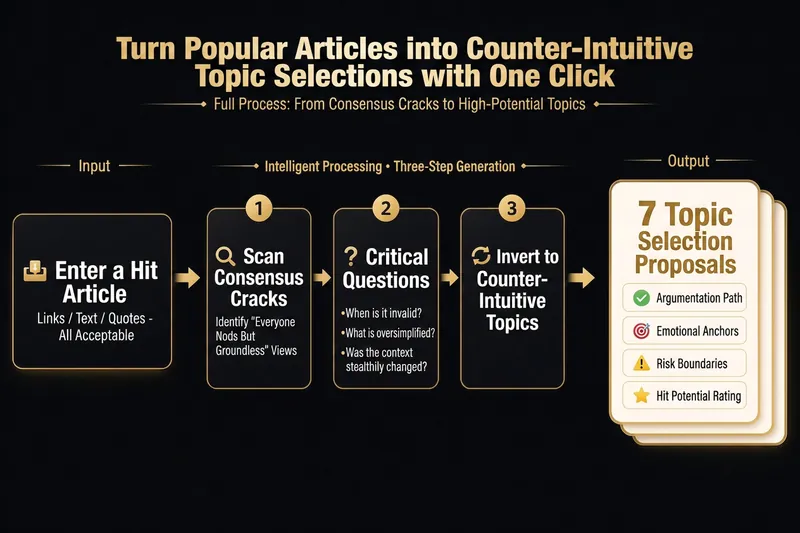
😤 Do you feel this too— You scroll through viral articles for an hour, save seven or eight, and feel like you've "learned." But when you sit down to come up with topics—your mind goes blank. Hundreds of articles in your bookmarks, and not one of them turns into your own content. You're not lacking material; you're lacking a method to "extract your own topics from others' viral posts." 🔍 Where's the problem— Inside every 100,000+ viral article, there are a few viewpoints that "most people nod along with, but actually don't hold up." Most people scroll past them. A few people pick these views out, think in reverse—and a new topic is born. The gap is in this one "deconstruction" action. 🛠️ How it helps you— 📥 Drop in a viral article link 🔬 Automatically scans the full text, picks out common consensus that "sounds right, but the conditions for truth are quietly stripped away" ❓ Dives into three key questions for each: ① Under what circumstances is it false? ② What does it oversimplify? ③ Which context did it sneak in from? 🔄 Reverses into 3–7 counterintuitive topic ideas 📊 Each comes with a complete output: ✅ Logical path — why this topic holds up ✅ Emotional hook audience — who it's for, what hits them ✅ Risk boundary — where you might go wrong ✅ 5‑dimensional viral score — how hard this topic can hit It doesn't give you a bunch of directions to think about; it gives you topics you can start writing on right away. ✍️ 🚀 Give it a try— Search for "1 Post->3-7 Unexpected Topics" in YouMind. Open it and drop a link to a viral article you've seen recently, and it will walk you through deconstructing it into topics. 🗂️ Supports deep dives on single articles + batch filtering 📎 Opinion pieces, experience sharing, tutorials, lists—works with any article type
Short-Form Content Extractor
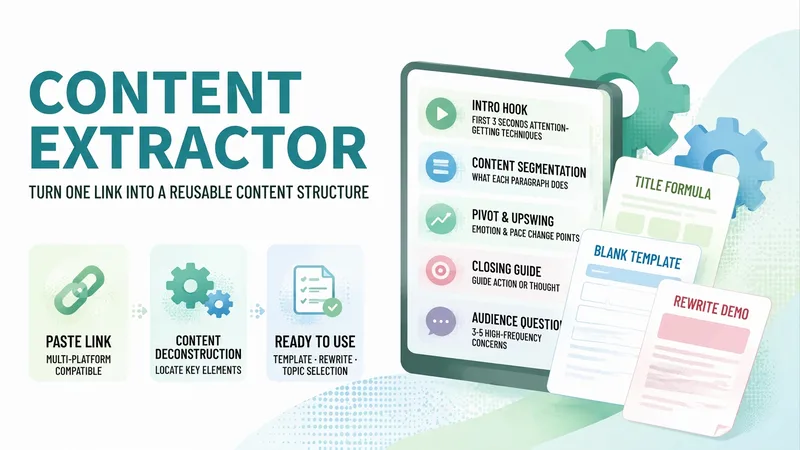
You come across a particularly well-made piece of content and want to learn its structure, but don’t know where to start. **Content Extraction Sheet** breaks down a link from Douyin, Xiaohongshu, WeChat Official Accounts, Bilibili, Weibo, or Zhihu into a practical structure you can use right away: what technique the first three-second hook uses, how many sections the content has and what each one does, where the transitions and emotional build-ups appear, and what the ending calls viewers to do. It then gives you three highly practical resources: an abstracted headline formula, with three examples adapted to your field; a blank structure template with fill-in fields; and a rewritten example based on a topic you choose. It also finds 3–5 questions viewers genuinely care about in public comments, which can become topics for your next piece of content. The honest boundary comes first: when the link content is accessible, it will clearly say “based on the original.” When it isn’t, it will say so plainly and give you a three-step method for obtaining the material—never inventing content from a link alone. Strict rules: no downloading videos, removing watermarks, bypassing login or paywalls, reposting original content, rewriting to disguise plagiarism, or extracting other people’s personal information.
Information
- Version
- v3
- Last updated
- Runtime credits
- Usage-based
- Models
- Auto
- Use cases
- Writing & contentResearch & analysisMarketing & growth
- What you get
- ReportBriefPlan
