
1 Post->3-7 Unexpected Topics
From viral assumptions to ready topics
1 Post->3-7 Unexpected Topics
From viral assumptions to ready topics
Showcase
Description
😤 Do you feel this too— You scroll through viral articles for an hour, save seven or eight, and feel like you've "learned." But when you sit down to come up with topics—your mind goes blank. Hundreds of articles in your bookmarks, and not one of them turns into your own content. You're not lacking material; you're lacking a method to "extract your own topics from others' viral posts." 🔍 Where's the problem— Inside every 100,000+ viral article, there are a few viewpoints that "most people nod along with, but actually don't hold up." Most people scroll past them. A few people pick these views out, think in reverse—and a new topic is born. The gap is in this one "deconstruction" action. 🛠️ How it helps you— 📥 Drop in a viral article link 🔬 Automatically scans the full text, picks out common consensus that "sounds right, but the conditions for truth are quietly stripped away" ❓ Dives into three key questions for each: ① Under what circumstances is it false? ② What does it oversimplify? ③ Which context did it sneak in from? 🔄 Reverses into 3–7 counterintuitive topic ideas 📊 Each comes with a complete output: ✅ Logical path — why this topic holds up ✅ Emotional hook audience — who it's for, what hits them ✅ Risk boundary — where you might go wrong ✅ 5‑dimensional viral score — how hard this topic can hit It doesn't give you a bunch of directions to think about; it gives you topics you can start writing on right away. ✍️ 🚀 Give it a try— Search for "1 Post->3-7 Unexpected Topics" in YouMind. Open it and drop a link to a viral article you've seen recently, and it will walk you through deconstructing it into topics. 🗂️ Supports deep dives on single articles + batch filtering 📎 Opinion pieces, experience sharing, tutorials, lists—works with any article type
Why we love this skill
It accurately identifies counterintuitive consensus cracks in viral articles and transforms them into 3-7 ready-to-create topic plans, helping you easily craft highly shareable content.
Related Skills
View allXiaohongshu Hit Breakdown
Seen a viral Xiaohongshu post and want to know exactly what it got right? This Skill breaks down a viral post to the level of its "original sentences": how the cover and title work together to earn the click; what is said in the first 3 seconds and why viewers do not swipe away; the retention tactics and exact lines used in each section; what it gives users that they would be afraid of losing if they did not save it; and finally, a directly reusable structural template, along with an assessment of how feasible it is to adapt to your account. Every breakdown adds the structural template to your template library. The more you analyze, the more structures you can directly use when writing your next post. It will not claim that a title "must be effective" just because a post has high likes. When captions or performance data are unavailable, it clearly tells you what evidence is missing instead of making things up. This Skill focuses only on breakdown analysis. It does not call image or video generation, and each run uses few points (40–100 points in testing, depending on the amount of evidence and video length). Best for Xiaohongshu creators—especially spoken, knowledge, and educational-content creators—along with social media operators and MCN planners who want to understand exactly "why this post went viral" before creating their next one.
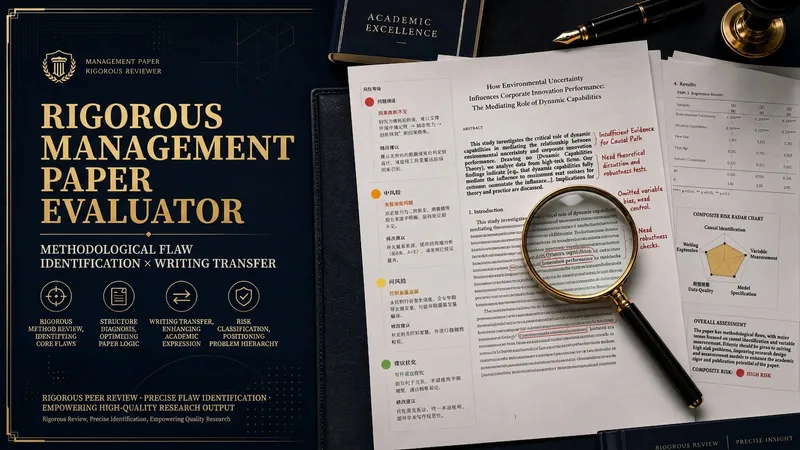
Management Paper Strict Review
Have you encountered these problems? ❌ You cited a seemingly authoritative paper, only to have reviewers question, 'This study has severe endogeneity issues.' ❌ When writing a literature review, you're unsure whether a paper's conclusions are trustworthy. ❌ After reading dozens of papers, you still don't know how to apply others' writing techniques to your own paper. ❌ Before submission, you want to check for methodological risks but don't know which hard flaws top journal reviewers focus on. This Skill helps you: ✅ Quick mode (15–25 min): Determine whether a paper is worth reading in depth and can be cited confidently. ✅ Deep mode (45–60 min): Check methodological flaws item by item like an AMJ/ASQ/SMJ reviewer. ✅ Quantitative credibility rating: 🔴 Not citable / 🟠 Use with caution / 🟡 Reference only / 🟢 Safe to cite – at a glance. ✅ Writing transfer task card: Turn techniques from others' papers into executable tasks for your own Introduction/Methods/Results/Discussion sections. Covers seven methodology types: Quantitative regression, experimental studies, quasi-experimental causal identification, fsQCA, case studies, grounded theory, mixed methods. Output includes: - Six-area deep reading (theoretical dialogue, mechanism pathways, construct operationalization, method-data fit, contribution critique, writing techniques) - P1/P2/P3 risk levels (fatal/important/arguable) - Counterfactual testing (can the model explain reverse scenarios?) - Boundary condition check (5 dimensions: market/regulation/capital/technology/competition) - Writing transfer task card (specific techniques directly applicable to your own paper) In a nutshell: It is not a gentle paper summarizer. It's a strict academic writing assistant that helps you discover, 'Where can't this paper be trusted? What is worth learning from it? How can I apply it to my paper?' Suitable for you if you are: 📚 PhD/master's students writing literature reviews 📝 Management researchers preparing submissions to top journals 🔍 Reviewers needing quick paper quality assessments 📖 Paper writers wanting to learn top journal writing techniques
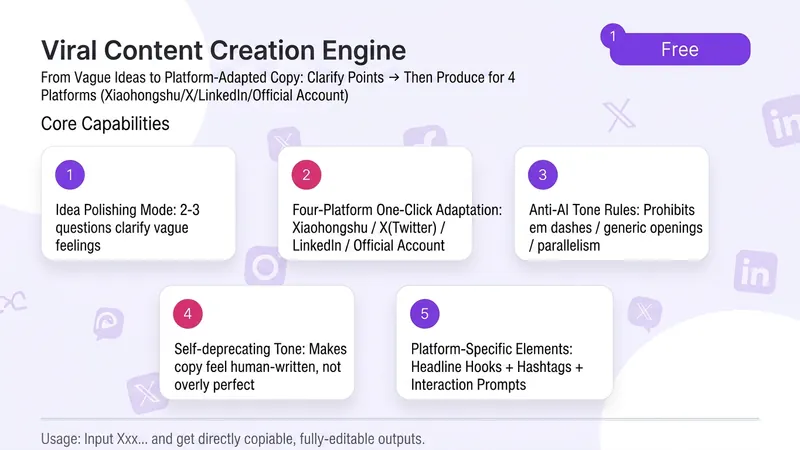
Viral Content Creation Engine
Sometimes you have a brilliant idea in your head, but when you open the editor, you don't know where to start. After agonizing for an hour, you end up posting something that feels flat—the insight that initially excited you gets buried under 'formal' expression. Feed it a vague idea, and it first helps you sharpen it—asks a few pointed questions to turn your insight from 'sounds plausible' to 'that's exactly it.' Then it translates it into Xiaohongshu friend-sharing, X founder insights, WeChat Official Account warm know-how. ✨ Core Capabilities 1. Idea Refinement Mode: 2-3 questions to turn vague feelings into shareable insights 2. One-click adaptation for 4 platforms: Xiaohongshu / X (Twitter) / WeChat Official Account / LinkedIn — tone, rhythm, and format all switch automatically 3. Anti-AI flavor mandate: No dashes, generic openings, hollow parallelisms, or abstract wisdom. Each sentence under 30 characters. 4. Self-deprecating tone: Makes your copy sound like it's written by a real person, not a grammatically correct robot. 5. Each platform includes: headline hook + hashtags + engagement prompt 📱 Use Cases - Personal brands/entrepreneurs who want to post consistently but often get stuck on 'how to say it' - Marketers who need multi-platform distribution but don't want to rephrase for each platform - Professionals with industry insights but no time to polish copy - Content creators looking to level up from 'writing articles' to 'making an impact' Good expression isn't 'writing beautifully'—it's 'making people feel that you get them.'
Information
- Version
- v9
- Last updated
- Runtime credits
- Usage-based
- Models
- Auto