
Anti-AI Tone Skill
Remove AI tone backed by 5.2M words of testing
Showcase
Description
A de-AI-tone skill based on two rounds of empirical corpus testing (totaling 1,169 articles, ~5.2 million Chinese characters, 100+ metrics, and ~500,000 model semantic evaluations), known as lieflat-less-ai-tone with 7.3K+ stars on GitHub. This Skill quantifies what makes writing sound like AI through two rounds of data experiments: the first round covered 629 articles (2.83 million words), and the second round ran 540 new paired articles (2.56 million words), totaling 1,169 articles and 5.2 million Chinese characters. The Skill breaks down every conceivable AI tone into over 100 metrics, validated through script detection, large model semantic detection, and manual blind reviews. It ran 507,000 sentence-by-sentence and paragraph-by-paragraph machine semantic judgments, followed by extensive manual blind-reading assessments. Ultimately, it was packaged as a Skill for easy use, bringing you the lieflat-less-ai-tone project. The Skill first delivers a detection report complete with metrics, research references, original example sentences, and revision methods, then proceeds to rewrite and retest after you reply.
Recommended by
Dancang
Why we love this skill
Built on large-scale corpora and hundreds of thousands of semantic evaluations, it avoids relying on word lists or intuition. Instead, it offers tiered detection with detailed evidence, rewriting minimally and re-testing only after user confirmation.
Best for
Writers and editors who want to reduce mechanical tone in text, keep the original meaning, and get traceable revision suggestions.
How to use this Skill
Provide your input
Provide the Chinese article or paragraph you want to check, specify the scope, and optionally add writing style references.
Run the Skill
First analyzes suspicious expressions to generate an inspection report with reasoning, original sentences, and suggestions. After your confirmation or adjustments, it rewrites the text with minimal changes and retests it.
Review your result
Receive a pre-edit inspection report, revised text based on your confirmed plan, and a comparison with retest results before and after rewriting.
Related Skills
View all Write
Where's the AI?
Note: This skill is a diagnostic tool, not an automatic rewriter. It provides rewrite suggestions instead of directly modifying your text. Diagnose and correct AI flavor in Chinese writing. At the lexical level, it marks high-frequency AI words and vague modifiers. At the syntactic level, it identifies issues like equal-length parallelism, excessive conjunctions, and monotonous rhythm. Output: diagnostic report + specific rewrite suggestions. No automatic rewriting. Triggered when users mention 'AI flavor', 'de-AI', 'reads like AI', 'too robotic', 'reduce AI rate', 'too smooth', 'no human touch', or when requesting review, polishing, or style improvement. Also applicable for self-check after AI-assisted drafting.

WeChat AI Viral Article Engine
Give it a topic, and it produces a viral WeChat article. Built-in anti-AI detection rules—if it doesn't pass, you can call me out. Three facts: First, WeChat public accounts currently do not display "AI-generated" labels on articles. Please refer to the latest official WeChat policies for specific platform rules, but as of now, there is no mandatory labeling mechanism. Second, this Skill includes complete anti-AI detection rules. Zero em dashes, zero "it is worth noting", zero "in summary", zero "firstly, secondly, finally". Run it through any AI detection tool—the recognition rate is extremely low. Third, if you don't believe it, check out the WeChat public account "跨境风向标". Every article is AI-written using this methodology, and readership consistently goes viral.
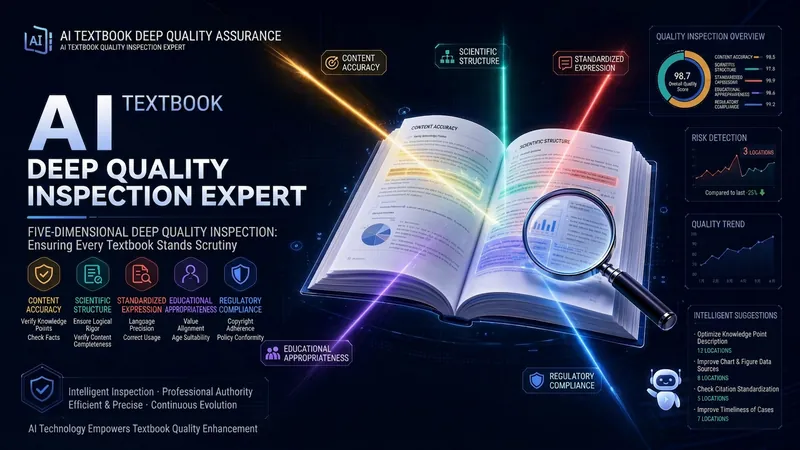
AI Textbook Quality Inspector
📚 AI Textbook Quality Inspector — Five-dimensional scan to make AI-written textbooks withstand review Textbooks written with AI assistance suffer from five common problems: hard-to-detect knowledge errors, instructional design lacking classroom feel, excessive 'correct but empty' statements, templated writing that feels robotic, and obscure language that makes students give up reading. This system performs a five-dimensional in-depth quality check chapter by chapter, examining each chapter from the perspectives of four roles: subject matter expert, instructional designer, fact-checker, and style reviewer. It outputs quantitative scores and directly replaceable modification suggestions. Five Dimensions: 📐 Knowledge Accuracy — Trace and correct concepts, models, and data one by one, with each error annotated with a source 🎯 Instructional Design — Review difficulty curve, prerequisite preparation, and chapter connections like a seasoned teacher 💎 Content Substantiveness — Expose 'correct but empty' statements, calculate real information gain per section 🤖 AI-Flavor Detection — Textbook-specific standards to distinguish normal writing from AI template patterns 📖 Readability — Paragraph rhythm, term density, assess whether students can read smoothly Highlight Features: 🔗 Cross-Chapter Consistency — Automatically generate knowledge profile, detect conceptual contradictions, inconsistent terminology, and duplicate definitions 🔄 Closed-Loop Iteration — After revision, resubmit and automatically track improvements, remaining issues, and new problems 📊 Layered Report — First see overview score + top 3 issues, then expand section-by-section analysis as needed 🎤 Sharp Commentary — No sugarcoating; if a definition is wrong, it says so bluntly, with each criticism accompanied by a revision reference Applicable to: AI-assisted undergraduate and graduate textbooks, academic monographs, and course handouts. Current version is optimized for undergraduate textbooks, but also works for graduate textbooks. Paste chapter → Get score → Make targeted revisions → Re-test until quality passes.
Information
- Version
- v5
- Last updated
- Runtime credits
- Usage-based
- Models
- Auto
- Use cases
- Writing & contentResearch & analysis
- What you get
- ReportDocument
