
Where's the AI?
Marks AI tone, explains, guides—no rewrite
Where's the AI?
Marks AI tone, explains, guides—no rewrite
Showcase
Description
Note: This skill is a diagnostic tool, not an automatic rewriter. It provides rewrite suggestions instead of directly modifying your text. Diagnose and correct AI flavor in Chinese writing. At the lexical level, it marks high-frequency AI words and vague modifiers. At the syntactic level, it identifies issues like equal-length parallelism, excessive conjunctions, and monotonous rhythm. Output: diagnostic report + specific rewrite suggestions. No automatic rewriting. Triggered when users mention 'AI flavor', 'de-AI', 'reads like AI', 'too robotic', 'reduce AI rate', 'too smooth', 'no human touch', or when requesting review, polishing, or style improvement. Also applicable for self-check after AI-assisted drafting.
Recommended by
nene@YouMind
Why we love this skill
This skill doesn't rewrite text directly; it diagnoses AI writing's 'fingerprint vocabulary' and 'syntactic patterns', fundamentally improving your Chinese writing's distinctiveness.
Related Skills
View all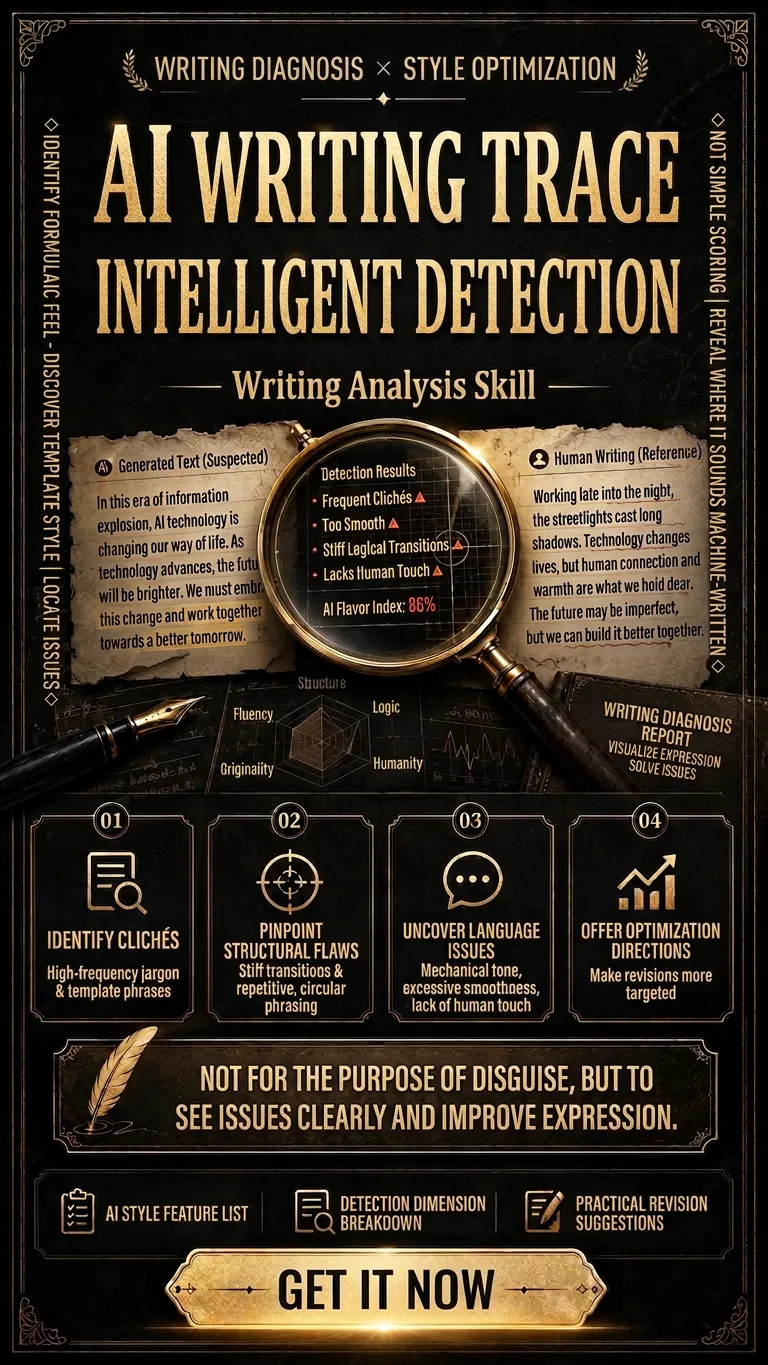 Write
AI Writing Trace Detector
Want your writing to be free of AI traces and read like a product of genuine human thought? This intelligent assistant precisely identifies and eliminates possible AI-generated traces in your text. It deeply analyzes your writing from four core dimensions: structure, language, thought, and rhythm, ensuring your expression is full of judgment, personality, and authentic hesitation, rather than the machine's pursuit of 'correct and comprehensive'. After submitting your text, you will receive a detailed AI trace detection report. The report clearly marks high, medium, and low risk trace types, and provides original text citations and an overall diagnosis, giving you a clear view of the AI feel's source. Whether it's mechanically symmetrical paragraphs, frequently occurring AI high-frequency words, thought patterns lacking personal imprint, or overly uniform sentence rhythms, nothing will escape detection. Going further, it provides specific correction suggestions for each high and medium risk trace. These suggestions not only include correction examples, but also explain the rationale, helping you understand how to break uniformity, replace AI language, add traces of human thought, and create rhythm changes to make your writing radiate 'human touch'. Finally, it can output a fully corrected version and list key changes compared to the original, helping you create truly engaging and personalized content.
 Write
AI Writing Humanizer
Want to eliminate the common 'industrialized' traces in Chinese AI text, giving your writing genuine human warmth and depth? This skill focuses on removing formulaic expressions in AI writing, injecting lively judgment, natural rhythm, unique emphasis, rich details, and authentic tone. It is especially adept at handling in-depth content such as comments, personal essays, historical analysis, political philosophy, social observations, reading notes, and long-form WeChat articles. By identifying and rewriting rigid aspects—from word choice and sentence structure to overall argumentation—this skill helps you transform grand, universally correct narratives into specific, nuanced insights, giving your writing a smooth and natural flow. Without altering the original meaning, it carefully diagnoses AI traces, such as identifying vague clichés, repetitive sentence patterns, and overly balanced tones. It replaces these mechanical elements with more concrete and insightful expressions, infusing your article with the author's personal thoughts and judgments rather than a cold logical construct. Additionally, for issues that mere polishing cannot solve, it points out where facts, examples, or arguments are needed, ensuring both depth and breadth. The result is a Chinese article that is not only clear in viewpoint but also full of human touch and personalized expression. It retains necessary professionalism while removing exaggerated adjectives and stiff connectors, making the text as natural as breathing—powerful yet warm, and far from being 'correct nonsense'.
 Write
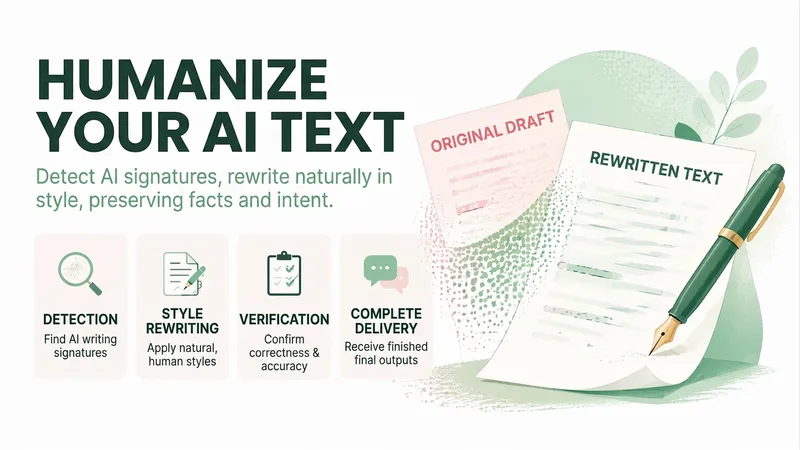
De-AI Chinese Rewriter
Make your Chinese drafts sound more like they were written by a real person in a specific scenario, while preserving the original facts, stance, and tone strength. Whether it is WeChat messages, emails, Xiaohongshu posts, work reports, or academic papers, it first identifies the style and expression issues, then targets clichés, empty phrasing, mechanical structures, nominalizations, and inappropriate tones. This makes the text more specific, natural, and smooth without becoming overly colloquial. It strictly guards factual boundaries during rewriting: it does not arbitrarily add numbers, dates, names, organizations, cases, promises, or effects, nor does it change "might" to "will," or delete key qualifiers and conclusions. Where necessary information is missing, it clearly marks content to be added to avoid fabricating details for completeness. Formal expressions in academic papers and work reports are not misjudged as "AI-sounding" and overly altered. You will receive a fact-checked and doubly verified Chinese rewrite, ready for direct communication, publishing, reporting, or academic writing. When needed, you can also view specific trace judgments, modification rationales, and pending information to clearly understand what was adjusted and how information consistency was maintained.
Information
- Version
- v2
- Last updated
- Runtime credits
- Usage-based
- Models
- Claude Opus 4.6
