
Paper Revision Quality Guard
Protect core ideas and ensure quality during revisions
Paper Revision Quality Guard
Protect core ideas and ensure quality during revisions
Showcase
Description
Keep great insights and content intact so your paper improves with every draft. This tool checks your paper's logic, evidence, literature, and expression quality, protects existing work, tracks important ideas, and compares old and new drafts to catch omissions and issues during revision.
Recommended by
Dancang
Why we love this skill
It turns revision into verifiable quality control: tracking core ideas, multi-layer verification of evidence and citations, strict boundary control, and preventing omissions and regression between drafts.
Related Skills
View all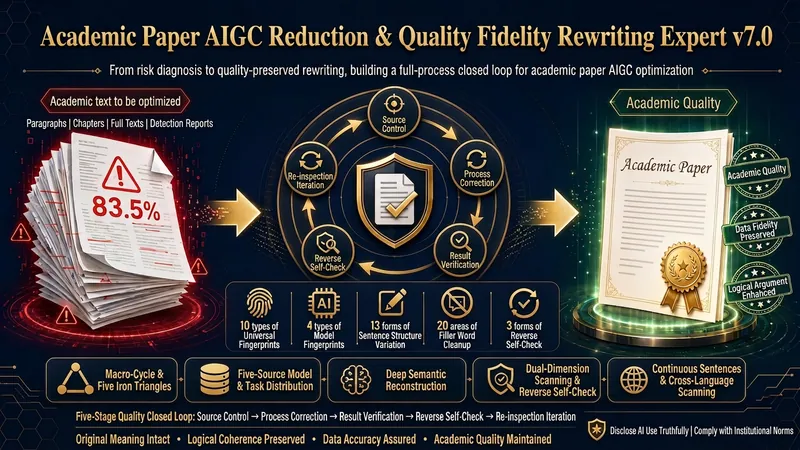 Write
AIGC Reduction & Rewrite v7.0
📚 Academic Paper AIGC Reduction and Quality-Preserving Rewriting Expert v7.0 Designed for graduate students, researchers, and paper authors, this academic text optimization skill operates on a core closed loop of 'source control → process correction → result verification → reverse self-check → iterative re-check'. It systematically diagnoses and optimizes issues such as templated expressions, mechanical logic, vague content, inaccurate terminology, and style inconsistencies while preserving original meaning, technical terms, data, and core conclusions. 🔍📝 🌟 Core Capabilities 🔬 Multi-layer Risk Diagnosis Covers 10 types of universal text fingerprints and assists in identifying common expression patterns of models such as ChatGPT, Claude, DeepSeek, and Wenxin Yiyan. 🧠 Deep Semantic Restructuring Goes beyond synonym replacement to rebuild more natural and in-depth academic reasoning by adjusting proposition expression, information order, argument approach, and evidence organization. ✍️ Quality-Preserving Rewriting Comprehensively applies 13 sentence transformation strategies and 20 methods for cleaning high-frequency templated expressions, improving mechanical sentence structures, repetitive connectors, and overly rigid formatting. 📊 Full-text Structure Diagnosis Through macro-cycle and five key triangles, checks whether research problems, theory, literature review, methods, results, conclusions, and innovation form a complete closed loop. 🧩 Fine-grained Section Adaptation Develops differentiated diagnostic and rewriting strategies for abstract, introduction, literature review, research methods, results, discussion, and conclusion respectively. 🌐 Cross-language Risk Scanning Assists in identifying translationese, passive voice stacking, long sentence nesting, and mixed Chinese-English formatting abnormalities to make Chinese academic expression more natural and accurate. 🔄 Reverse Self-check Loop After rewriting, re-verifies from three aspects: technique distribution, new text fingerprints, and information integrity, to avoid 'becoming more templated' or losing key content. 🛡️ Academic Integrity Protection Does not fabricate literature, data, cases, or policy evidence; separately marks information requiring author verification and reminds users to honestly disclose AI usage. 🎯 Use Cases ✅ Single paragraph or partial section optimization ✅ Targeted modification of marked paragraphs from inspection reports ✅ Polishing of abstract, introduction, literature review, discussion, and conclusion ✅ Full-text AIGC risk feature diagnosis ✅ Language and structure adaptation for target journals ✅ Pre-submission quality review and consistency check 📦 Final Deliverables 📄 Quality-preserving rewritten text 🔎 Risk and issue diagnosis report 🛠️ Rewriting strategy and technique description ✅ Reverse self-check and information integrity report 💡 Items requiring author verification and subsequent revision suggestions 🎓 Original meaning preserved · Logic intact · No fabricated data · Academic quality maintained ⚠️ This skill aims to improve academic expression quality and reduce text risk features. It does not guarantee passage through any specific detection platform or achieving a particular detection score.
 Write
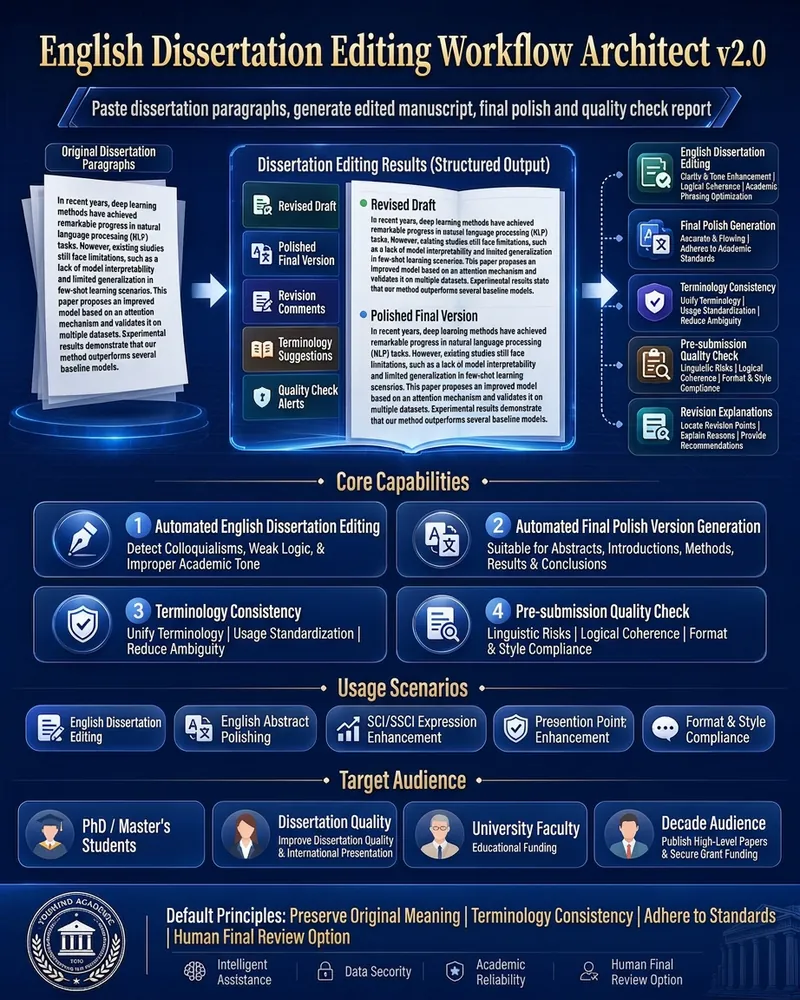
Academic Paper Editor
Paste a paper paragraph to generate a polished version, an English translation, and a quality-check report. It can help you: 1. Automatically polish Chinese academic papers Identify conversational wording, loose expression, logical jumps, and insufficiently academic tone, then produce more standardized and clearer academic Chinese. 2. Automatically generate an English translation Translate Chinese paper paragraphs into English that follows academic writing conventions while preserving terminology, logical relationships, and the tone of the research. 3. Automatically perform bilingual quality checks Check terminology consistency, logical flow, semantic deviations, grammar issues, long-sentence risks, and whether the academic phrasing is sound. 4. Automatically explain revisions In addition to providing the results, explain what was changed and why, making it easier to continue revising the full paper. Suitable for: PhD students, master's students, university instructors, researchers, paper submission authors, research group members, and writers of English abstracts and SCI/SSCI papers. How to use: Paste a paper paragraph and say what you want to do: “Please polish this Chinese academic paragraph.” “Please translate it into English.” “Please polish the Chinese first, then translate it into English.” “Please check whether this English paragraph fits academic writing conventions.” If you do not specify a mode, I will default to “Chinese polishing + English translation + quality-check report.”
 Write
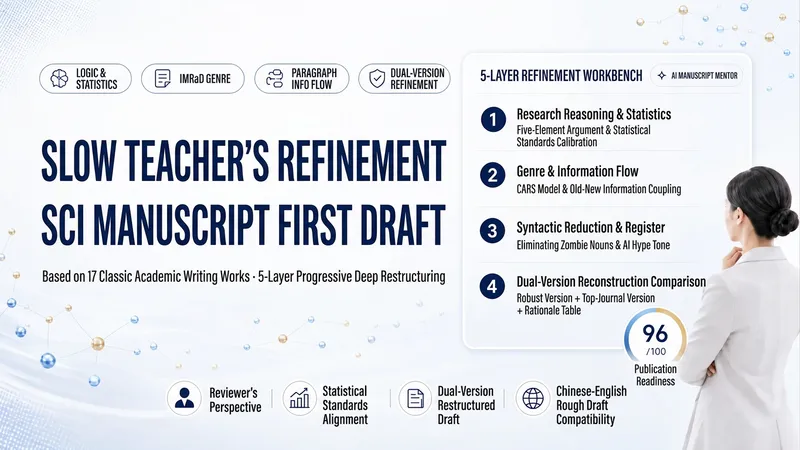
SCI Paper Revision
This goes beyond basic vocabulary polishing. It acts like an experienced mentor with peer-review expertise, helping you refine your early SCI draft toward top-journal standards. It places the [Original ❌] and the [Polished Version ✅] side by side, explaining in plain language why each change was made. [Paste Any Draft Directly] Whether it is a bilingual draft, a single section (Abstract, Introduction, Methods, Results & Discussion, Conclusion, figure captions), a full manuscript, a Cover Letter, or a Response to Reviewers, you can send it directly. [How to Use This Skill (Three-Step Reading Method)] Step 1 (Read the full paragraph preview for rhythm): After you submit your draft, each version (Robust Version A / Advanced Version B) begins with an underlined full-paragraph preview without Chinese explanations. Spend 15 seconds reading it from start to finish to sense the flow and rhythm. Step 2 (Review sentence-by-sentence comparisons and reasoning): Next, review the sentence-by-sentence breakdown. The [❌ Original (with strikethrough)] and [✅ Polished (bold and underlined)] are aligned right next to each other. Each sentence includes [💡 Writing Tip] explaining the awkwardness of the original, the rationale for the change, and underlying English writing principles. Step 3 (Select a version for a clean, copy-ready text): Reply with your choice of A or B (or request minor adjustments), and it will remove all underlines and notes to provide a clean, copy-ready English draft for your Word document. [3 Core Safeguards] 1. Preempts reviewer critiques by closing logical and statistical loopholes (such as treating P > 0.05 as proof of no effect, mismatched comparisons, or missing control experiment premises); 2. Avoids overly long, breathless sentences, keeping standard sentences within the 15–25 word golden range with a natural mix of sentence lengths; 3. 100% zero fabrication of data and literature, clearly marking missing values or error bar definitions for you to verify.
Information
- Version
- v4
- Last updated
- Runtime credits
- Usage-based
- Models
- Auto
