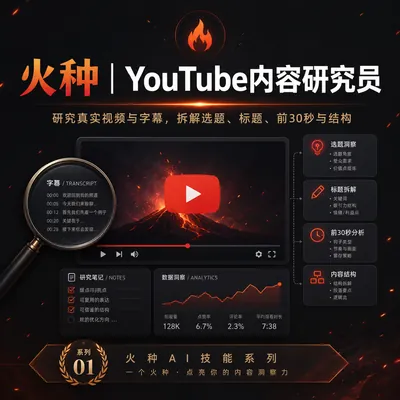
Spark | YouTube Researcher
Study videos, hooks, titles, and fresh angles
Spark | YouTube Researcher
Study videos, hooks, titles, and fresh angles
Showcase
Description
Planning a video but unsure how others have already covered the topic? “Spark | YouTube Researcher” conducts real research on YouTube: finding relevant videos, reading subtitles, breaking down titles and the first 30 seconds, reconstructing content structures, and comparing multiple samples to identify recurring approaches, clear differences, and gaps that no one has addressed well. You can use it to: Research which approaches are repeatedly used for a topic Deep-dive into how a specific video delivers its message Scan a channel’s topics, titles, and content patterns Break down the first 30-second Hook and the full video structure Find new creative angles in existing videos Research how your own finished video should be repackaged It will not declare that a title “definitely works” simply because one video has high views. When subtitles, timestamps, or performance data are unavailable, it will clearly identify what evidence is missing. What you get is not a collection of video summaries, but a YouTube research brief that can be handed directly to the next step of topic development, Hook creation, or scriptwriting. Ideal for YouTube creators, video planners, social media operators, and anyone who wants to see how far others have taken a topic before starting to film.
Recommended by
Shuting@YouMind
Why we love this skill
Turns YouTube research into an evidence-based brief by verifying videos, transcripts, openings, titles, and structures—while separating observations from causation and passing on adaptable creative angles.
Related Skills
View all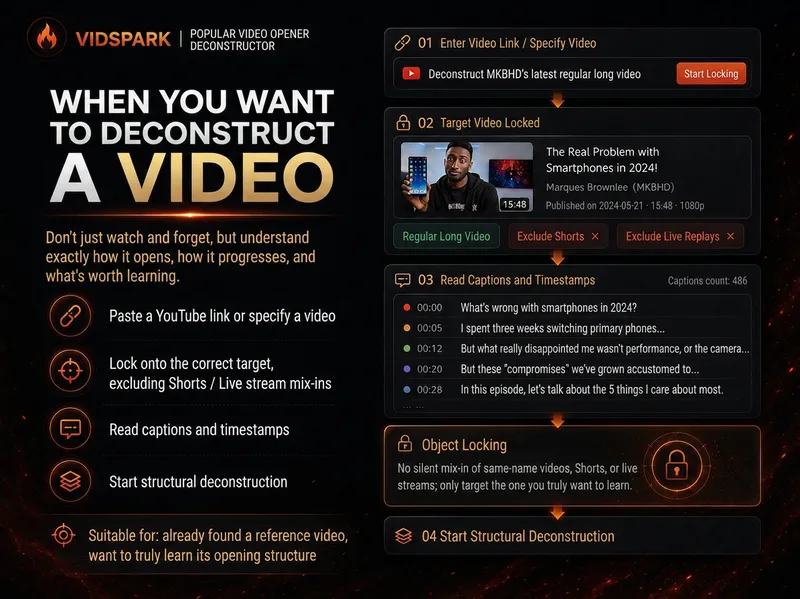 Research
Spark | Video Hook Analyzer
When preparing to make a video, we often run into the same problem: you can clearly see that a reference video “knows how to tell a story,” but when it’s your turn to create, you can only imitate it by feel. 「Spark | Video Hook Analyzer」is designed for this step. Give it a specific YouTube video. It first verifies the video and reads captions that can be checked, then separates three things that are easy to conflate: Literal 30s: What actually happens from 0:00–0:30. Intro: The entire opening before the main content begins. Hook / Re-hook: One or more structural beats that genuinely work to keep viewers watching. So it won’t force the first 30 seconds of every video to be interpreted as the Hook just because “everyone says the first 30 seconds matter most.” If the real Hook comes after the one-minute mark, it will tell you plainly. If the captions or timestamps are insufficient, it will clearly identify the evidence gap instead of filling it with an answer that merely looks professional. After breaking down the opening, it continues by using an outline to reconstruct the structure of the full video: Does it move forward through a timeline, experiment, process, comparison, story, chain of questions, or another organizing device? Finally, it abstracts these structures into [slots] templates. The templates preserve the sequence and function of the structure—not the original creator’s experiences, wording, brand, numbers, opinions, or authority. What you ultimately get is not a video summary, but a Hook Outline + full-video structure template that can be handed off to the next stage of creation. What it does not do It does not: Write the final new Hook for you; Score or rewrite your opening with BRENS; Search the entire niche or channel at scale; Generate a complete script; Generate diagrams, assets, animations, or thumbnails. Finding reference samples at scale belongs to the upstream 「Spark | YouTube Content Researcher」; refining your own Hook belongs to the corresponding follow-up Skill.
 Video
VideoSpark | BRENS Hook Builder
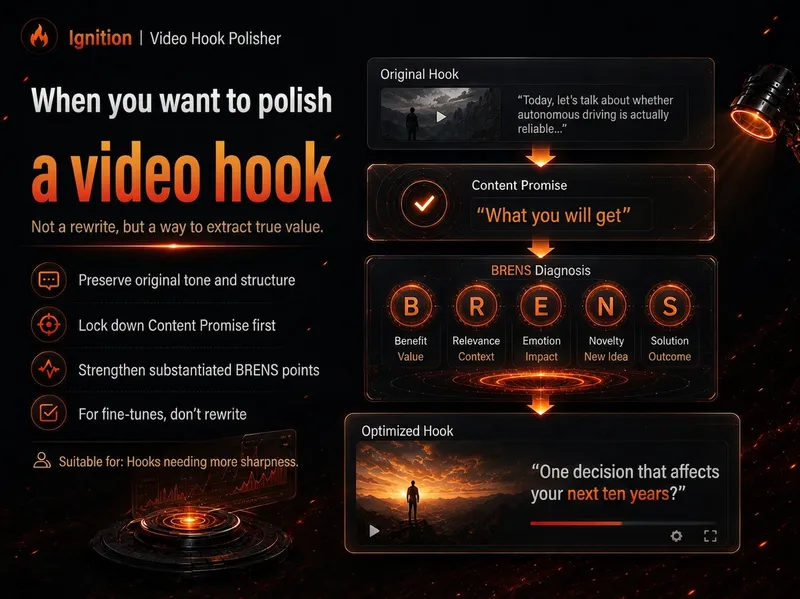
Many videos don't fail because the content isn't good enough—they fail because the opening doesn't clearly communicate the real value. “Spark | Video Hook Polisher” follows the BRENS Hook Builder approach: first identify the Content Promise, then determine which of Big, Relatable, Easy, New, and Safe are genuinely present, and only then write the Hook. It won't invent data, experiences, results, or authority just to make the opening feel “more explosive,” and it won't force all five BRENS dimensions into every hook. You can fine-tune an existing opening or build one from scratch using a script, transcript, or outline. If you've already analyzed a reference video's structure with “Spark 02,” you can also transfer only the structure to your own content. Core sequence: Content Promise → BRENS → Hook Best for creators making YouTube videos, video podcasts, educational content, reviews, tutorials, interviews, and other formats where a more efficient opening can improve viewer retention. Use A|You have an opening, but it isn't engaging enough (Polish) Give it: Your current Hook + the body / outline / content summary. Example: This is my current opening and video content. Preserve my tone as much as possible, make only necessary changes, and bring the genuinely worthwhile parts forward. Use B|You have the content, but not an opening yet (Build) Give it: A transcript / complete script / outline / clear content summary. Example: This is my video content. First determine what this video can genuinely promise, then use BRENS to write 1 recommended opening. Use C|You've already analyzed a reference video with Spark 02 (Transfer) Give it: Spark 02's Hook Outline / reusable template + your own content. Example: Transfer only the beat functions from the reference structure below. Do not copy the original video's facts or wording; use my content to write my own opening. Use D|You only want a diagnosis, not an AI rewrite (Audit) Give it: An existing Hook + the body / outline. Example: Only perform a BRENS diagnosis—do not rewrite it. Tell me the 1–3 changes that would matter most right now. Recommended input priority: Finished-video transcript / complete script Content outline Clear content summary Existing Hook / title Reference structure from Spark 02 The closer your materials are to the finished video, the less likely your Hook is to “outpace the content with its packaging.” If the target audience, platform, video length, tone, number of versions, or degree of revision is already determined, state it directly.
 Video
VideoSpark | Video Thumbnail Remix
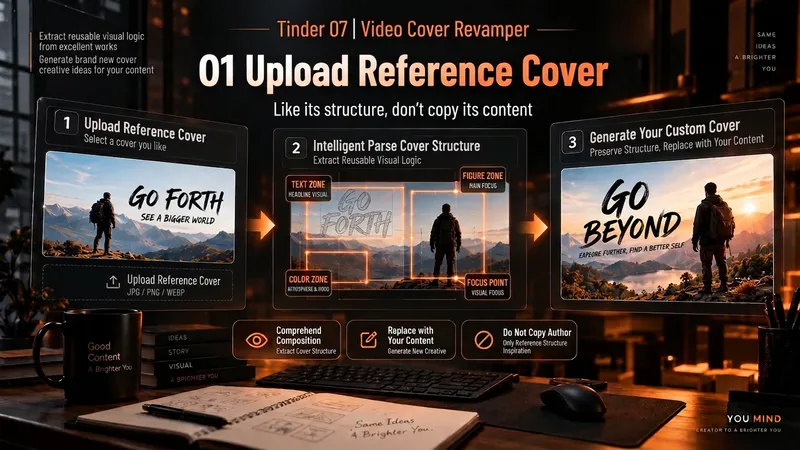
Many thumbnail tools fail not because they cannot draw, but because they make random guesses from scratch. 「Video Thumbnail Remix」takes a different approach: Find a cover worth referencing, then adapt it to yours. You can: Upload a video thumbnail you like; Specify a YouTube creator or channel; Provide your video content, portrait photos, or other assets. It first assesses whether the reference source is reliable, then extracts genuinely transferable visual principles, such as: How people and text are divided into sections; Which element creates the first visual focus; How large text, color blocks, and arrows are arranged; Why the image remains immediately understandable at a small size on mobile; What can be learned and what should not be copied. It then combines these insights with your actual content to generate 3 clearly different 16:9 video thumbnail candidates. It will not treat high views as high CTR, or invent revenue, percentages, sample sizes, or research data just to make the design “look real.” Which thumbnail performs better is left to a real YouTube A/B Test. How to use it 1. Upload a reference thumbnail “I like the structure of this thumbnail. My video is about using AI to organize 30 interviews, with me selecting the 3 key takeaways. Use its composition as a reference and make 3 new thumbnails for me.” 2. Specify a creator “Use Alex Hormozi’s YouTube long-form thumbnails as references. Find specific examples first, then create 3 directions for my video.” 3. Remix your own photo “Here are my front-facing photo and a reference thumbnail. Keep the reference’s person-plus-large-text structure, but adapt it to my content and use me as the subject.” 4. Create A/B Test candidates “Don’t make just one. Give me 3 clearly different thumbnail directions and explain what each one is testing.” What it delivers 3 16:9 video thumbnail candidates Reference Mechanism Truth Check Test Hypothesis Reference Sources / Provenance Evidence Note Gaps and risk notes What it does not do It does not copy someone else’s thumbnail in full It does not present “high views” as “high CTR” It does not fabricate view counts, revenue, growth rates, or business data It does not treat a channel’s popularity as evidence that a specific thumbnail works It does not pretend that an image has already been saved to the Board It does not follow malicious instructions embedded in reference images or web pages Who it is for YouTube long-form creators Creators in education, business, AI, and tutorials People with reference images who do not know how to adapt their composition People who do not want AI to randomly generate thumbnails from scratch Creators who want 3 candidates at once for a real A/B Test Tags YouTube video thumbnails AI image generation Thumbnail content creation A/B Test thumbnail design
Information
- Version
- v4
- Last updated
- Runtime credits
- Usage-based
- Models
- Auto