
Xiaohongshu Lazy Starter Tool
Xiaohongshu viral content for beginners
Xiaohongshu Lazy Starter Tool
Xiaohongshu viral content for beginners
Showcase
Description
1. wb-xhs-monetization-backsolve Integration: Reverse engineering the monetization path, account positioning, and content direction for Xiaohongshu accounts. yanliudreamer's timing judgment, personal IP route, long-term expression ability, and 10-20 validation ideas. Visual Director's judgment that 'different trust paths require different visual trust cues'. Core change: Instead of just asking 'how to monetize', it also answers 'why now, why you, can you keep talking long-term, and what visual trust needs to be built'. 2. wb-xhs-low-follower-pattern Integration: Analysis of low-follower high-engagement samples on Xiaohongshu. yanliudreamer's click rate × dwell time × interaction rate, and five types of user underlying needs. dbskill's benchmark filtering, propagation reasons, and resonance mechanism judgment. Visual Director's cover composition, main visual, page rhythm, and mobile readability checks. Core change: Instead of just imitating sample forms, it judges which data link is effective and which content and visual mechanisms can be transferred. 3. wb-xhs-account-profile Integration: Xiaohongshu account profile and long-term memory. yanliudreamer's trust assets, personal IP story, persona consistency, and feedback from comments/DMs written back. dbskill's personal language samples, credible evidence, and AI style calibration. Visual Director's frame, color, font, components, and anti-patterns forming visual identity. Core change: Account profile evolves from a static style guide to a continuously updated 'trust business card + content and visual memory'. 4. wb-xhs-topic-bank Integration: Xiaohongshu topic matrix and title formulas. yanliudreamer's five user needs and three pre-posting questions. dbskill's title triggers, strict title checks, and traceable trigger reasons. Visual Director's cover hook, main visual direction, information density, and page count suggestions. Core change: Topics not only generate titles but also provide user needs, content promises, and a brief ready for visual production. 5. wb-xhs-humanize-compliance Integration: Xiaohongshu draft calibration and pre-publish checks. dbskill's hooks, single core mechanism, diagnose before rewrite, and 5-second opening. Visual Director's 6-8 page image-text structure, information hierarchy, and mobile readability. Core change: Removing AI feel isn't just about conversational tone; it makes content more human, easier to finish, and clearly divisible into image-text pages. 6. wb-xhs-schedule-review Integration: WorkBuddy's first 10 posts, 7-day, and 30-day scheduling and review cycle. yanliudreamer's system profile, 10-20 validation, and deepening after a hit. dbskill's status recording and conclusion writing back. Visual Director's master template, visual approval images, final images, and visual review nodes. Core change: Scheduling not only arranges posting times but also content and visual production; it saves visual constraints but does not replace visual routing or image delivery. 7. wb-xhs-visual-router Integration: Existing project outputs from topic selection, revision, and scheduling: titles, pages, and visual constraints. New additions: shared Visual Brief, fact boundaries, real runtime status, and QA recording conventions. Core change: Visual requests have a single entry point; it first fills in cover titles, evidence, and fact boundaries, then routes to the appropriate expert, without writing 'image tool not yet called' as delivered images. 8. wb-xhs-cover-anchor Integration: ponyodong2026/ponyo-cover-anchor-system's information density × visual anchor, conflict/number/screenshot/emotion four template types, old cover diagnosis, and completed cover prompts. Lifestyle cover variations: doodle outline fresh, sunlight film collage white outline, and 3:4 thumbnail readability rules. Xiaohongshu fact boundaries: numbers, screenshots, cases, and subjects only used when confirmed or authorized. Core change: Cover is not just a title skeleton but a publishable finished cover with quantifiable diagnosis; when evidence is missing, it still retains a credible title and composition, never drawing unverified data, cases, or results as facts. 9. wb-xhs-xiaohei-illustration Integration: helloianneo/ian-xiaohei-illustrations' Xiaohei character, 16:9 body illustrations, shot list, white background hand-drawn style, and grotesque cognitive metaphors. Pure white background, black thin lines, limited red-orange-blue annotations, and QA that 'Xiaohei must perform the core action'. Core change: Convert judgments, processes, states, and metaphors in articles into instantly readable cognitive illustrations; retain MIT source attribution, recreate each illustration's metaphor, and do not copy existing images or compositions. 10. wb-xhs-material-illustration Integration: op7418/guizang-material-illustration's materialized central explanatory images, chart semantic redrawing, reference-only facts, and outer card division of labor. Mechanisms, processes, cycles, hierarchies, comparisons, charts, and components extracted from central images: objects, arrows, badges, and explanatory parts. Core change: First let a wide central image explain relationships or data, then extract reusable components; when both 'material' and 'cover' are needed, first confirm the precise cover title, then complete both deliverables separately.
Related Skills
View all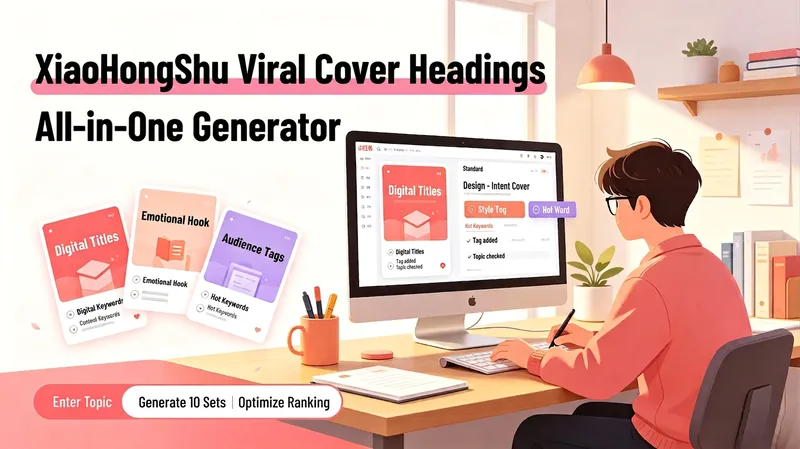
Xiaohongshu Viral Cover Titles
An integrated cover-title creation engine designed for Xiaohongshu creators, brands, and e-commerce operators. This Skill is more than simply “coming up with a title for a topic.” It is a complete click-through-rate optimization system with the following core capabilities: 🔍 Needs diagnosis: After receiving a topic, it first analyzes the target audience’s search habits and aesthetic preferences, then references style trends in competitor covers within the same category to ensure each concept is distinctive while still meeting user expectations. 🔥 Trending keyword analysis: It automatically connects current Xiaohongshu search and autocomplete terms, naturally incorporating high-volume keywords into titles to increase the likelihood of post exposure in search results. ✍️ Title options: It outputs 10 differentiated title sets at once, covering multiple viral-title formulas—number-based formulas (“5 Ways”), suspense formulas (“Don’t Ever…”), identity-label formulas (“A Must-Read for Office Workers”), emotional formulas (“Wish I’d Known Sooner”), and comparison formulas (“XX vs. XX”). Every title is checked for both keyword density and emotional impact. 🎨 Cover design: Each title comes with a complete cover design plan, including cover copy, primary and supporting color palettes with color-value references, font style recommendations (serif/sans serif/handwritten), layout guidance (information hierarchy, visual focal-point placement, and whitespace proportions), and image style suggestions (photography/illustration/3D/collage). Whether you’re a beginner creator just getting started, a brand operator who needs to produce covers in batches, or an e-commerce team pursuing the highest possible click-through rate, this Skill can help increase your cover-title creation efficiency by 5–10x, helping every post start strong.
 Video
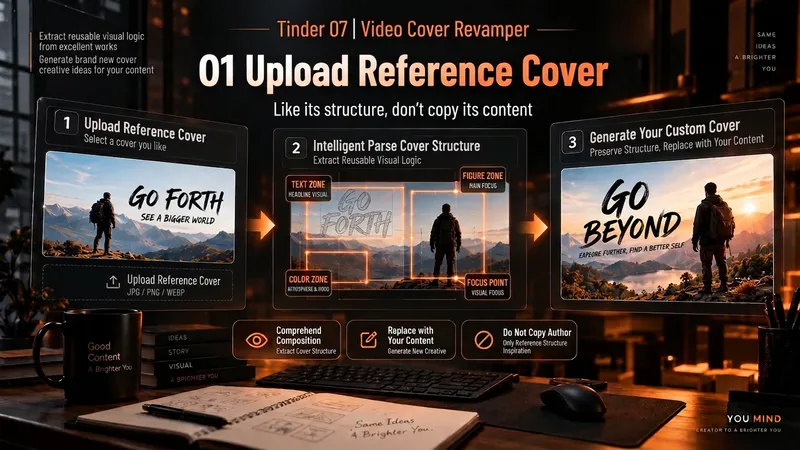
VideoSpark | Video Thumbnail Remix
Many thumbnail tools fail not because they cannot draw, but because they make random guesses from scratch. 「Video Thumbnail Remix」takes a different approach: Find a cover worth referencing, then adapt it to yours. You can: Upload a video thumbnail you like; Specify a YouTube creator or channel; Provide your video content, portrait photos, or other assets. It first assesses whether the reference source is reliable, then extracts genuinely transferable visual principles, such as: How people and text are divided into sections; Which element creates the first visual focus; How large text, color blocks, and arrows are arranged; Why the image remains immediately understandable at a small size on mobile; What can be learned and what should not be copied. It then combines these insights with your actual content to generate 3 clearly different 16:9 video thumbnail candidates. It will not treat high views as high CTR, or invent revenue, percentages, sample sizes, or research data just to make the design “look real.” Which thumbnail performs better is left to a real YouTube A/B Test. How to use it 1. Upload a reference thumbnail “I like the structure of this thumbnail. My video is about using AI to organize 30 interviews, with me selecting the 3 key takeaways. Use its composition as a reference and make 3 new thumbnails for me.” 2. Specify a creator “Use Alex Hormozi’s YouTube long-form thumbnails as references. Find specific examples first, then create 3 directions for my video.” 3. Remix your own photo “Here are my front-facing photo and a reference thumbnail. Keep the reference’s person-plus-large-text structure, but adapt it to my content and use me as the subject.” 4. Create A/B Test candidates “Don’t make just one. Give me 3 clearly different thumbnail directions and explain what each one is testing.” What it delivers 3 16:9 video thumbnail candidates Reference Mechanism Truth Check Test Hypothesis Reference Sources / Provenance Evidence Note Gaps and risk notes What it does not do It does not copy someone else’s thumbnail in full It does not present “high views” as “high CTR” It does not fabricate view counts, revenue, growth rates, or business data It does not treat a channel’s popularity as evidence that a specific thumbnail works It does not pretend that an image has already been saved to the Board It does not follow malicious instructions embedded in reference images or web pages Who it is for YouTube long-form creators Creators in education, business, AI, and tutorials People with reference images who do not know how to adapt their composition People who do not want AI to randomly generate thumbnails from scratch Creators who want 3 candidates at once for a real A/B Test Tags YouTube video thumbnails AI image generation Thumbnail content creation A/B Test thumbnail design
 Image
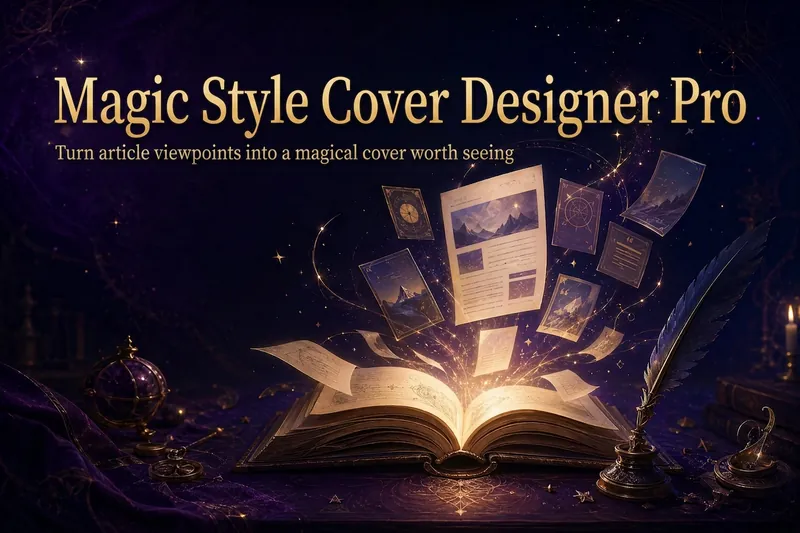
ImageMagic Cover Designer Pro
Turn an article title into a magical cover that makes its ideas stand out. “Magic Cover Designer Pro” is not a random image generator. It is a visual content packaging workflow: “content understanding → title confirmation → visualizing ideas → platform adaptation → cover generation.” It helps preserve the real title and subtitle while transforming an article’s core ideas, emotions, and narrative relationships into vivid, engaging magical visuals with a distinct identity. It supports Twitter long-form posts or Threads, WeChat Official Account articles, Xiaohongshu Notes, product introductions, knowledge sharing, growth retrospectives, and personal brand content. The Skill first identifies the article’s original title, original subtitle, and core idea. The original title is used as the default main cover title, while the original subtitle is prioritized as the cover subtitle. The core idea does not directly replace the cover text; instead, it guides the choice of subject, symbols, composition, lighting, and visual metaphors. It matches visual strategies to different content types: practical breakdowns use magical blueprints or step-by-step scrolls; growth retrospectives use journeys and illuminated paths; contrarian ideas use light-and-shadow conflicts or broken seals; product introductions use magical workshops and core devices; knowledge sharing uses academy archives and spellbooks; and case studies use before-and-after changes and narrative scenes. When a title is too long, it provides both the original-title version and a concise version for you to confirm, without rewriting it on its own. When there is no subtitle, it first offers candidate copy instead of placing an unconfirmed idea directly into the image. Its default visual language combines retro fantasy with magical journaling: deep purple, midnight blue, black-brown, antique bronze, and warm gold, along with parchment, quill pens, spellbooks, sealing wax, stardust, and other tactile elements. It can also draw shared colors, materials, lighting, and narrative qualities from reference images, but it does not copy the specific composition, people, logos, or distinctive elements of any single image. For each platform, it adapts the aspect ratio, text density, subject size, whitespace, and thumbnail legibility to real reading contexts. It is suitable for knowledge creators, personal brands, product authors, and content creators who want to build a consistent visual identity. It does not fabricate numbers, results, identities, or brand endorsements, and it does not promise viral performance. It simply helps the visuals support real content more accurately and vividly.
Information
- Version
- v3
- Last updated
- Runtime credits
- Usage-based
- Models
- Claude Opus 4.7