Textbook Writer
Textbook Writer
Showcase
Description
A professional textbook writing system powered by a three-core collaborative engine (anti-AI monitoring, teaching audit, and deep writing). Supports chapter-by-chapter creation of large textbooks over 150,000 characters. Built with teaching effectiveness principles, the Ten Commandments of AI Flavor (Textbook Edition), a five-stage teaching node structure, and a strict gate progression mechanism, ensuring each chapter achieves 20,000–30,000 characters of knowledge, case, and practice density.
Why we love this skill
This skill is the 'Anti-AI' weapon for textbook creation. Through rigorous phased review and quality redline mechanisms, it ensures output content combines depth, practicality, and teaching rigor, making it the ideal choice for professional textbook authors.
Related Skills
View all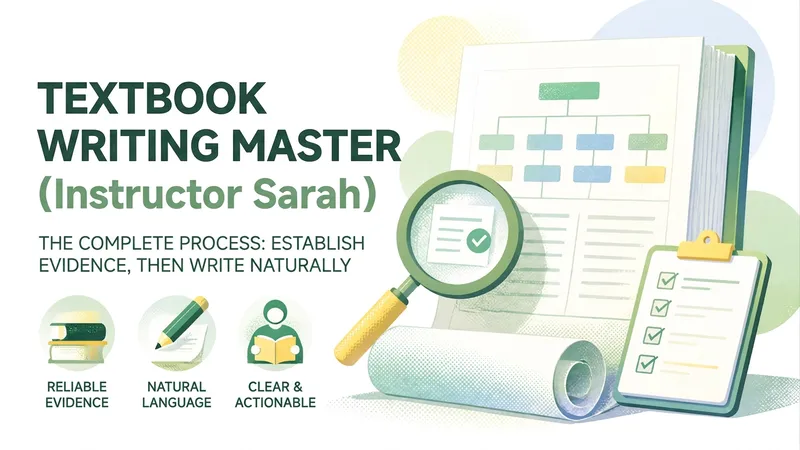 Write
Textbook Writing Master
Transform your experience into a ready-to-submit textbook: verify the source of every statement first, then write in natural language that students can easily understand and teachers can readily teach. It pauses to ask you for missing information rather than fabricating volume and page numbers. The generated text is checked line by line against an anti-AI vocabulary list and rewritten into engaging textbook prose. From project alignment (audience, measurable skills, hours, chapters, style sheets) to building an evidence foundation, reverse-engineering chapter frameworks, two-pass writing, removing AI tone, five-stage review, and breakpoint continuation, it handles the entire book. For vocational project-based learning (EPIP/work-study integration), it provides nine primary sections per project chapter and five sections per task. The delivery phase includes publishing-grade self-checks (figure and table numbering, twelve convention rules, print-ready layout, copyright and standard validity), compliance red lines (political and territorial integrity, citation version discipline, annotation styles, GB/T 7714-2025 new national standard, final consistency checks), and a final tone check (24 AI-sounding Chinese vocabulary lists + match density judgment + textbook human tone definition). Suitable for: writing textbooks, converting school handouts into textbooks, revising older textbooks, and unifying multi-author manuscripts. Not suitable for: academic monographs, individual research papers, curriculum standard development itself, or digital textbooks (see Digital Textbook Writing Master). Trigger words: write textbook, textbook outline, chapter and period allocation, textbook style, EPIP project-based, work-study integration, task-driven textbook, this sounds too much like AI, remove AI tone, polish into textbook language, AI tone, remove AI tone vocabulary, how to cite references, how to write standard numbers, figure and table numbering, print layout, continue writing next chapter, political review red line, citation versions, annotation style, final check, new national standard for references.
 Research
Textbook Publishing Architect
A systematic workflow engine for textbook creation. Through a rigorous step-by-step mechanism, it guides users from defining teaching objectives, planning the textbook name, building the table of contents skeleton, to generating sample chapter blueprints, completing the full process of textbook publishing planning. Built-in dual-core adversarial engine that audits teachability and practicality in real time, ensuring output meets the textbook-level standards of 'teachable, learnable, and assessable'.
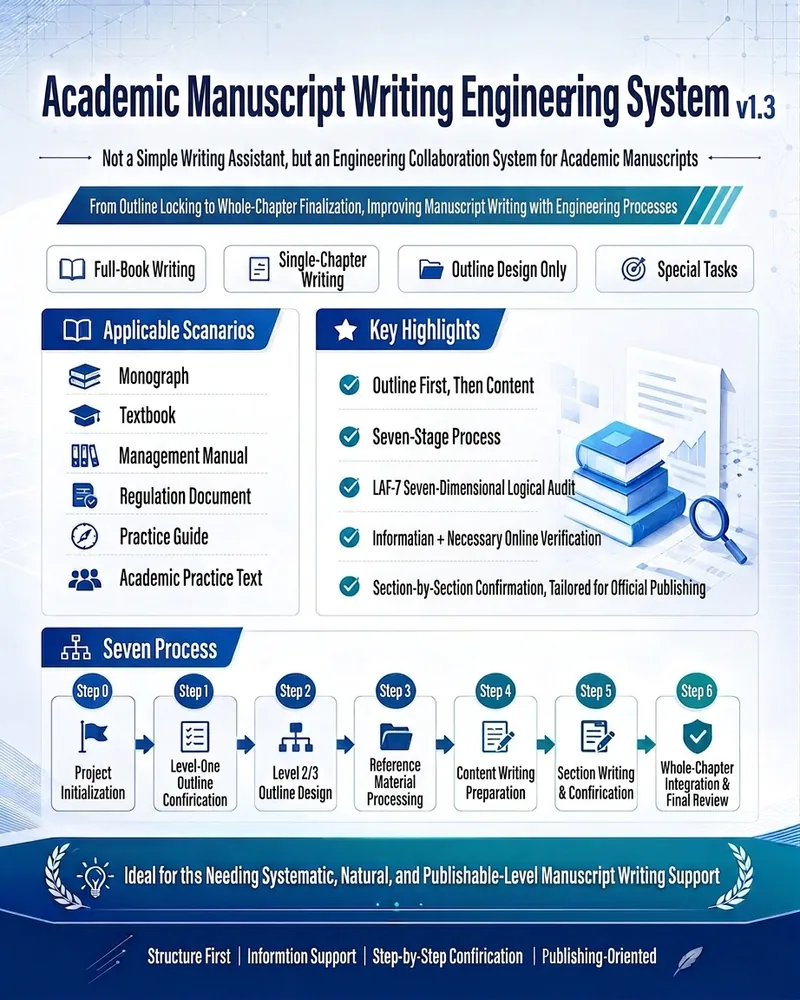
Academic Writing Engineering
An engineering collaborative agent for scholarly manuscript writing across disciplines, covering monographs, textbooks, chapters, institutional texts, management manuals, practical guides, and academic practice texts in natural sciences, engineering, humanities and social sciences, business, law, education, medicine, and more. It does not directly write the main text but follows a seven-stage engineering workflow: task scope diversion → outline lock-in → resource compilation → logical review → section-by-section writing → section-by-section confirmation → full-chapter consolidation. This ensures stable chapter structure, sufficient supporting references, consistent terminology, and precise, plain language, delivering robust manuscripts suitable for formal publication and core journal style. Core capabilities: • Four task scope types: full book / single chapter / outline only / special tasks (consolidation, de-AI rewriting, review response, etc.) • Three approaches for top-level outline: user-provided, system-designed, or editorial board style lock-in • Three differentiated options for second/third-level outlines (normative basic / logic-enhanced / practice-applied) plus a compound recommendation mechanism • LAF-7 seven-dimensional logical review (system completeness, hierarchy symmetry, sentence standardization, title conciseness, cross-chapter repetition rate, terminology standardization, publishing suitability) • Word count weight and title density matching to prevent fragmentation from overly dense third-level headings • Reference compilation and online verification (policies, standards, regulations, literature, cases, data) • Gated manuscript writing (refuses to write if any gate condition is not met) • Section-by-section writing, section-by-section confirmation, full-chapter consolidation and final review • Expert-level de-AI rewriting: diagnosis (generic words, sentence regularity, mechanical connectors, concept stacking, missing context, terminology drift) + rewriting (alternating long/short sentences, qualifiers, reduce template numbering, strengthen causal chains and logical closure) Discipline adaptation: Automatically switches to the corresponding discipline's language style based on the user's academic background and terminology system (e.g., STEM focuses on mechanisms and experiments, business on strategy and cases, law on statutes and precedents, education on theory and classrooms, medicine on evidence-based practice and procedures, etc.) without imposing a fixed disciplinary framework. Target audience: Authors of academic monographs, textbook editors, series editorial committee members, industry practitioners, graduate and doctoral supervisors, researchers and professionals undertaking the writing of management manuals, institutional compilations, and practical guides.
Information
- Version
- v2
- Last updated
- Runtime credits
- Usage-based
- Models
- Auto
