
Teaching Award Assistant
From materials to a teaching award proposal
Teaching Award Assistant
From materials to a teaching award proposal
Showcase
Description
Designed for teachers at universities and vocational colleges, this teaching award application assistant works like a submission consultant who has participated in final expert panel reviews. It guides you through the recommendation form in six steps: build a profile, organize materials, distill the positioning, develop the title and draft, align the evidence, and conduct an expert quality check. Ask one question at a time to help clarify the three teaching problems the achievement solves and where its innovations lie Draft according to the distinct writing approaches used by four types of institutions: academic undergraduate, applied undergraduate, vocational undergraduate, and higher vocational Built-in review experts score the application across six dimensions—pain points, logic, rigor, innovation, outcomes and demonstrative value, and compliance—and provide revision suggestions Automatically check common critical issues such as the practice validation period, attribution of outcomes, and the years used in key statements Never fabricate data. Clearly flag areas without supporting evidence and remind you to provide additional materials Suitable for school-level, provincial-level, and national teaching achievement awards, across the higher education (undergraduate) and vocational education tracks.
Recommended by
Dancang
Why we love this skill
Socratic questioning turns real teaching reform into reviewer-recognized positioning, innovations, and evidence. Its six-stage workflow adapts to institution type and application standards, with expert review, resumable progress, and a strict no-fabrication policy.
Best for
For university and vocational college teachers who need to systematically organize teaching reforms and prepare teaching award application materials.
How to use this Skill
Provide your input
Provide basic information about the teaching reform, implementation process, outcome data, supporting materials, and application requirements—or start with materials you already have.
Run the Skill
Through staged Q&A, organize the teaching problems, reform approach, innovations, and evidence, then draft, review, and refine the recommendation form based on the institution type and application requirements.
Review your result
Receive a draft or final teaching award recommendation form, an evidence comparison table, and expert-style quality review. Content lacking support will be clearly marked.
Related Skills
View all Research
Teaching Award App Auto Expert
Teaching Achievement Award Application · Full-Process Automation Advisor System 🎯 Adaptive Recognition of Coverage Levels: Education Type: Basic Education / Vocational Education / Higher Education → Automatically matches the application system Award Level: National / Provincial / School Level → Automatically identifies difficulty and focus of competition 📊 Four Delivery Phases (Staged Closed Loop): | Phase | Output | Core Value | |-------|--------|------------| | 1. Diagnosis & Profiling | 7-8 question smart survey + achievement positioning report | Identify the right application level to avoid over or under applying | | 2. Topic Selection | Topic direction matrix + 3-5 similar successful cases | Know which direction to adjust to be most visible | | 3. Title Incubation | 5-8 alternative titles (SCPAR naming) | If the title is right, half the application is done | | 4. Body Writing | Complete version of the application with strict word count | How many words for innovation, results, and dissemination value — precise to the paragraph | | 5. Diagnostic Scoring | Three-dimensional innovation assessment + expert checklist | Reviewing it yourself after editing is like having a professional review | 🔧 Built-in Standardized Tool Library: ✓ SCPAR Naming Rule — The invisible scoring table for teaching achievement titles ✓ Word Count Hard Constraint Check — Automatically enforces 5000-12000 word range ✓ Three-Dimensional Innovation Assessment Model — Full reproduction of the scoring logic used by award judges ✓ Title Template Library — Reference templates for national/provincial/school level achievements ✓ Expert Checklist — Item-by-item self-check for the finished application 📈 Expected Results: Application success rate from random 30% to precise 70%+ Application preparation time from 2-3 months to 2-3 weeks Higher first-submission hit rate (more accurate topic selection)

Vocational Ed Award Assistant
Designed for secondary and higher vocational accounting (diploma and bachelor's) teaching achievement award applications. Enables incubation from limited materials, draft application editing, key theme extraction, core section expansion, key content highlighting, modification notes, and pre-submission checks. Also generates overall framework diagrams and solution mechanism diagrams after main text approval. Compliant with 2026 vocational education teaching achievement award requirements.
 Write
Project Completion Generator
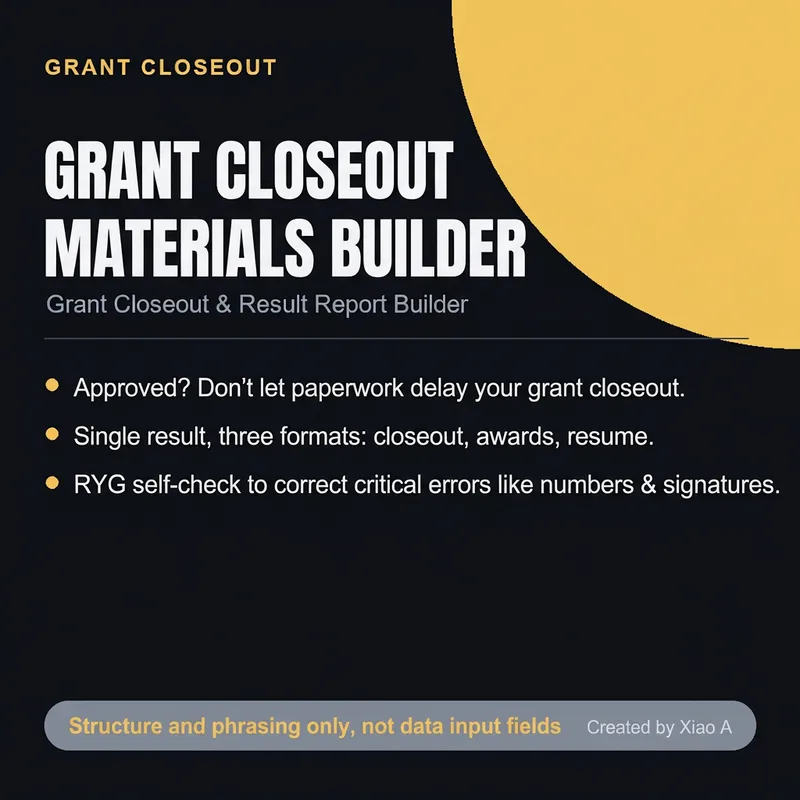
While the Social Science Fund Dual-Track Application Argumentation Generator handles applications, this skill handles completion. For university faculty, early-career researchers, and graduate students who have secured project approval, the most time-consuming part is often not the research itself, but the administrative paperwork: completion reports, achievement submissions, award materials, promotion forms, and CV entries. They have rigid formats, strict phrasing conventions, require the same achievement to be rewritten in three different ways, and are easily rejected over minor details like serial numbers, dates, or authorship. ## Quick Overview **Application approved? Don't let the paperwork block completion.** Turn your project approval info and achievement list into a completion report skeleton, three-angle achievement descriptions, scenario-based submission checklists, and a red-yellow-green self-check table. It provides structure and phrasing only, does not invent table fields or achievements, and does not guarantee review approval. ## What You Get 1. **Completion ID card and achievement inventory**: Align serial numbers, dates, members, and achievement counts at once, marking missing items as needs verification. 2. **One achievement, three angles**: Academic completion angle, award contribution angle, and CV/promotion entry angle, with traceable facts, phrasing, and evidence for each column. 3. **Six-section completion report skeleton**: Objective review, execution process, main conclusions, achievements and impact, funding and progress, and challenges and next steps, complete with writing points, customizable starting sentences, and common reasons for rejection. 4. **Scenario-based material checklist**: Common items for project completion, awards, promotions, CVs, and annual reviews, plus common format issues. 5. **Red-yellow-green self-check table**: Catch hard errors like inconsistent serial numbers, dates, or authorship first, with a printable version. 6. **Exaggerated phrasing replacement table**: Replace phrases like filling a gap or remarkable results with verifiable, review-friendly wording. ## Who It Is For - University faculty, early-career researchers, and project leaders: When projects are due for completion and you are worried about mismatched serial numbers, authorship, or achievements. - Graduate students and research assistants: Helping advisors organize achievement submissions, award applications, and annual review materials. - Previous users of the Social Science Fund Dual-Track Application Argumentation Generator: Moving naturally from application to completion.
Information
- Version
- v3
- Last updated
- Runtime credits
- Usage-based
- Models
- Auto
- Use cases
- Writing & contentResearch & analysisLearning & education
- What you get
- ReportDocument
- Capabilities
- Web research
