
SCI 7-Step Top-Journal Writing
Write top-tier SCI, not just any SCI.
SCI 7-Step Top-Journal Writing
Write top-tier SCI, not just any SCI.
Showcase
Description
Learn to write top-journal SCI papers. Have AI first study your provided top-journal examples and then write the SCI for you. Seven steps from experimental data to finished English manuscript: literature survey → data to topic → distill findings → example study → Chinese writing → Chinese-to-English polishing → comparative learning. The method was verified sentence-by-sentence against a real paper from CEJ 2021—AI scored 81, real paper scored 90, a gap of only 9 points. Suitable for STEM graduate students and early-career researchers submitting to SCI journals. Also applicable to social sciences. Customer service WeChat: foreverme17, feedback welcome. First three free, then price increases by 500 every three users, with a cap of 20,000. (If you're among the first three and the price hasn't increased, congratulations—I fell asleep; grab the deal!)
Why we love this skill
This skill innovatively uses 'example learning' to guide SCI writing by deeply analyzing top journal examples. It not only generates papers but also reveals the core publication gap through comparison with real top journals.
Related Skills
View all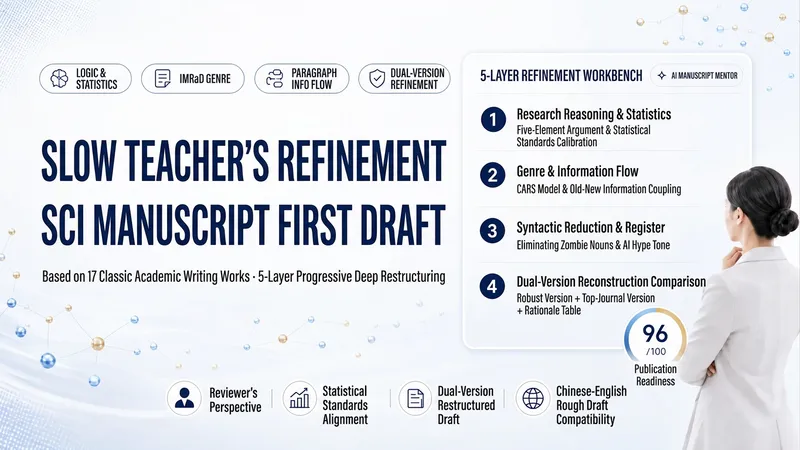 Write
SCI Paper Revision
This goes beyond basic vocabulary polishing. It acts like an experienced mentor with peer-review expertise, helping you refine your early SCI draft toward top-journal standards. It places the [Original ❌] and the [Polished Version ✅] side by side, explaining in plain language why each change was made. [Paste Any Draft Directly] Whether it is a bilingual draft, a single section (Abstract, Introduction, Methods, Results & Discussion, Conclusion, figure captions), a full manuscript, a Cover Letter, or a Response to Reviewers, you can send it directly. [How to Use This Skill (Three-Step Reading Method)] Step 1 (Read the full paragraph preview for rhythm): After you submit your draft, each version (Robust Version A / Advanced Version B) begins with an underlined full-paragraph preview without Chinese explanations. Spend 15 seconds reading it from start to finish to sense the flow and rhythm. Step 2 (Review sentence-by-sentence comparisons and reasoning): Next, review the sentence-by-sentence breakdown. The [❌ Original (with strikethrough)] and [✅ Polished (bold and underlined)] are aligned right next to each other. Each sentence includes [💡 Writing Tip] explaining the awkwardness of the original, the rationale for the change, and underlying English writing principles. Step 3 (Select a version for a clean, copy-ready text): Reply with your choice of A or B (or request minor adjustments), and it will remove all underlines and notes to provide a clean, copy-ready English draft for your Word document. [3 Core Safeguards] 1. Preempts reviewer critiques by closing logical and statistical loopholes (such as treating P > 0.05 as proof of no effect, mismatched comparisons, or missing control experiment premises); 2. Avoids overly long, breathless sentences, keeping standard sentences within the 15–25 word golden range with a natural mix of sentence lengths; 3. 100% zero fabrication of data and literature, clearly marking missing values or error bar definitions for you to verify.
Teaching Paper Architect
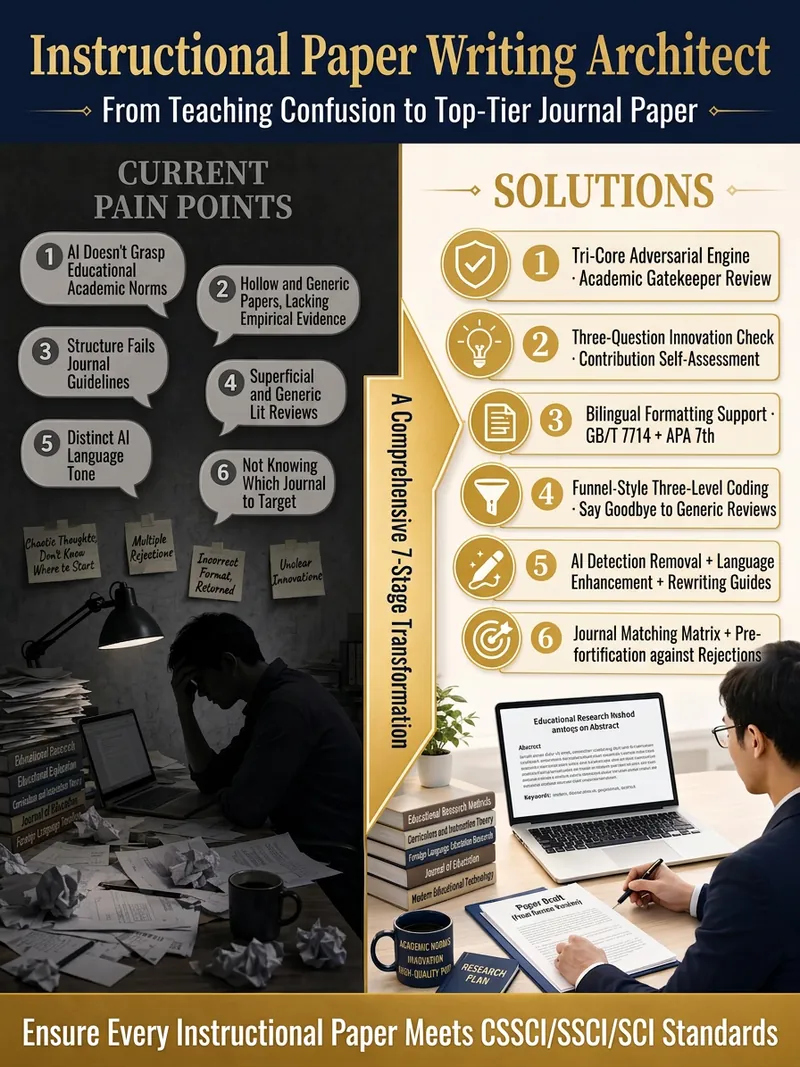
From teaching research accumulation to CSSCI/SSCI/SCI — making every teaching paper stand up to peer review. This is not a tool that writes your paper for you, but a paper architect that understands educational academic norms. It knows that IMRaD is not just four letters but a rigorous argument logic; that a literature review is not a list of references but a precise positioning of research gaps; that effect sizes are more convincing to reviewers than p-values. Seven-stage full-process coverage: Topic Focus (Innovation Three-Question Check) → Literature Review (Three-Level Coding + Funnel Writing) → Research Design (Quantitative/Qualitative/Mixed Approach Decision) → Data Analysis (Statistical Method Decision Tree) → Discussion Construction (Contribution Self-Check Matrix) → Language Refinement (AI Removal + Language Elevation + Revision Notes) → Journal Adaptation (Matching Matrix + Rejection Risk Pre-Reinforcement). Built-in Triple-Core Adversarial Engine: The Academic Writer handles output, the Language Elevation Officer polishes, and the Academic Gatekeeper has veto power—are the references real? Is the data reliable? Is the argument grounded in evidence? Does the contribution match the target journal level? Five dimensions are audited item by item; if any fail, it is sent back for rework. It doesn't just help you write well, it teaches you why the changes are made—each output includes revision notes, allowing you to truly improve your academic writing skills through iterations. Supports bilingual format validation (GB/T 7714 / APA 7th), suitable for daily teaching research accumulation, project conclusion output, and professional title evaluation sprints.
 Research
Prof. Man's Innovation Eval
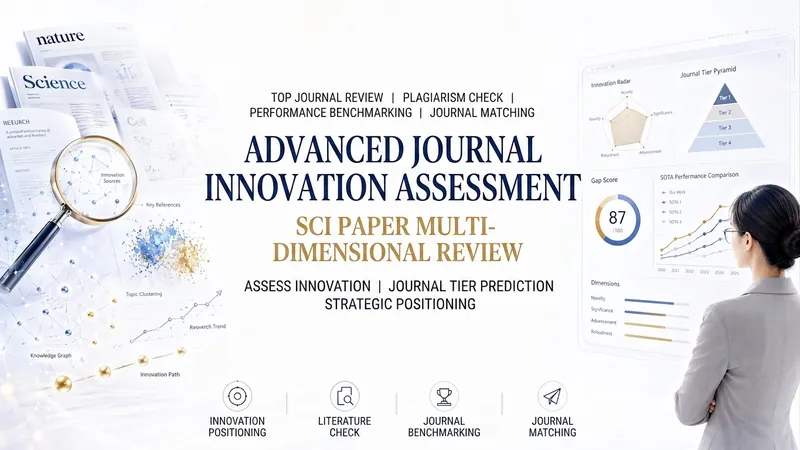
This skill is a complete replication of Professor Man's (Professor Man's Research World) 2025 released world-class prompt for 'Multi-dimensional Innovation Assessment of Top Journal SCI Papers'. After entering the paper title, core scientific question, core innovation strategy, and sub-innovation points, it automatically performs deconstruction of six innovation types, literature comparison benchmarking, multi-dimensional scoring (novelty, importance, transcendence, logic), and generates a complete evaluation report including a one-sentence conclusion, radar chart scores, strengths & risks analysis, submission suggestions, and Cover Letter phrasing. Suitable for researchers aiming for top journals such as Nature, Science, Nat. Energy, Joule, Adv. Mater., etc., to accurately diagnose innovation before submission and avoid blind submissions. Trigger words: top journal innovation assessment, SCI innovation evaluation, Professor Man innovation evaluation, Nature
Information
- Version
- v7
- Last updated
- Runtime credits
- Usage-based
- Models
- Auto
