
SCI Cover Letter Slow Teacher
SCI Cover Letter Slow Teacher
Showcase
Description
This skill treats your journal submission cover letter as an advertisement for your paper. It first forces you to compress your research into a single core innovation point ("one word") and decide whether it follows the "science" route (material/structure/mechanism/method) or "engineering" route (performance/application). Then, it generates an 8-section English cover letter ready for submission: a four-sentence selling arc covering problem, innovation, data, and significance; journal matching information; and standard declarations. It uses the most concise, objective language (rejecting flashy words like "employs" or "shatter the ceiling") and fits within one page. Including a figure is mandatory: for performance types, it provides literature comparison scatter plots or tables; for mechanism/structure types, it actively diagnoses your existing figures (five-point check), gives a redraw list, and directly outputs an SVG draft. It can also critique an existing draft, pointing out common flaws such as listing multiple innovations, lacking data, copying the abstract, or having no journal targeting, and rewrite it. Compatible with universal agents like Claude Code and Codex. Trigger phrases include "help me write a cover letter", "submit to SCI", "is this letter good", and "which figure should I show the editor".
Related Skills
View all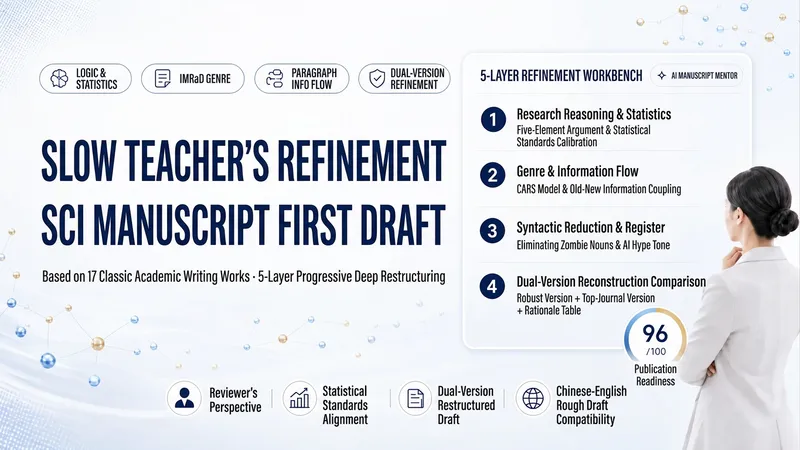 Write
SCI Paper Revision
This goes beyond basic vocabulary polishing. It acts like an experienced mentor with peer-review expertise, helping you refine your early SCI draft toward top-journal standards. It places the [Original ❌] and the [Polished Version ✅] side by side, explaining in plain language why each change was made. [Paste Any Draft Directly] Whether it is a bilingual draft, a single section (Abstract, Introduction, Methods, Results & Discussion, Conclusion, figure captions), a full manuscript, a Cover Letter, or a Response to Reviewers, you can send it directly. [How to Use This Skill (Three-Step Reading Method)] Step 1 (Read the full paragraph preview for rhythm): After you submit your draft, each version (Robust Version A / Advanced Version B) begins with an underlined full-paragraph preview without Chinese explanations. Spend 15 seconds reading it from start to finish to sense the flow and rhythm. Step 2 (Review sentence-by-sentence comparisons and reasoning): Next, review the sentence-by-sentence breakdown. The [❌ Original (with strikethrough)] and [✅ Polished (bold and underlined)] are aligned right next to each other. Each sentence includes [💡 Writing Tip] explaining the awkwardness of the original, the rationale for the change, and underlying English writing principles. Step 3 (Select a version for a clean, copy-ready text): Reply with your choice of A or B (or request minor adjustments), and it will remove all underlines and notes to provide a clean, copy-ready English draft for your Word document. [3 Core Safeguards] 1. Preempts reviewer critiques by closing logical and statistical loopholes (such as treating P > 0.05 as proof of no effect, mismatched comparisons, or missing control experiment premises); 2. Avoids overly long, breathless sentences, keeping standard sentences within the 15–25 word golden range with a natural mix of sentence lengths; 3. 100% zero fabrication of data and literature, clearly marking missing values or error bar definitions for you to verify.
 Research
Prof. Man's Innovation Eval
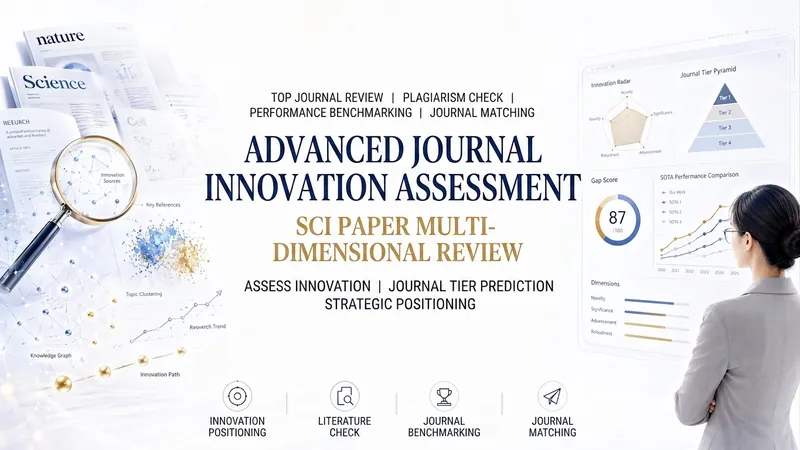
This skill is a complete replication of Professor Man's (Professor Man's Research World) 2025 released world-class prompt for 'Multi-dimensional Innovation Assessment of Top Journal SCI Papers'. After entering the paper title, core scientific question, core innovation strategy, and sub-innovation points, it automatically performs deconstruction of six innovation types, literature comparison benchmarking, multi-dimensional scoring (novelty, importance, transcendence, logic), and generates a complete evaluation report including a one-sentence conclusion, radar chart scores, strengths & risks analysis, submission suggestions, and Cover Letter phrasing. Suitable for researchers aiming for top journals such as Nature, Science, Nat. Energy, Joule, Adv. Mater., etc., to accurately diagnose innovation before submission and avoid blind submissions. Trigger words: top journal innovation assessment, SCI innovation evaluation, Professor Man innovation evaluation, Nature
SCI Desk Reject Pre-check
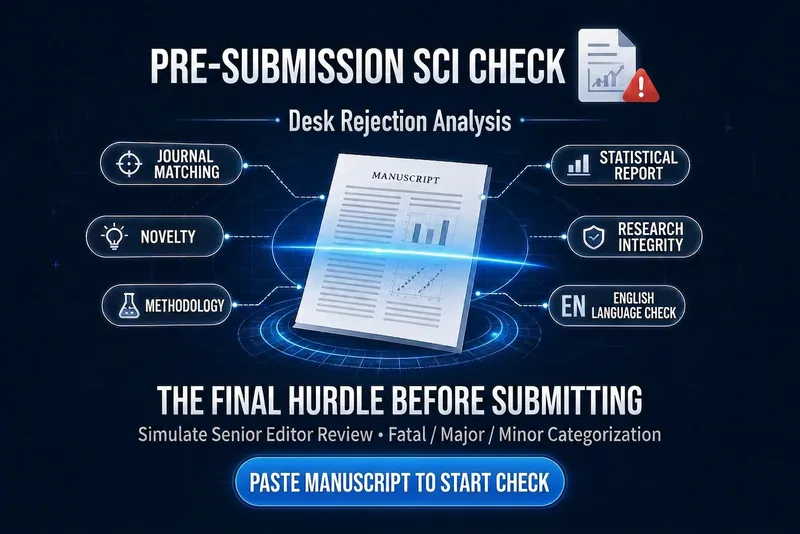
You spend months writing a manuscript, submit it—and three days later receive a rejection letter with no review comments. The editor-in-chief didn't even send it out for peer review; it was a desk rejection. 「SCI Desk Reject Pre-check」offers the initial screening perspective of a seasoned handling editor, helping you ensure quality before submission. What does it check? 📌 Journal Fit — Whether the topic aligns with the target journal's scope 🔍 Novelty and Contribution — Can the editor-in-chief identify your core contribution in 30 seconds? ⚗️ Methodology and Reproducibility — Design flaws and description gaps that trigger red flags 📊 Statistics and Quantitative Reporting — Issues in data presentation, significance, sample size, etc. 🛡️ Research Integrity and Ethics — Ethics approval, conflicts of interest, plagiarism check, AI disclosure, data availability 📝 Structure and Readability — Broken logic chains, weak abstracts, buried key information 🌐 English Language Risk — Whether language quality might trigger a language-based desk rejection All issues are categorized as 'Fatal / Major / Minor', each with actionable revision suggestions. Suitable for any SCI discipline: physics, chemistry, materials, engineering, life sciences, computer science, environment, geosciences, and more. Send your manuscript (or abstract + methods section) and start the check.
Information
- Version
- v2
- Last updated
- Runtime credits
- Usage-based
- Models
- Auto
