
Research Status & Trends Expert
Research Status & Trends Expert
Showcase
Description
An expert skill for applications to National Social Science Fund of China and Ministry of Education humanities and social sciences projects. Drawing on the four-dimensional synthesis-and-review method, expert lecture methodology, and successful National Social Science Fund applications, it uses multiple rounds of interaction to generate a format-compliant, literature-grounded “Research Status and Trends in China and Abroad” section (approximately 1,000 characters). Key upgrades: a three-part logical chain, a thematic synthesis method instead of periodization, at least two non-Chinese scholars in the international research section, embedded regional specialization, and summaries that acknowledge strengths before identifying gaps.
Related Skills
View all
Doomsday Research Content Gen
Expert skill for National Social Science Fund (NSSF) or Ministry of Education (MOE) humanities and social science project applications. Based on the methodology from the 4th lecture on 'Research Content' (five pillars, problem tree and problem chain, six techniques, and intuitive clarity), it generates research objects, research objectives (two versions: lecture style and expert standard style), overall framework, key points and difficulties, research plan, and feasibility through multi-round interaction. Each step requires the user to confirm and proceed.
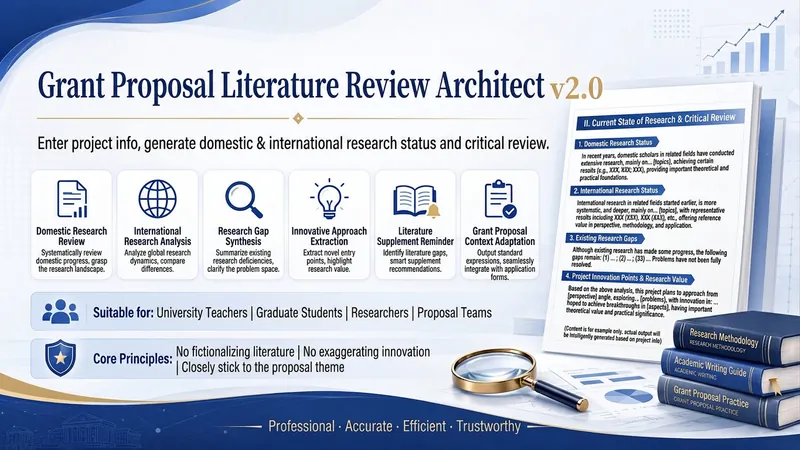
Proposal Review Architect v2.0
Enter your research topic information to generate a proposal-ready review of domestic and international research status and critical commentary. It can help you: 1. Automatically break down topic keywords Based on the topic title, research field, and research content, extract core concepts, research subjects, methodological approaches, and application scenarios. 2. Automatically structure review dimensions Organize the research status into 3–4 domestic research dimensions and 2–3 international research dimensions, avoiding simple literature lists and weak logic. 3. Automatically generate critical review text Following the common proposal structure of “domestic research status—international research status—critical review,” generate 900–1,200-character prose. 4. Automatically identify research gaps Summarize limitations in research perspectives, interdisciplinary integration, model development, and practical validation, then naturally lead into the topic’s innovative entry points. Suitable for: University faculty, doctoral students, master’s students, researchers, project leaders, applicants for teaching reform projects, applicants for education planning projects, and teams applying for social science and humanities projects. How to use: Enter a topic title or research direction directly, or paste part of your proposal materials. If you have references, paste them as well; I will prioritize the sources you provide. If you do not have references, I will generate “replaceable citation placeholders” and “search keywords” to avoid fabricating specific sources.

Research Value Red Team
An expert skill for the research value section of National Social Science Fund and Ministry of Education Humanities and Social Sciences applications—the Topic Collision Radar edition. Built on Lecture 8, Lecture 64, a case library of five winning proposal templates, and a knowledge base of 535 funded-project lists, it provides: topic-collision radar searches across three comparison levels (National Social Science Fund → Ministry of Education → provincial philosophy and social sciences), with project status labels → six-dimensional difference analysis and collision warnings → T1–T5 academic value formulas and A1–A4 applied value formulas → format-adaptive output ("Academic Value + Applied Value" for the National Social Science Fund application’s free-form section / "Theoretical Value + Practical Application Value" for Ministry of Education Form B, limited to 2,000 Chinese characters). Includes a four-sentence template for "new progress compared with similar projects already funded." Confirm each step with a button to proceed. The term "空白" is prohibited in the output and is always replaced with specific wording such as "blind spots," "gaps," "weak areas," or "research limitations."
Information
- Version
- v3
- Last updated
- Runtime credits
- Usage-based
- Models
- Auto