
Dual-Core Proposal Reviewer
Dual-Core Review: Worth Doing & I Can Do
Dual-Core Proposal Reviewer
Dual-Core Review: Worth Doing & I Can Do
Showcase
Description
Using 'Worth Doing' and 'I Can Do' as the dual-core propositions, this skill conducts a cross-examining review of your draft project proposal. It systematically evaluates the value of the topic (genuine question, incremental contribution, contemporary relevance) and research capability (prior accumulation, plan feasibility, team conditions), automatically scans for red-flag expressions like 'fill the blank', tests the tension between the two cores, and outputs a prioritized revision checklist. Applicable to optimizing project proposals at various levels including National Social Science Fund, Provincial Social Science Planning, and Ministry of Education Humanities and Social Sciences projects.
Why we love this skill
This skill centers on 'Worth Doing' and 'I Can Do', and like a review expert, it cross-examines your grant proposal, providing a prioritized revision checklist and example rewrites to boost your application success rate.
Related Skills
View allGrant Proposal Reviewer v2.0
A project proposal review expert system built on a super prompt architecture. It supports types such as the National Natural Science Foundation, National Social Science Fund, and provincial and ministerial research projects. Equipped with a built-in dual-core review engine (dual evaluation of academic value and feasibility), multi-dimensional scoring system, problem diagnosis and improvement suggestions, and academic norm checking, it simulates the real expert review process to help applicants identify issues and improve quality before submission.
 Write
Social Science Grant Proposal Generator
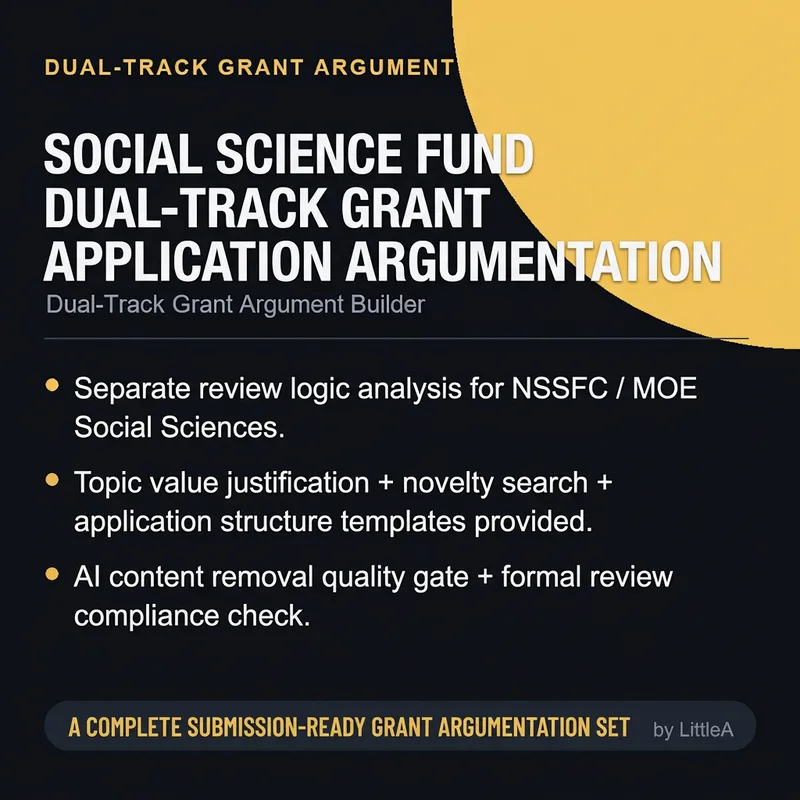
A combined grant proposal generator for the National Social Science Fund and the Ministry of Education Humanities and Social Sciences Research Projects, using the dual-track proposal method. Triggered when users ask about applying for national social science grants, writing Ministry of Education project proposals, simultaneous applications, word count allocation for blind review forms, feasibility sections, narrowing broad topics, drafting the background section, removing AI phrasing in proposals, literature searches, quota limits, youth project selection, anonymizing blind review forms, or project proposal generators. Using the dual-track proposal method (eligibility gate, topic argument, dual-track generation, AI phrasing removal, and formal review), it produces topic value arguments, literature search conclusions, the full proposal text (formatted for social science blind review forms or Ministry of Education Form B), an AI-phrasing-revised edition, and formal review red-line self-checks. Version 2.0.0. ## Overview A combined project proposal generator for the National Social Science Fund and Ministry of Education review tracks: clears prerequisite exclusion gates, helps narrow broad directions into specific genuine research questions, generates full proposal texts according to dual-track formats, and passes the AIGC < 10% quality gate and rejection-level formal reviews. Covers frequent pain points such as application procedures, simultaneous submissions, word count distribution, narrowing topics, removing AI tone, quota calculations, and blind review anonymization. ## What You Will Get 1. Topic value argument and literature search conclusions (3 targeted topic options, search comparison, and gap positioning) 2. Full proposal text (according to the selected track: 8 sections for social science blind review forms or 5 columns for Ministry of Education Form B) 3. AI-phrasing-revised edition (machine tone scan and natural phrasing comparison) 4. Formal review red-line self-check checklist (quotas, anonymity, word counts, and disciplines, rejection-level) ## Best For University humanities and social science faculty (lecturers and associate professors), early-career researchers, regional college teachers, postdoctoral researchers, and research administrators applying for national, ministry, or provincial social science planning grants.
Grant Proposal Review PRO V2.0
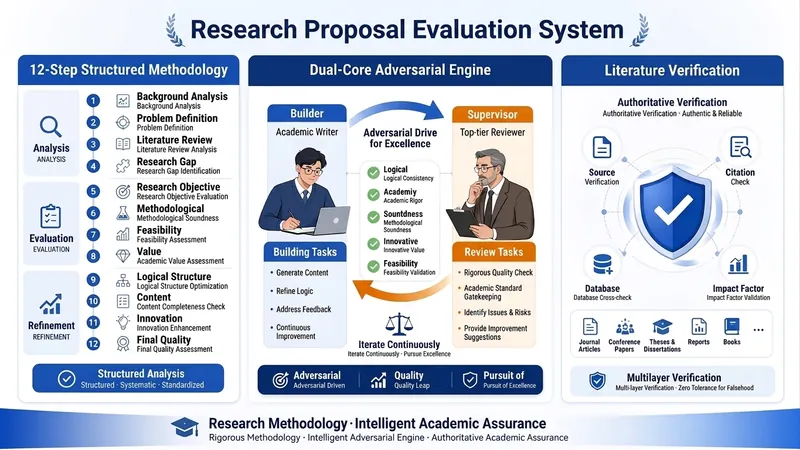
🎯 Core Functionality Overview This is an intelligent review and optimization system specially designed for national social science, education ministry, and provincial grant applications. It simulates the thinking mode of a senior review expert with 15 years of experience, ensuring academic rigor and competitiveness through three core mechanisms. 🔧 Three Core Mechanisms 1️⃣ 12-Step Structured Methodology Covers the full lifecycle of grant proposal review: Phase 1-3: Basic Diagnosis - In-depth analysis of announcement (funding priorities, review criteria, application requirements) - Cross-disciplinary type judgment (precise identification of 8 types) - Research GAP five-dimension identification (theory/methodology/empirical/policy/technology) Phase 4-7: Core Element Review - Research question TMAQ model analysis (theory/methodology/approach/question four dimensions) - Research objective SMART principle test - Research content framework completeness assessment - Research approach type matching (6 types) Phase 8-10: Deep Quality Enhancement - Precise extraction of key difficulties (distinguish criteria + breakthrough paths) - Innovation point seven-dimension mining - Feasibility seven-dimension argumentation Phase 11-12: Overall Optimization - Nine-dimension quality check (academic rigor, innovativeness, feasibility, etc.) - Comprehensive optimization suggestions and final report 2️⃣ Dual-Core Adversarial Mechanism (Builder vs Supervisor) Working Principle: - Builder (academic writer): Generates optimization plans based on user materials - Supervisor (top journal reviewer): Challenges Builder's plans with the strictest standards - Adversarial iteration: 3 rounds of confrontation to ensure plans are robust Application Scenarios: - Innovation point mining: Builder proposes innovation points → Supervisor questions novelty → iterative optimization - Feasibility argumentation: Builder designs plan → Supervisor challenges feasibility → supplementary argumentation - Literature citation: Builder cites literature → Supervisor verifies authenticity → ensure academic standards 3️⃣ Literature Authenticity Verification Mechanism Two working modes: Mode A: Placeholder Mode (Default) - Use markers like [Literature Placeholder-001] in place of specific references - Output a Literature Requirement List specifying search requirements for each placeholder - User searches and fills in real references Mode B: Real-Time Verification Mode - Call Google Scholar to verify literature authenticity in real time - Generate Literature Verification Report (authenticity/relevance/authority scores) - Ensure every citation is traceable Preventing AI Hallucination: - Prohibits fabricating authors, journals, DOIs - All references must be verified or marked as placeholders - Guarantees academic integrity bottom line 💡 Core Value and Applicable Scenarios ✅ Key Pain Points Addressed 1. Academic sloppiness: AI-generated content often includes fake references, logical gaps 2. Insufficient innovation: Difficulty uncovering true academic innovation points 3. Weak feasibility: Research plans lack systematic argumentation 4. Cross-disciplinary difficulty: Interdisciplinary topics often fall between two stools 🎓 Target Users - University faculty (social sciences, education, humanities) - Researchers (applying for national and provincial grants) - Academic teams (needing systematic review processes) 📋 Typical Workflow 1. Input: Upload announcement + proposal draft 2. Review: System executes 12-step structured analysis 3. Adversarial: Dual-core mechanism iteratively optimizes key sections 4. Verification: Literature authenticity check 5. Output: Complete review report + optimization suggestions + literature list 🔍 Differences from Traditional Review | Dimension | Traditional Human Review | Expert Review System | |-----------|------------------------|----------------------| | Review depth | Depends on personal experience | 12-step structured + 9D QC | | Academic rigor | Hard to fully audit | Literature verification + dual-core adversarial | | Innovation mining | Subjective judgment | 7-dimension systematic analysis | | Feasibility argumentation | Experience-driven | 7-dimension item-by-item argumentation | | Consistency | Varies by individual | Standardized process | | Efficiency | Days to weeks | 1-2 hours for initial review | The core advantage of this system is: it makes the tacit knowledge of a 15-year senior review expert explicit, structured, and replicable, enabling every user to receive top-level expert review services.
Information
- Version
- v5
- Last updated
- Runtime credits
- Usage-based
- Models
- Auto
