
AFP Policy & CSSCI Topics
Decode policy; generate 3–5 CSSCI topics
AFP Policy & CSSCI Topics
Decode policy; generate 3–5 CSSCI topics
Showcase
Description
AFP prompt system for in-depth policy analysis—three-level source attribution, interpretation of hot topics, and academic mapping—and CSSCI topic generation (3–5 topics, each with policy basis, theoretical foundation, theoretical and practical significance, and publication potential assessment). Supports two entry points: A1 panoramic analysis and A2 targeted analysis, plus B reverse matching from ideas. Runs with Auto-Flow: strict step-by-step progression, silent background self-checks, a heartbeat HUD, and hard stops at each stage.
Recommended by
Dancang
Why we love this skill
Connects policy verification, structured interpretation, and academic problem formulation through traceable sources, theoretical mapping, and literature evidence to identify 3–5 CSSCI topics.
Related Skills
View all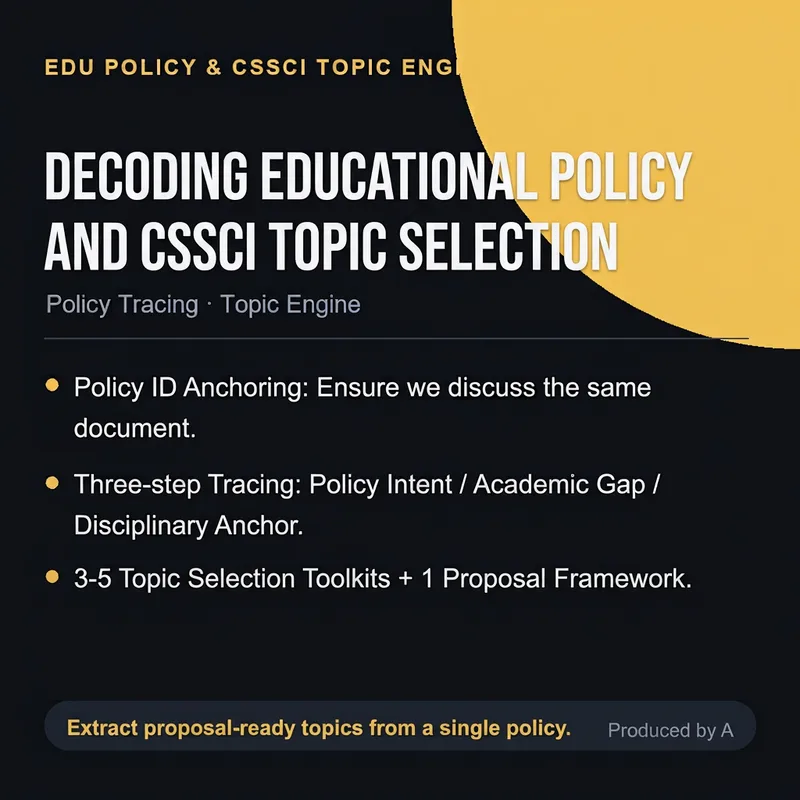 Research
Education Policy Decoder
Activated when users send an educational policy document or name, or request help turning educational policies into paper topics, writing CSSCI or core journal articles, interpreting policies like Double Reduction, New Curriculum Standards, or Education Strong Nation Guidelines for publication, or finding National Social Science Fund or Ministry of Education project directions. It uses a policy-tracing method to deliver traceable interpretations, 3 to 5 high-potential topics, and 1 proposal skeleton without fabricating policy clauses while highlighting research gaps. ## Summary Transforms a national education policy into traceable interpretations, 3 to 5 high-potential topics, and 1 proposal skeleton ready for your report. Covers high-frequency pain points such as turning education policies into research topics, writing CSSCI and core journal papers, publishing based on major guidelines, and finding project directions. Designed specifically for education researchers and graduate students. ## What You Will Get 1. Policy ID: Issuing authority, release date, legal hierarchy, core proposition. 2. Three-Step Tracing Breakdown: Policy intent, academic gaps, and disciplinary landing points. 3. 3–5 Topics, Each with Four Elements: Policy basis, theoretical foundation, theoretical and practical significance, and publication potential rating. 4. 1 Proposal Skeleton: Research questions, literature review framework, analytical approach, and potential innovations. 5. Traceability Verification: Any clause absent from the original text is marked as unverified; no forced fabrication. 6. Case Library: Complete breakdown demonstrations of policies like Double Reduction, New Curriculum Standards, and Education Strong Nation Guidelines. ## Who It Is For Education graduate students facing proposal blocks, young university teachers and researchers aiming for CSSCI or core journals and national or ministry projects, and education faculty research secretaries and mentor groups. Note: Since primary and secondary school teachers no longer primarily rely on papers for professional titles, this Skill is not tailored for that group.
Policy Tracing & CSSCI Topics
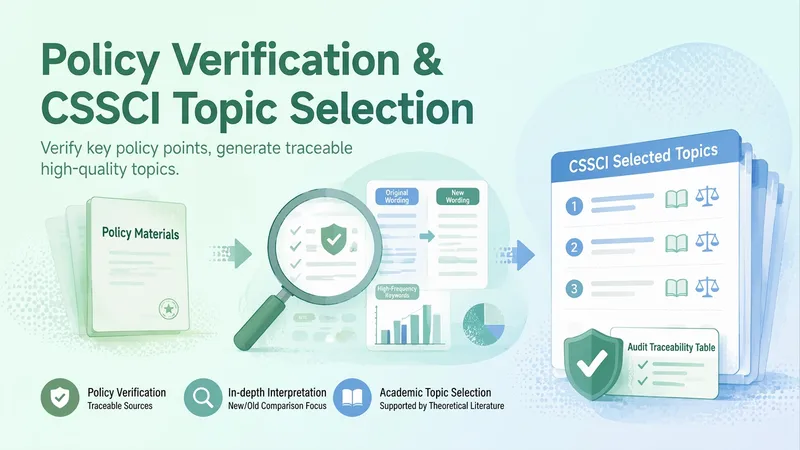
Turn national policy materials into verifiable, traceable CSSCI research topics. Suitable inputs include full policy texts, older and newer versions of documents, policy keywords, policy lists, or document numbers. Whether the materials are complete or not, build a source record covering the policy origin, issuing body, document number, date, level, and validity status. Check each item against authoritative source texts, noting the citation location, source link, and verification status—“consistent,” “uncertain,” or “needs verification”—to avoid mistaking summaries for original policy language. Building on this verification, identify additions, strengthened measures, and phased-out content in newer and older policies. Extract high-frequency terms, policy context, and timing windows, then connect policy trends to real-world problems supported by evidence. Next, develop research questions at the levels of phenomena, mechanisms, and theory; match them with perspectives such as institutional theory, principal–agent theory, and policy diffusion; and identify research gaps through recent, traceable literature. The result is a pool of candidate topics with theoretical support, literature evidence, and proposed data and methods. Finally, select 3–5 CSSCI topics and assess each one’s policy timeliness, theoretical and practical value, and publication feasibility. Provide the policy basis, real-world problem, theoretical perspective, literature gap, data sources, and methodological approach. Confirmed results can be compiled into a structured research report that preserves complete source details, verification status, and audit-trail information—suitable for topic development in policy research, public administration, economics and management, and related social sciences.
CSSCI Research Topics & Proposals
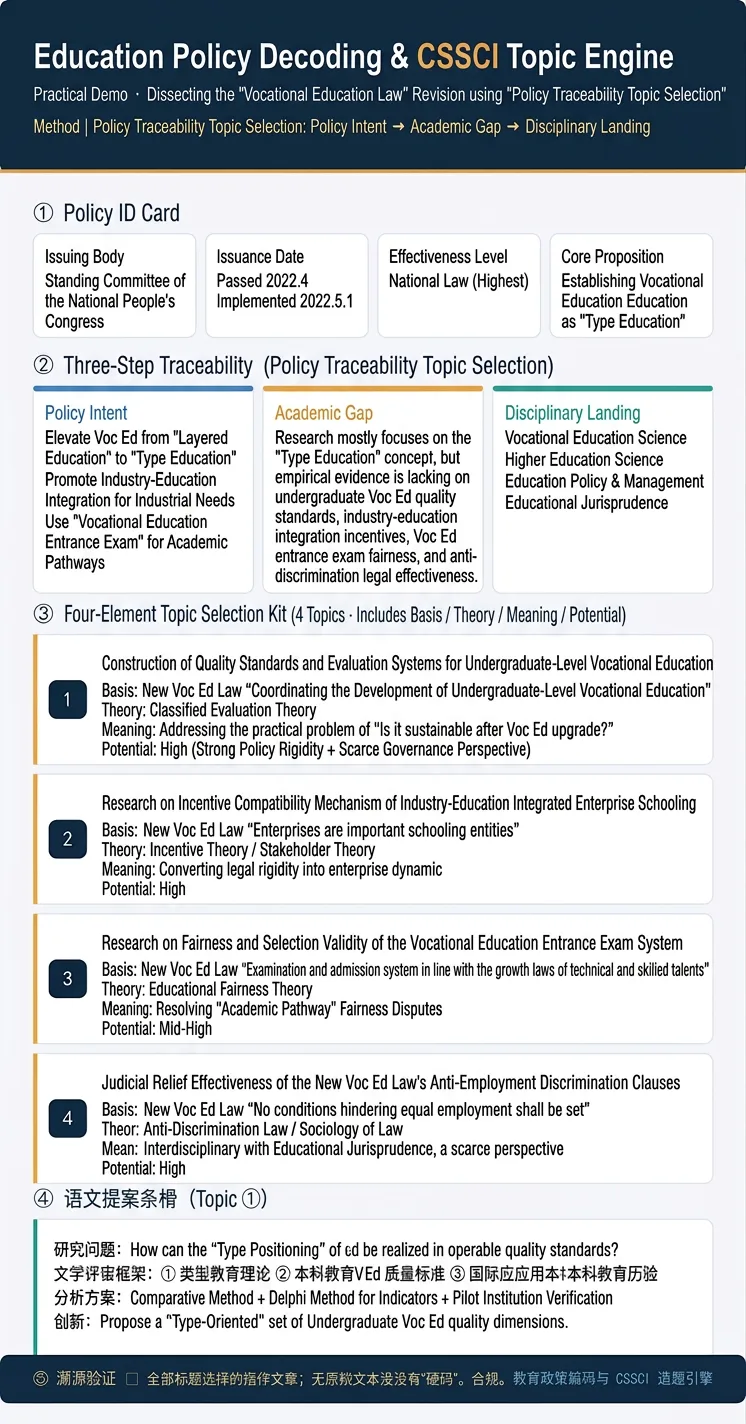
A policy decoding and CSSCI research topic generation skill designed for education master's and PhD students and university faculty. Triggered when users say things like 'help me turn education policies into research topics', 'how to write CSSCI papers from education policies', 'interpret the Double Reduction policy for journal publication', 'give me research topics based on the Education Powerful Country guidelines', or 'education policies + proposal framework'. It uses the Policy-Traceable Topic Method (policy intent -> academic gap -> disciplinary focus) to produce traceable interpretations, 3 to 5 high-potential topics, and proposal skeletons. Version 1.0.0. > This skill is not just a file collection; it acts as an academic topic advisor right inside your chat box. > > It goes through five steps: **Policy Anchoring** (a one-line "policy ID") -> **Three-Step Traceable Breakdown** (policy intent / academic gap / disciplinary focus) -> **Topic Generation** (3 to 5 topics, each with policy basis + theoretical foundation + theoretical/practical significance + publication potential rating) -> **Proposal Skeleton** (the highest-potential topic directly provides research questions / review framework / analytical approach / innovations) -> **Traceability Verification** (each topic is marked with the original policy source, and anything not mentioned in the original text is marked as "to be verified", ensuring no fabrication). > > What you get: a traceable policy interpretation, 3 to 5 CSSCI/PKU-core-rated topics, and 1 ready-to-fill research proposal skeleton. Built-in real breakdown examples for Double Reduction, the New Curriculum Standards, and the Education Powerful Country guidelines; suitable for higher education, basic education, vocational education, educational technology, and other fields.
Information
- Version
- v6
- Last updated
- Runtime credits
- Usage-based
- Models
- Auto
