![[S.007] Eye Eyes](https://cdn.youmindassets.com/user-files/321f06ba7c5560e68907403603947ff76a420662adf6490f59fbc0fa1abf3ef3)
[S.007] Eye Eyes
Turn photos into watercolor eye worlds
[S.007] Eye Eyes
Turn photos into watercolor eye worlds
Showcase
Description
Turn a single photo into a unique vertical “eye world” artwork: the original photo fills the entire canvas, preserving the subject, colors, and lighting, while the center contains a watercolor scene reimagined from the photo’s content. The photo and the painted world echo one another, making the embedded scene feel like an impossible space opening inside reality rather than a simple overlaid illustration. The central scene translates the objects, materials, and group relationships in the photo into hand-drawn living forms with pairs of little eyes. Recursive nesting, shifts in scale, deep corridors, and self-containing spaces create a cute, clear, quiet, and slightly eerie atmosphere. Lightweight, luminous watercolor and semi-transparent gouache textures keep the image airy, avoiding gore, darkness, muddiness, and unrelated elements. The final result is a flat vertical artwork suited for collecting, display, or visual experimentation.
Recommended by
淡苍
Why we love this skill
Preserves the original photo as a real background while embedding a watercolor “eye world” evolved from the same source, creating gentle, subtly absurd tension through recursive spaces, collapsing scale, and collective gazes.
Best for
For anyone who wants to turn everyday photos into narrative artworks with a subtle surreal quality.
How to use this Skill
Provide your input
Provide one photo as the creative source.
Run the Skill
Keep the photo intact as a vertical background and blend a watercolor eye world derived from its content into the center, creating a cute, clear, slightly eerie visual space.
Review your result
A flat vertical artwork featuring the original photo as its background with a central watercolor scene embedded within it.
Related Skills
View all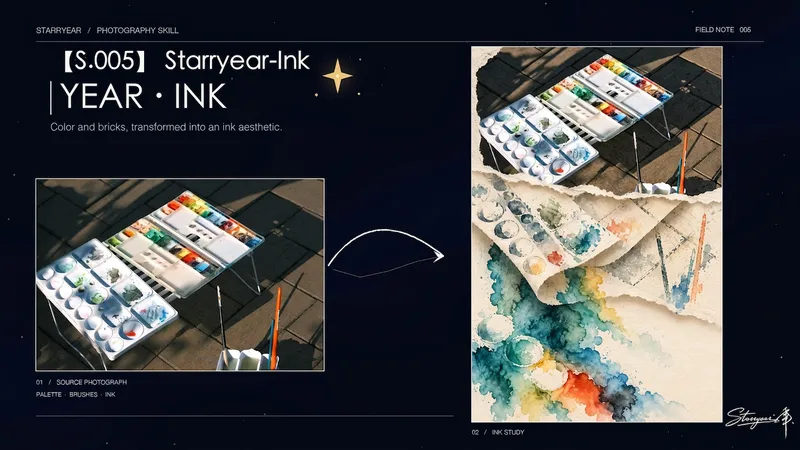 Image
Image【S.005】Photo Ink · Starryear
Transform a single photo into a vertical artwork with tactile quality and narrative depth: the top preserves the source photo as real visual evidence, the middle presents a three-dimensional memory of the photo through lifted, curled, and layered warm ivory handmade paper, and the bottom releases a moist, translucent, diffused afterimage in colored ink. It is suited to creating Starryear ink, torn-paper photo ink, and three-dimensional turning-page ink works with the “original image above, flowing ink released below” structure. It is especially suitable for photos of people, animals, buildings, or landscapes where the original identity, number, direction, and spatial relationships need to remain intact. The finished piece emphasizes one complete vertical composition rather than a simple filter or evenly divided collage. The photo area remains clear and recognizable, while the paper layers carry the rhythm, contours, reflections, or negative space of the scene, using natural paper thickness, deckled fibers, overlaps, and soft shadows to create a convincing page-turning effect. The lower ink section uses a small number of related color families to show water-driven blooming, layered color, backflow, pooling, and seepage, creating a clear spatial transformation as the image moves between materials. The overall design centers on matte warm ivory paper and negative space, avoiding a second complete person, unrelated fantasy elements, decorative paper strips, imitation traditional Chinese painting, or overly saturated visual noise. The final output is a polished vertical artwork.
 Image
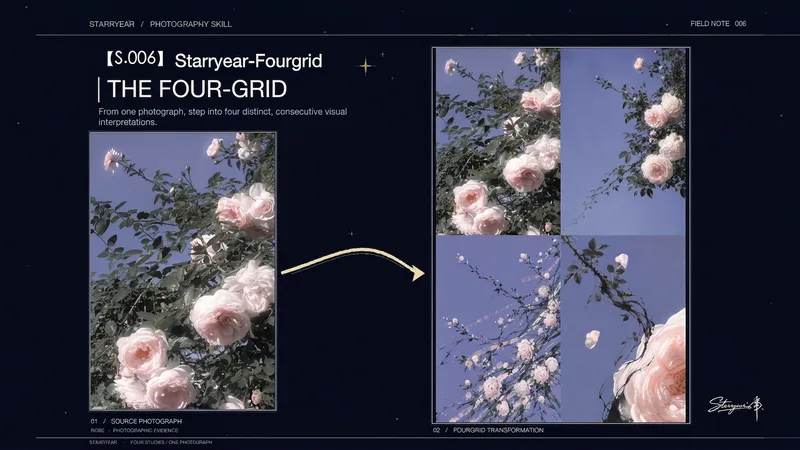
ImageS.006 · Starryear Four-Grid
Turn a single photo into a vertical 2:3 ink four-panel artwork. The original image remains as the top-left panel, while three distinct visual expressions extend from the photo's own colors, compositional relationships, motion paths, and spatial rhythms. The final work is not a standard collage or four filters, but a continuous transformation from photographic evidence to poetic memory, dot-and-line rhythm, and surreal space. The second panel distills the photo's atmosphere in a semi-abstract, moist, and subtly veiled style. The third transforms observable directions, intersections, repetitions, and variations in density into restrained dot-and-line structures, moving beyond the outlines of specific objects. The fourth preserves the original image's spatial grammar and layering, replacing real objects with photo-derived folds, interfaces, passages, or other non-representational forms to create a surreal world whose source remains recognizable. Colors and visual features are extracted anew from each uploaded photo, avoiding fixed themes, palettes, or compositions. Use it to create ink four-panel artworks, one-photo-into-four transformations, source-image abstractions, and editorial-style visual posters. The result is a complete, unified vertical artwork with no text or borders.
 Image
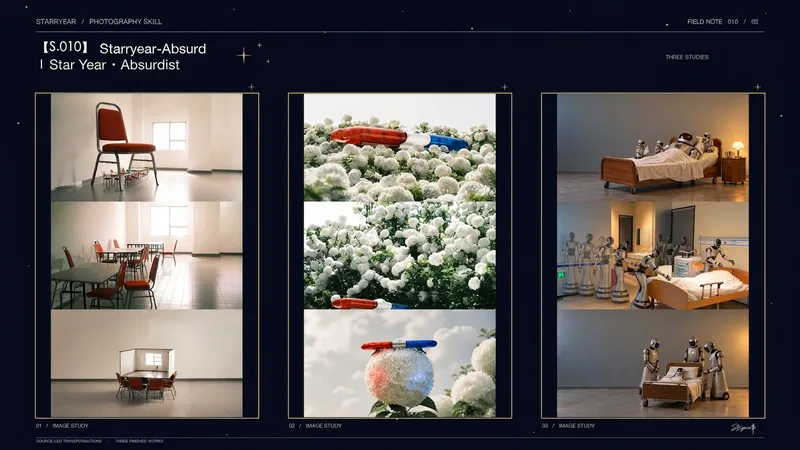
ImageS.010 · Starryear Absurdist
Turn one photo into a vertical absurd triptych that uses the original image as visual evidence: the top panel presents a scale-shifted absurd scene, the middle preserves the original photo with a horizontal crop, and the bottom forms a return or causal loop from the same absurd relationship. The final image combines three equal-width landscape 16:9 panels vertically with no gaps, creating an exact 16:27 composition without borders, text, or watermarks. The generated top and bottom panels develop new relationships only from the people, animals, objects, actions, quantities, colors, and lighting in the photo. They preserve important identifying features and recognizable outlines, using a spacious, restrained real-world or puppet-theater aesthetic. The middle panel uses only the original photo pixels, with orientation correction, proportional scaling, and conservative cropping where necessary. It is not redrawn, retouched, or filled in, ensuring that it remains a reliable record of the original image. Ideal for vertical absurd triptychs with the original image in the middle, photo-based derivative art, and surreal posters with visual narratives. It is not intended for ordinary filters, unrelated fantasy scenes, dense collages, or layouts that redraw the middle evidence photo.
Information
- Version
- v4
- Last updated
- Runtime credits
- Usage-based
- Models
- Auto
- Use cases
- Images & design
- What you get
- Image
- Visual styles
- WatercolorSurrealist